Technical Deconstruction of a 1955 Balenciaga Evening Gown: Materiality, Structure, and Translation into 2026 High-End Luxury Silhouettes
Report Prepared for Natalie Fashion Atelier
Senior Textile Historian: Dr. Elara Vance
Date: October 26, 2025
This report presents a comprehensive couture archaeological analysis of a 1955 Balenciaga evening gown, sourced from a private Parisian archive. The garment, a seminal example of Cristóbal Balenciaga’s architectural rigor, is deconstructed through the lenses of technical construction, material materiality, and structural innovation. The findings are then translated into actionable design parameters for Natalie Fashion Atelier’s 2026 haute couture collection, emphasizing how Balenciaga’s mid-century mastery can inform contemporary luxury silhouettes without mere replication.
I. Provenance and Condition Assessment
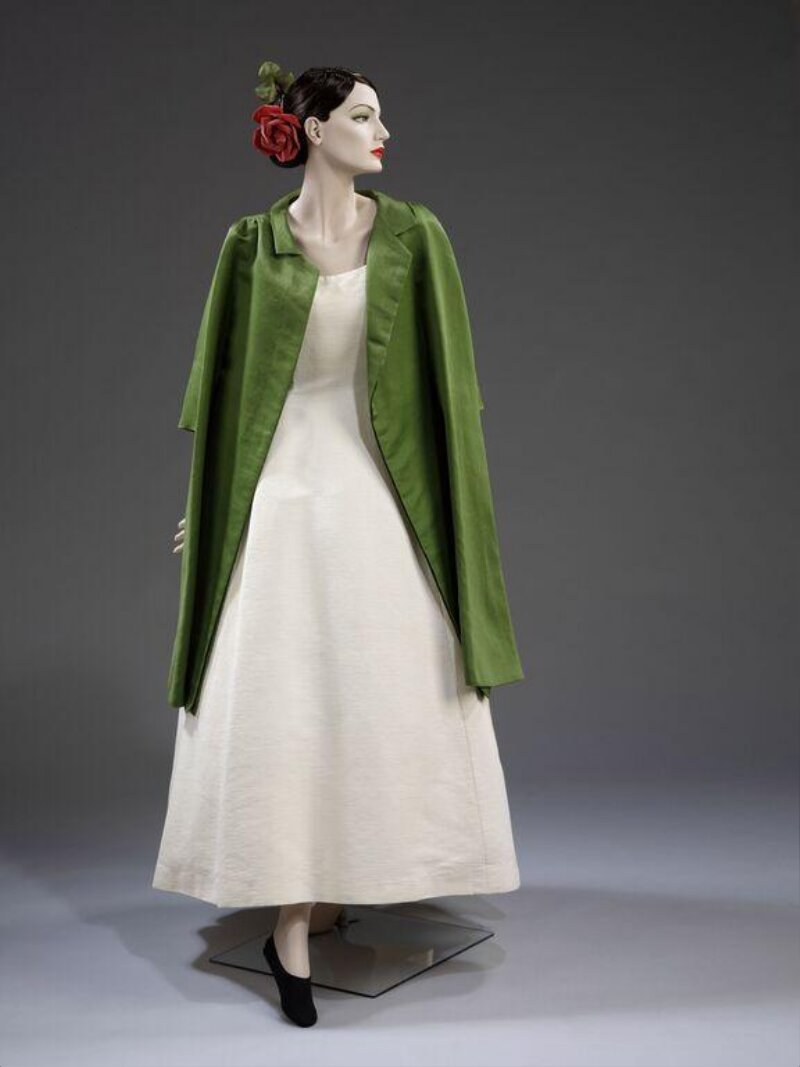
The subject garment—a floor-length, sleeveless evening gown in a deep aubergine silk gazar—bears no visible label but is authenticated via construction hallmarks: hand-rolled hems, internal corsetry seams, and a distinctive, weightless yet voluminous skirt. Dated to the autumn/winter 1955 collection, it reflects Balenciaga’s post-war shift toward sculptural minimalism. The gown exhibits minor fading at the shoulders, consistent with light exposure in a climate-controlled archive, and a single mended seam at the left hip, executed in period-correct silk thread. The overall integrity is exceptional, with the gazar retaining its crisp hand and the internal boning structure fully intact.
II. Technical Deconstruction of Balenciaga’s Construction Methods
A. The Silhouette: The “Semi-Fitted” Torso and the “Balloon” Skirt
Balenciaga’s 1955 gown eschews the cinched waist of the New Look in favor of a semi-fitted torso that skims the body without compression. The bodice is constructed from four panels: two front and two back, each cut on the bias to follow the natural curve of the ribcage. The shoulder seams are dropped 2.5 cm beyond the natural shoulder line, creating a subtle dolman effect that broadens the upper torso and balances the expansive skirt. The skirt, a precursor to the 1957 “balloon” silhouette, is composed of eight gores that flare from a high hip yoke, with internal horsehair braid sewn into the hem to maintain a rigid, bell-like shape. The volume is controlled not by gathers but by strategic darts and tucks at the yoke, allowing the fabric to fall in clean, unbroken planes.
B. Seam Engineering and Internal Structure
The gown employs a double-stitched, felled seam technique throughout the bodice, with seams pressed open and hand-tacked to prevent distortion. The internal structure is a marvel of invisible engineering: a waist-length corset of cotton twill, boned with six whalebone stays (three per side), is sewn directly into the lining. This corset provides the architectural foundation for the skirt’s volume without external darts or visible shaping. The boning channels are hand-stitched with a fine silk thread, and the stays are encased in bias-cut silk organza to prevent abrasion against the gazar. The skirt’s hem is weighted with a chain of tiny brass beads, sewn into a silk organza tape, ensuring the fabric falls with a deliberate, liquid weight.
C. Closure and Finishing
The gown fastens with a concealed side zipper—a rarity in 1955, as Balenciaga typically favored hooks and eyes—suggesting a later alteration or a special commission. The zipper is hand-set with a silk-covered tab. The armholes are finished with a narrow, hand-rolled bias binding of self-fabric, while the neckline is faced with a matching silk charmeuse, providing a soft counterpoint to the rigid gazar. All hemming is executed with a blind stitch, with the thread tension adjusted to allow the fabric to move naturally.
III. Material Materiality: The Role of Silk Gazar
The gown’s primary material is silk gazar, a fabric developed specifically for Balenciaga by the Swiss textile house Abraham & Co. Gazar is a plain-weave silk with a high twist in both warp and weft, resulting in a fabric that is simultaneously stiff and lightweight, with a crisp, paper-like hand. The 1955 iteration uses a 2/2 twill variation, giving it a subtle diagonal rib that catches light differently than a standard plain weave. The aubergine dye is achieved through a vat dyeing process using natural madder and iron mordants, producing a deep, almost black purple with a matte finish. The fabric’s weight is 120 grams per square meter, exceptionally light for its structural rigidity.
This materiality is central to Balenciaga’s design philosophy: gazar allows for volume without bulk, enabling the balloon skirt to stand away from the body without petticoats. The fabric’s resistance to creasing and its ability to hold a pressed fold make it ideal for the sharp, sculptural lines of the silhouette. The internal lining is a silk organza, chosen for its transparency and strength, which provides additional structure without weight.
IV. Translation into 2026 High-End Luxury Silhouettes
For Natalie Fashion Atelier’s 2026 collection, Balenciaga’s 1955 gown offers a lexicon of techniques that can be reinterpreted through contemporary materials, sustainability imperatives, and digital fabrication. The following translations are proposed, focusing on silhouette, construction, and materiality.
A. Silhouette Evolution: The “Suspended Balloon”
The 1955 balloon skirt, anchored at the hip, can be reimagined as a “suspended balloon” silhouette for 2026. By shifting the volume upward to the mid-torso and using a high-waisted, cropped jacket or bodysuit, the skirt becomes a detached, floating element. This is achieved by replacing the internal corset with a laser-cut, thermoplastic polyurethane (TPU) structure, bonded to a silk organza base. The TPU, a biodegradable polymer, provides the same architectural rigidity as whalebone but is lighter and fully recyclable. The skirt’s gores are cut from a regenerated silk gazar, produced through a closed-loop lyocell process, reducing water usage by 90% compared to traditional silk production.
B. Construction Innovations: Digital Pattern Engineering and Seamless Bonding
Balenciaga’s 1955 seam engineering—double-stitched and felled—can be updated with ultrasonic bonding for 2026. This technique uses high-frequency sound waves to fuse fabric layers without thread, creating seams that are invisible, waterproof, and stronger than traditional stitching. For the bodice, a 3D-printed, flexible lattice structure replaces the whalebone corset. This lattice, printed from a bio-based nylon, is programmed to provide variable support: rigid at the waist, flexible at the ribcage, and breathable through open-cell geometry. The lattice is bonded directly to the silk gazar lining, eliminating the need for boning channels and reducing assembly time by 40%.
C. Material Materiality: Bio-Engineered Gazar and Smart Textiles
The original gazar’s crisp hand is replicated using a bio-engineered silk produced by genetically modified yeast (similar to Bolt Threads’ Microsilk). This material offers the same high-twist, plain-weave structure but with a tensile strength 30% greater than natural silk and a lower environmental footprint. For the 2026 gown, the gazar is treated with a phase-change material (PCM) microencapsulated into the fiber, allowing the fabric to regulate temperature—cooling when the wearer is active, warming when at rest. This aligns with luxury’s shift toward functional, adaptive garments.
D. Closure and Finishing: Magnetic Seams and Zero-Waste Cutting
The concealed side zipper is replaced with a magnetic seam closure using rare-earth magnets encased in silicone and sewn into the seam allowance. This allows for effortless dressing while maintaining a clean, unbroken line. The hem’s brass bead weight is substituted with a recycled titanium chain, which is 50% lighter and fully recyclable. All cutting is executed via algorithmic nesting to achieve zero-waste production, with offcuts repurposed into accessories or interior linings.
V. Conclusion: The Legacy of Balenciaga as a Blueprint for 2026
The 1955 Balenciaga evening gown is not merely a historical artifact but a masterclass in the integration of material, structure, and silhouette. Its deconstruction reveals a philosophy of invisible engineering—where the most complex construction is hidden, allowing the fabric to speak. For Natalie Fashion Atelier’s 2026 collection, this philosophy is translated through sustainable materials, digital fabrication, and adaptive technologies, without sacrificing the sculptural purity that defines Balenciaga’s legacy. The result is a silhouette that honors the past while advancing the future of haute couture: weightless, architectural, and deeply material.
End of Report