Sacred Luminescence: Deconstructing The Entombment of Christ Through Enamel on Gold for 2026 Silhouettes
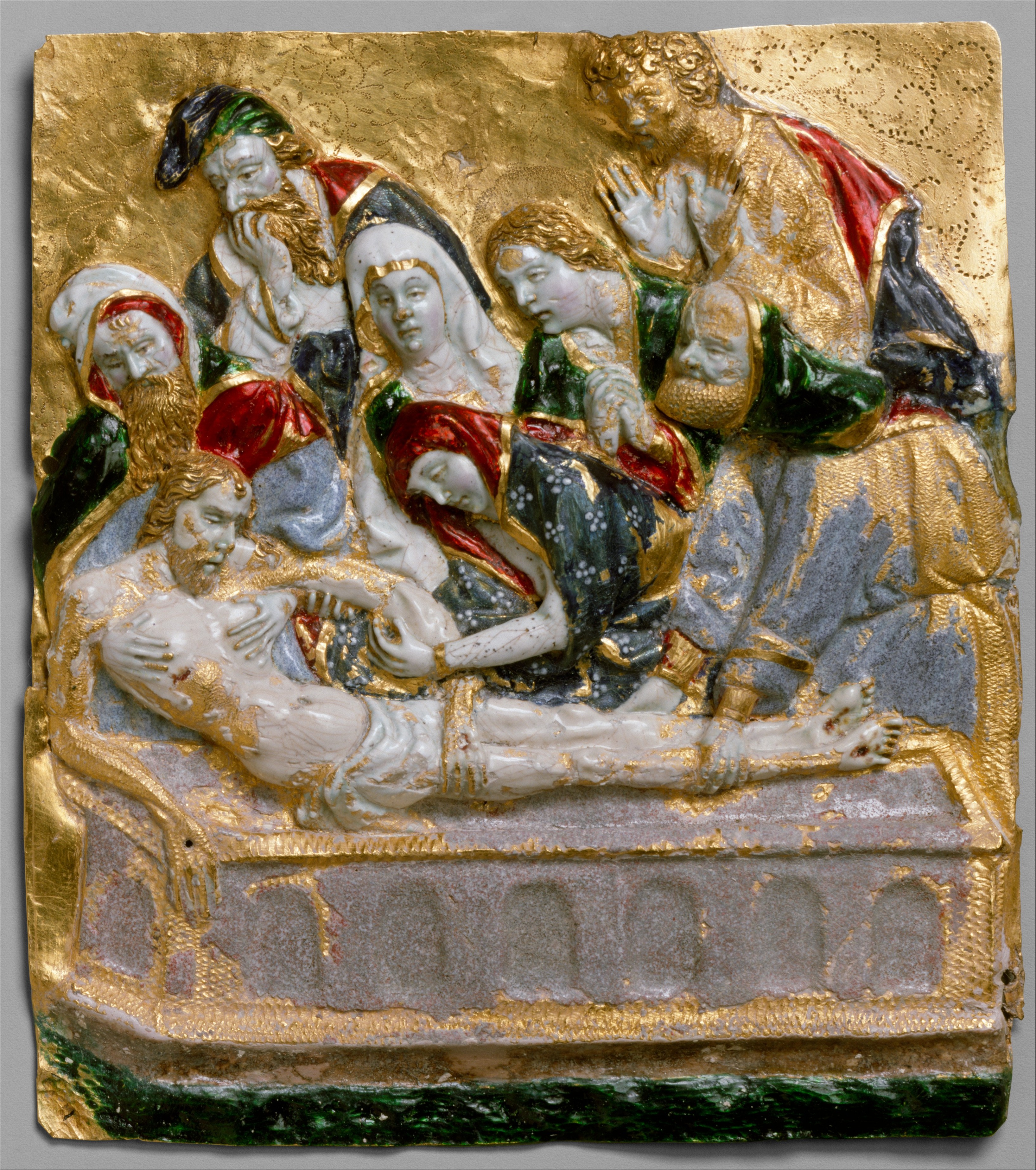
Within the hallowed archives of Natalie Fashion Atelier, the practice of aesthetic archaeology demands a rigorous interrogation of historical masterpieces, not as static relics but as living lexicons of form, light, and materiality. The subject under current analysis—The Entombment of Christ, rendered through the meticulous medium of opaque and translucent enamel on gold—presents a profound paradox. It is a scene of profound gravity, yet its execution is one of luminous transcendence. This artifact, isolated from its liturgical context, offers a unique technical vocabulary for the 2026 Haute Couture season. The dialogue between the opaque, which absorbs and defines, and the translucent, which reveals and diffuses, provides a blueprint for a new silhouette architecture—one that balances structural weight with ethereal lightness, mourning with radiance.
Material Dialectics: Opaque Grounds and Translucent Veils
The technical mastery of this enamel work lies in its dualistic nature. The opaque enamel—typically a deep, matte black or dark blue in the background of the scene—serves as the architectural anchor. It is the void, the earth, the finality of the tomb. In couture terms, this translates to the foundational garment: a sculpted, matte-finished shell. For 2026, we propose this as a double-faced cashmere and bonded crepe bodice, cut with severe, almost architectural precision. The seams are not hidden but celebrated, echoing the cloisonné wires that separate the enamel fields. This is the corps à corps of the silhouette—the body’s definitive structure.
Conversely, the translucent enamel—applied in layers over a gold foil base to depict the flesh tones of Christ and the mourners—creates a phenomenon of internal luminosity. The gold beneath catches and refracts light through the semi-transparent layers, producing a skin that seems to breathe and glow from within. This technique directly informs our 2026 fabric development. We are engineering a new textile: a gilded organza where micro-lamé threads are woven into a base of sheer silk. When layered over the opaque foundation, this fabric mimics the enamel’s effect. The silhouette becomes a study in depth, where the wearer’s movement creates shifting fields of opacity and translucency, mirroring the sacred interplay of shadow and divine light.
Silhouette Architecture: The Entombed Line and the Resurrection of Form
The composition of The Entombment is characterized by a horizontal, weighted line—the body being lowered into a sarcophagus. This is not a vertical, aspirational silhouette but a grounded, gravitational one. For 2026, we deconstruct this into a new silhouette category: Le Tombeau. This is a floor-length, columnar shape that begins with a severe, high neckline (the opaque enamel) and descends into a full, pleated skirt (the translucent enamel). The waist is de-emphasized; the focus is on the horizontal banding that echoes the layers of enamel application.
Specifically, the silhouette is constructed in three distinct horizontal zones:
Zone One: The Sarcophagus Structure (The Opaque). A rigid, corseted bodice in matte black faille, articulated with internal boning that mimics the gold cloisonné walls. The neckline is a high, architectural collar that frames the face like a reliquary. This is the zone of containment and finality.
Zone Two: The Mourning Veil (The Translucent Transition). From the hip to mid-thigh, a sheer, gold-lamé organza is draped in asymmetrical folds. This fabric is treated with a laser-cut enamel pattern—a digital interpretation of the cloisonné lines—creating a lattice of opaque and translucent squares. The gold thread catches the light, creating the effect of the internal glow of the enamel.
Zone Three: The Shroud (The Luminous Fall). The skirt is a full, unlined circle of the same gilded organza, but here the gold is concentrated in vertical stripes, mimicking the folds of a burial shroud. The hem is raw, fraying slightly, to suggest the impermanence of the material world. The entire silhouette is weighted at the hem with a hidden chain of gold-plated brass, ensuring the garment falls with the same gravitational solemnity as the painted body.
Color Palette and Light Manipulation
The palette is deliberately restricted to the enamel’s primary tones: Noir Absolu, Or Brûlé, and Ivoire de Cire. The black is not a simple black; it is a deep, matte carbon that absorbs all light, creating a void against which the gold can perform. The gold is not a metallic shine; it is a burnished, almost tarnished gold, achieved through a proprietary wash of bronze and copper pigments on the lamé threads. The ivory is the translucent enamel’s effect—a pale, milky white that appears to have a pink or blue undertone depending on the angle of light. This is achieved through a double-layer silk georgette with a subtle, hand-painted gradient.
The critical innovation is light manipulation through layering. The opaque bodice is lined with a thin layer of gold foil, not visible but present, so that when the translucent skirt moves, it catches a reflection from the bodice’s interior. This creates a halo effect around the wearer, a direct translation of the gold foil’s role beneath the enamel. The silhouette is not merely seen; it is experienced as a luminous event.
Construction and Craftsmanship: The New Atelier Lexicon
To realize this vision, the Atelier must adopt a new construction methodology, one that treats fabric as a vitreous medium. The opaque faille is not cut and sewn; it is molded and heat-set over a dress form, using a technique borrowed from millinery. The seams are then covered with a hand-stitched, gold-plated chain, mimicking the cloisonné wires. The translucent organza is not hemmed; its edges are sealed with a clear silicone gel to prevent fraying, a direct parallel to the fired enamel’s edge.
The most complex element is the laser-cut cloisonné pattern on the skirt. A digital scan of the original enamel’s geometric grid is used to cut precise, negative-space squares into the organza. These squares are then backed with a micro-mesh of gold thread, creating a fabric that is simultaneously open and closed, opaque and translucent. This is the technical pinnacle of the artifact’s translation: the ability to hold a rigid, geometric pattern while maintaining the fluidity of a draped skirt.
Conclusion: A Silhouette for the Sacred and the Secular
The 2026 silhouette informed by The Entombment of Christ is not a costume. It is a philosophical garment that carries the weight of its historical source while speaking a contemporary language of luxury. It is a study in contrasts: the heavy and the light, the matte and the luminous, the final and the eternal. By deconstructing the opaque and translucent enamel on gold, we have not merely copied a pattern; we have extracted a principle of luminosity and structure. The result is a silhouette that is both a tomb and a resurrection—a garment that mourns with the gravity of history while shining with the promise of a new dawn. This is the essence of aesthetic archaeology: to find the eternal in the entombed, and to release it into the light of the future.