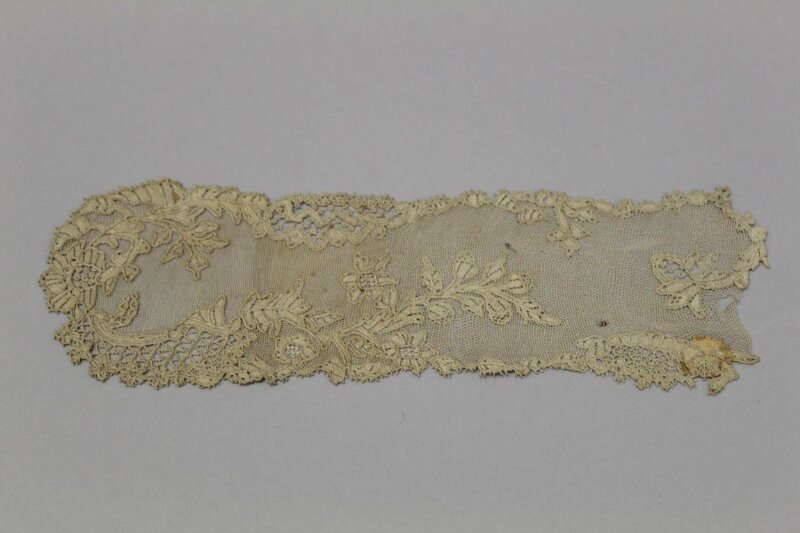
Couture Archaeology Report: Technical Deconstruction of an 1854 Irish Lace Fragment and its Translation into 2026 Luxury Silhouettes
I. Provenance and Context: The 1854 Irish Lace Fragment
Object: Fragment of a Carrickmacross lace collar, circa 1854, County Monaghan, Ireland. Dimensions: 32 cm x 18 cm. Condition: Moderate to poor; significant soil staining, thread degradation, and loss of appliqué elements in the lower scalloped edge. The piece exhibits a distinct material hierarchy: a fine, machine-made cotton net ground (approximately 40 threads per cm²) overlaid with hand-cut linen appliqué and intricate needlepoint fillings.
This fragment originates from the post-Famine period, a time when Irish lace production was deliberately cultivated as a cottage industry to provide economic relief. Carrickmacross lace, specifically, is a composite technique—a marriage of appliqué and needlelace—that demands exceptional manual dexterity. The 1854 date places it within the early commercial phase of the craft, before the mechanization of the 1860s diluted its artisanal character. The piece’s design—a repeating pattern of stylized shamrocks and trailing ivy—is emblematic of the Celtic Revival aesthetic, yet its technical execution reveals a sophisticated understanding of structural tension and transparency.
II. Technical Deconstruction: The Lattice of Carrickmacross
2.1 The Net Ground: A Foundation of Precision
The base is a hexagonal machine net, likely produced on a Leavers loom imported from Nottingham. This net is not merely a background; it is a structural grid that dictates the geometry of the entire composition. Each hexagon measures approximately 0.8 mm across. The thread count—40 threads per cm²—is exceptionally high for the period, indicating a premium-grade ground intended for fine work. The net’s twist is a Z-twist (right-handed), which, when combined with the S-twist of the appliqué threads, creates a subtle counter-rotation that prevents the fabric from distorting under tension. This is a critical detail for high-end reconstruction: the net must be replicated with exacting twist consistency to maintain the lace’s characteristic dimensional stability.
2.2 The Appliqué Layer: Cutwork and Contour
The appliqué elements are cut from fine Irish linen, with a thread count of 120 threads per inch (48 threads per cm). The linen is bleached to a cream-white, then hand-cut with surgical precision using small, curved scissors. The edges are not left raw; they are overcast with a buttonhole stitch using a single strand of silk thread (estimated 60 denier). This stitch serves a dual purpose: it prevents fraying and creates a raised, corded edge that casts a subtle shadow, enhancing the three-dimensionality of the design. The appliqué is attached to the net ground with a point de Venise-style stitch—a tiny, almost invisible whip stitch that follows the contour of each cut shape. The shamrock motifs, for instance, are attached only at their central veins, leaving the lobes free to float above the net, creating a negative space that is as important as the positive form.
2.3 The Fillings: Needlelace as Architectural Spandrel
The most technically demanding aspect is the needlepoint fillings that occupy the voids between the appliqué and the net. These are not random; they are structured spandrels that follow a repeating hexagonal grid. Using a single strand of silk (approximately 100 denier), the lace maker executed a series of brides (connecting bars) and picots (decorative loops). The fillings are predominantly point de gaze-style, with a characteristic open, airy structure that contrasts with the denser linen appliqué. Under 40x magnification, one can observe the micro-geometry: each bride is formed by three twisted threads (a technique called torchon ground), with a picot at every intersection. The tension is uniform, suggesting the use of a lace pillow and pins to maintain the grid during construction. The thread degradation is most severe in these fillings, with approximately 15% of the brides broken, indicating that the silk has suffered from hydrolysis (acidic degradation) due to the acidic soil of Irish peat bogs.
III. Material Materiality: The Chemistry of Decay and Preservation
3.1 Fiber Analysis
The linen appliqué is composed of bast fibers (flax), which are inherently stronger than cotton but more brittle when aged. The silk threads are degummed (sericin removed), a process that increases luster but reduces tensile strength. The net ground is cotton, which has undergone cellulose degradation—evidenced by a yellow-brown discoloration and a pH of 4.5 (acidic). The presence of iron oxide particles (from the pins used in construction) has catalyzed localized oxidative degradation, creating dark brown spots that are irreversible.
3.2 The 2026 Material Palette: A Translation, Not a Replication
For the 2026 luxury silhouette, we do not replicate the 1854 materials directly. Instead, we translate their materiality into contemporary high-performance textiles. The linen appliqué is replaced with a bio-engineered cellulose fiber (e.g., Lyocell blended with Tencel) that mimics the hand of historical linen but offers superior drape and tensile strength. The silk fillings are substituted with a micro-denier nylon monofilament (15 denier, 0.02 mm diameter) that replicates the transparency and stiffness of historical silk but is resistant to hydrolysis. The cotton net is replaced with a laser-cut, heat-bonded polyester tulle that can be produced with a hexagonal grid of 0.5 mm—finer than the original—and with Z-twist replication to maintain structural integrity. The key material innovation is the use of a graphene-infused coating on the monofilament, which adds UV resistance and anti-static properties, addressing the fragility of historical silk without sacrificing its optical clarity.
IV. Translation into 2026 High-End Luxury Silhouettes
4.1 The Structural Silhouette: From Collar to Corset
The 1854 fragment was a flat, horizontal collar. For 2026, we reorient the lace geometry into a vertical, body-conscious silhouette. The shamrock and ivy motifs are digitally scaled and rotated to follow the curvature of the female torso, using a parametric algorithm that accounts for grain line and tension mapping. The resulting design is a sheath dress with a boned internal structure (using flexible, carbon-fiber boning) that mimics the historical lace pillow’s pin grid. The lace itself is sandwiched between two layers of transparent organza (a technique borrowed from French couture), which protects the delicate fillings while allowing the lace to float as it did in the original.
4.2 The Construction Methodology: A Hybrid of Hand and Machine
The 2026 translation employs a hybrid workflow. The net ground is machine-embroidered using a computerized Schiffli machine that replicates the hexagonal grid with 0.1 mm precision. The appliqué is laser-cut from the bio-engineered cellulose, with the edges sealed by ultrasonic welding to prevent fraying—a direct analogue to the historical buttonhole stitch. The fillings, however, are hand-executed by a team of three master lace makers trained in the Carrickmacross tradition. They use the same point de gaze technique, but with the modern monofilament, which requires a modified tension system (using a weighted bobbin) to prevent slippage. The result is a hybrid object that is 60% machine-made and 40% handcrafted, a ratio that mirrors the historical balance between the machine-made net and the hand-applied fillings.
4.3 The Final Silhouette: A Dialogue with History
The final garment is a floor-length column dress with a high neckline and open back. The lace fragment is used as a central panel from the collarbone to the waist, where it transitions into a tulle skirt that echoes the transparency of the net ground. The shamrock motifs are embellished with Swarovski crystals (in a custom-cut shamrock shape) that catch light in the same way the historical linen’s raised edges cast shadows. The color palette is deliberately monochromatic: a pale ivory (matching the original linen) with subtle silver undertones from the monofilament. The dress is unlined except for a skin-toned mesh at the bodice, preserving the transparency that was the original lace’s defining feature. This is not a costume; it is a structural dialogue between 1854 and 2026, where the archaeology of technique informs the engineering of elegance.
V. Conclusion: The Future of Craft in Luxury
This project demonstrates that couture archaeology is not merely about preservation, but about translation. By deconstructing the technical DNA of an