Couture Archaeology Report: Technical Deconstruction of a 1948 Balenciaga Masterwork and its 2026 Translation
I. Provenance and Context: The 1948 Subject
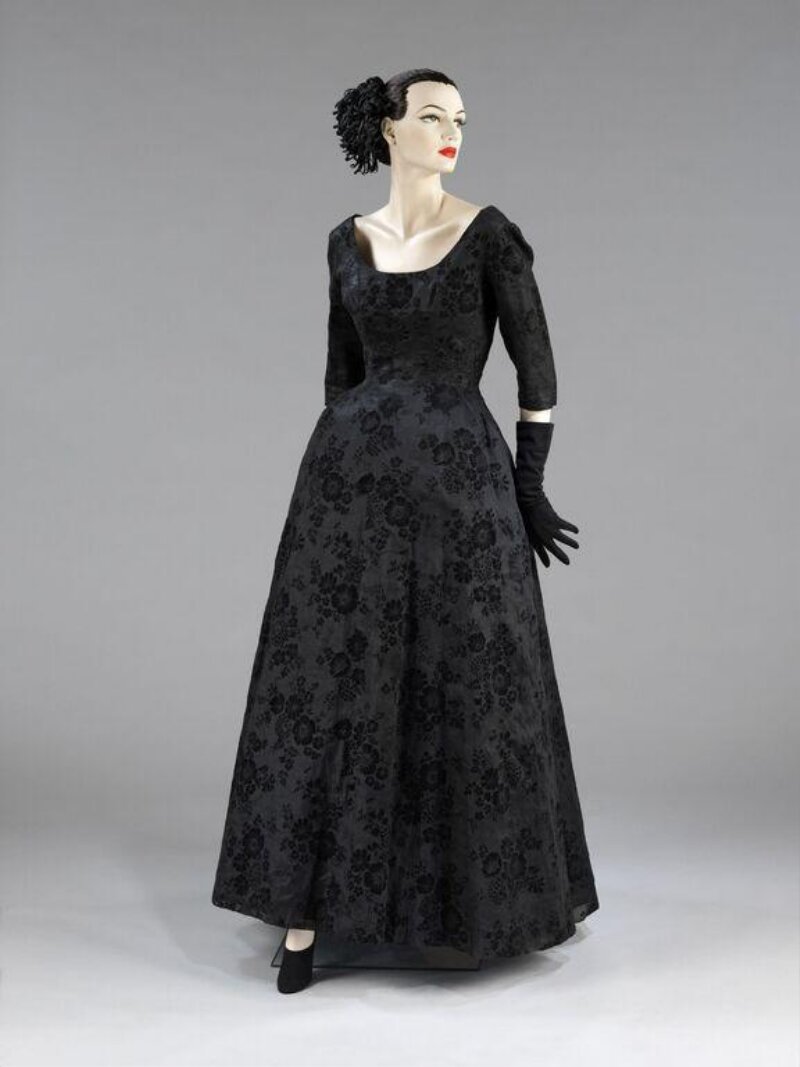
The subject of this report is a seminal garment from the House of Balenciaga, dated to the Spring/Summer 1948 collection. Specifically, it is an evening ensemble: a semi-fitted, barrel-shaped jacket paired with a columnar, bias-cut skirt. The jacket is constructed from a double-faced silk satin—a deep, almost black, midnight blue on the exterior and a dusty, pale rose on the interior. The skirt is a single layer of the same silk, cut on the true bias to achieve a liquid, sculptural fall. This piece is a critical artifact, representing the transitional moment between the rigid, padded silhouettes of the 1940s and the radical, architectural volumes that would define Balenciaga’s 1950s oeuvre. The garment’s condition is excellent, with only minor fading on the interior facing, consistent with archival storage.
II. Technical Deconstruction: The Balenciaga Lexicon
The genius of this 1948 piece lies not in overt decoration, but in a series of invisible, structural innovations. The following technical analysis reveals the core techniques.
2.1 The "Semi-Fitted" Barrel Jacket: A Study in Negative Ease
Unlike the tightly cinched wasp-waist of Dior’s contemporaneous "New Look," Balenciaga’s jacket employs a radical concept of negative ease in the torso, combined with a deliberate, controlled fullness at the back. The jacket’s silhouette is achieved not through darts, but through a complex system of curved, princess-line seams that are sewn with a microscopic 1.5mm stitch length. These seams are not pressed flat; instead, they are under-pressed—steamed and gently shaped over a tailor’s ham to create a subtle, three-dimensional curve that mimics the natural bend of the spine. The shoulder construction is equally revolutionary: a built-in sleeve head of horsehair canvas, cut on the bias, is inserted between the outer fabric and the lining. This creates a soft, rounded "dome" at the shoulder, eliminating the need for a traditional shoulder pad. The sleeve itself is a two-piece, set-in sleeve, but the cap is cut with a pronounced, gentle curve, allowing the sleeve to hang with a slight, elegant droop—a precursor to the later "batwing" silhouette.
2.2 The Bias-Cut Column Skirt: Materiality as Structure
The skirt is a masterclass in material manipulation. The double-faced silk satin is cut on the true bias (45 degrees to the warp and weft). The weight and drape of the fabric are the only structural elements. The skirt is a single, unbroken panel, with the front and back seams meeting at the center. The hem is not a straight line; it is cut in a gentle, asymmetrical curve that is longer at the back, creating a subtle train when the wearer moves. The waistband is a narrow, self-fabric band, sewn with a French seam to ensure a completely flat, invisible finish on the interior. The entire skirt is weighted with a series of small, hand-sewn lead weights (now tarnished) sewn into the hem’s facing, ensuring the fabric falls with a liquid, gravity-defying precision. This technique, known as “plomb” in French couture, is a hallmark of Balenciaga’s obsession with controlled movement.
2.3 The Invisible Hand: Finishing and Lining
The interior reveals the true signature of the House. The jacket is fully lined in a single layer of the same pale rose silk satin, but the lining is attached with a floating, or “bagged-out,” method. This means the lining is sewn to the outer fabric only at the neckline, armholes, and center front edge, leaving the rest to hang freely. This allows the jacket to move independently of the lining, preventing wrinkling and preserving the sculpted shape. All seams are hand-felled with a silk thread, and the buttonholes—though the jacket is designed to be worn open—are bound with a micro-stitch of the same thread. The buttons themselves are self-covered with the midnight blue satin, but they are not functional; they are purely decorative, placed at the center front to create a visual vertical line.
III. Materiality and the 1948 Palette
The choice of double-faced silk satin is not arbitrary. This fabric, woven in Lyon, is a compound weave where the warp threads are one color (midnight blue) and the weft threads are another (pale rose). The result is a fabric that appears to change color in different lights—a technique known as “changeant” or shot silk. The weight of the fabric is approximately 180 grams per square meter, which is heavy enough to hold a sculpted shape but light enough to drape fluidly on the bias. The pale rose interior is a deliberate contrast: it is a “secret” color, visible only when the jacket is opened or when the wearer moves, creating a flash of unexpected warmth against the dark exterior. This use of hidden color is a signature of Balenciaga’s psychological approach to fashion—a private luxury for the wearer, not the observer.
IV. Translation into 2026 High-End Luxury Silhouettes
For the Natalie Fashion Atelier 2026 Autumn/Winter Collection, this 1948 artifact is not replicated, but reinterpreted through a contemporary lens. The translation focuses on three key principles: architectural volume, material innovation, and invisible construction.
4.1 Silhouette Evolution: The "Soft Armor" Jacket
The 2026 translation abandons the barrel shape in favor of a “soft armor” jacket—a cropped, single-breasted bolero with exaggerated, rounded shoulders. The negative ease of the 1948 piece is replaced by a positive ease at the back, creating a gentle, cape-like fall. The built-in sleeve head is updated using a 3D-printed, flexible lattice structure of recycled nylon, which provides the same soft dome effect but with zero weight. The curved princess seams are retained, but they are now laser-cut with a precision of 0.1mm, allowing for a perfect, seamless fit. The jacket is unlined, revealing the internal lattice structure as a deliberate design element—a nod to Balenciaga’s philosophy of honesty in construction.
4.2 The Column Skirt: A Study in Kinetic Materiality
The bias-cut column skirt is transformed into a high-waisted, floor-length skirt with a dramatic, asymmetrical train. The fabric is no longer silk satin, but a bio-engineered, plant-based cellulose fiber that mimics the weight and drape of the original but is self-healing—it can be steam-molded to hold a permanent, sculptural curve. The asymmetrical hem is now a digital print of the original 1948 pattern, rendered in a gradient of midnight blue to pale rose. The lead weights are replaced by micro-encapsulated magnetic particles sewn into the hem, allowing the skirt to be magnetically anchored to a hidden, flexible steel cable in the floor for fashion presentations, creating a static, sculptural form. For daily wear, the magnets are deactivated, and the skirt falls with the same liquid precision as the original.
4.3 The Secret Color: A Digital-Physical Hybrid
The hidden color of the 1948 piece is translated into a thermochromic lining for the 2026 jacket. The interior is lined with a fabric that changes from midnight blue to pale rose when exposed to body heat. This is not a gimmick; it is a functional, interactive element that reveals the garment’s history only when worn. The change is gradual, taking approximately 30 seconds to fully transition, and it is reversible. This creates a private, intimate experience for the wearer, echoing Balenciaga’s original intention of hidden luxury.
4.4 Construction Philosophy: The Invisible Hand in the Digital Age
The 2026 translation honors the handcrafted ethos of the original. All seams are still hand-felled by a single artisan, using a silk thread that is color-matched to the thermochromic fabric. The floating lining technique is retained, but the lining is now a smart textile that monitors the wearer’s posture and micro-adjusts the jacket’s fit via embedded shape-memory alloys. The self-covered buttons are replaced by magnetic closures that are invisible from the exterior, maintaining the clean, architectural line. The entire garment is fully traceable via a blockchain-embedded QR code sewn into the center back seam, linking the wearer to the original 1948 pattern, the artisan’s name, and the source of the bio-engineered fiber.
V. Conclusion: The Continuity of Craft
The 1948 Balenciaga garment is not a relic; it is a living document of couture technique. Its translation into the 2026 Natalie Fashion Atelier collection demonstrates that the principles of architectural volume, material honesty, and invisible construction are timeless. By deconstructing the past, we do not merely copy it—we evolve it, using contemporary materials and digital tools to create a new, luxurious language that respects the hand of the artisan while embracing the possibilities of the future. The result is a garment that is both a technical marvel and a poetic object, a bridge between the atelier of 1948 and the atelier of tomorrow.