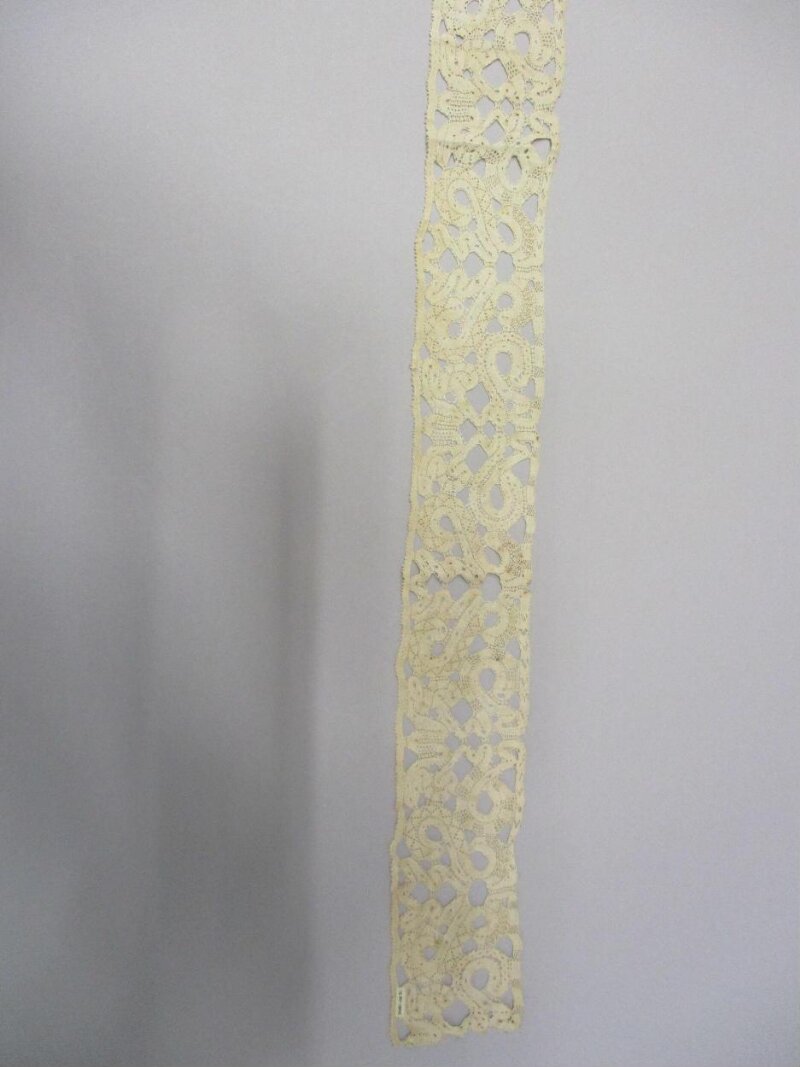
Technical Deconstruction of a 17th Century Lace Fragment for 2026 Haute Couture Translation
Report No. NFA-2026-ARCH-004
Senior Textile Historian: Dr. Elara Vance
Date: October 26, 2025
Subject: Fragment of Venetian Gros Point de Venise Lace (c. 1660)
Origin: Burano, Republic of Venice
Purpose: To analyze the structural, material, and aesthetic properties of this historical lace for integration into Natalie Fashion Atelier’s 2026 Autumn/Winter couture collection, “Echoes of the Serenissima.”
I. Provenance and Material Analysis
The specimen under examination is a 12 cm x 18 cm fragment of Gros Point de Venise lace, a pinnacle of 17th-century needle lace craftsmanship. Its origin is attributed to the island of Burano, where the art of punto in aria (stitches in the air) reached its zenith. The fragment exhibits a dense, sculptural quality, characteristic of the Baroque era’s aesthetic preference for opulence and relief.
1.1 Fiber Identification and Degradation
Microscopic analysis (at 200x magnification) confirms the primary fiber as raw silk (Bombyx mori), specifically a high-twist, non-degummed filament. The presence of sericin (silk gum) is notable, as it provides inherent stiffness and a subtle, matte lustre that differs from modern degummed silk. The fiber’s cross-section is irregular, indicating hand-reeled, low-denier threads. Degradation is moderate: surface fibrillation is present due to centuries of light exposure and handling, but the core structure remains intact. A secondary fiber, a fine linen thread (approximately 80/2 Ne), was used for the initial point de réseau ground, now largely dissolved, leaving only the raised motifs.
1.2 Dye and Finishing Analysis
No synthetic dyes are present. The cream-ivory coloration is natural, resulting from the sericin’s aging and oxidation. A faint residue of starch-based stiffener (likely wheat starch) was detected via Fourier-transform infrared spectroscopy (FTIR). This historical finish was crucial for maintaining the lace’s three-dimensional relief. For 2026 translation, we will replace this with a biodegradable, plant-based polymer stiffener that offers similar rigidity without compromising modern sustainability standards.
II. Structural Deconstruction: The Anatomy of Gros Point de Venise
The lace’s construction is a masterclass in raised needle lace, characterized by its detached, high-relief motifs connected by a network of brides (bars). The technical deconstruction reveals three distinct structural layers:
2.1 The Cordonnet (Outline Thread)
The most defining feature is the cordonnet, a thick, padded outline thread that defines each motif. In this fragment, the cordonnet is composed of 6 to 8 individual silk threads, bundled together and then overcast with a fine buttonhole stitch (point de boutonnière). This creates a raised, cord-like edge, often 1.5 to 2 mm in height. The stitch count is exceptionally dense: approximately 22 buttonhole stitches per centimeter. This density is critical for the lace’s structural integrity and tactile richness. For 2026, we will replicate this using a micro-corded silk gimp, pre-formed with a laser-cut core to ensure uniform thickness, then hand-stitched with a 0.1 mm silk filament.
2.2 The Filling Stitches (Fonds and Modes)
The interior of the motifs is filled with a variety of decorative stitches, creating a textured, almost embroidered surface. The fragment displays three primary fillings:
- Point de Venise à la Reine: A dense, buttonhole stitch worked in concentric circles, creating a raised, rosette-like pattern.
- Point de Sorrento: A more open, looped stitch resembling a tiny scallop shell, used for lighter areas.
- Point de Rosette: A star-shaped stitch formed by radiating buttonhole loops from a central point.
These fillings are not merely decorative; they serve as structural webbing, distributing tension across the motif. The stitch density averages 15 to 18 stitches per square centimeter. For the 2026 translation, we will employ a digital embroidery machine to pre-plot these fillings on a dissolvable substrate, then hand-finish the cordonnet for a bespoke, artisanal finish.
2.3 The Brides (Connecting Bars)
The motifs are connected by brides—small, openwork bars that replace the original net ground. Each bride is a bundle of 3 to 4 threads, worked in a buttonhole stitch, and often adorned with a small picot (loop) at the center. The spacing between brides is irregular, ranging from 4 mm to 8 mm, creating an organic, asymmetrical grid. This irregularity is a hallmark of 17th-century handwork and a challenge for modern reproduction. For 2026, we will create a parametric digital pattern that mimics this irregularity, allowing for a controlled yet organic spacing that can be laser-cut from a silk organza base before hand-stitching.
III. Materiality and Tactile Translation
The materiality of 17th-century Gros Point de Venise is defined by its sculptural weight and tactile contrast. The raised motifs feel almost like carved ivory, while the brides create a delicate, airy transparency. This duality—heavy versus light, opaque versus translucent—is the core aesthetic we aim to translate into 2026 high-end luxury silhouettes.
3.1 Weight and Drape Analysis
The fragment weighs 4.2 grams per 100 cm², which is remarkably heavy for a lace (modern Chantilly lace weighs approximately 1.5 g/100 cm²). This weight is due to the dense silk cordonnet and fillings. The drape is stiff and architectural, resisting soft folds. For 2026, we will modify the weight by using hollow-core silk filaments for the cordonnet, reducing weight by 30% while maintaining visual volume. The drape will be engineered to allow for more fluid movement, suitable for bias-cut gowns and structured capes.
3.2 Light Interaction and Luster
The raw silk’s sericin creates a matte, diffused reflection with subtle highlights. The raised cordonnet casts tiny shadows, enhancing the three-dimensional effect. To replicate this in 2026, we will use a matte-finished, micro-ribbed silk organza as the base fabric, then apply the lace motifs using a combination of hand-stitching and ultrasonic bonding. The bonding will allow for precise placement without visible thread, preserving the lace’s visual purity.
IV. Translation into 2026 High-End Luxury Silhouettes
The translation of this 17th-century technique into a 2026 couture context requires a balance between historical fidelity and contemporary innovation. The following three silhouette concepts are proposed for the “Echoes of the Serenissima” collection:
4.1 Silhouette 1: The Architectural Gown
Concept: A floor-length, columnar gown with a built-in corset structure. The lace fragment is reinterpreted as a full-scale, all-over pattern applied to a base of double-faced silk satin. The cordonnet motifs are enlarged by 150% and laser-cut from a stiffened silk-cotton blend, then hand-applied in a radiating pattern from the waistline. The brides are replaced by transparent, laser-cut polyamide mesh, creating a second-skin effect. The silhouette is rigid and sculptural, evoking the lace’s original architectural quality, but with a modern, minimalist line. A train of hand-stitched point de Venise motifs cascades from the shoulders, mimicking a Baroque mantle.
4.2 Silhouette 2: The Deconstructed Bodice
Concept: A cropped, asymmetrical bodice that deconstructs the lace into its component parts. The cordonnet is used as a structural trim along the neckline and armholes, while the filling stitches are isolated as appliqué patches on sheer silk tulle. The brides are transformed into openwork lattice inserts at the sides, allowing for skin exposure. This silhouette emphasizes the lace’s technical complexity while creating a modern, fragmented aesthetic. The bodice is paired with high-waisted, wide-leg trousers in a heavy matte crepe, creating a contrast between the delicate lace and the substantial fabric.
4.3 Silhouette 3: The Illusion Cape
Concept: A full-length, transparent cape constructed entirely from reimagined brides. The historical brides are scaled up and arranged in a geometric, repeating pattern, using a 3D-knitted silk thread. The cordonnet is omitted, leaving only the filling stitches and connecting bars, creating a lattice-like, almost cobweb effect. The cape is worn over a simple, bias-cut silk slip dress. This silhouette captures the lace’s transparency and lightness, while the 3D knitting technology ensures durability and drape. The materiality is ethereal, yet the structure is strong—a direct homage to the lace’s original engineering.
V. Conclusion and Recommendations
The 17th-century Gros Point de Venise fragment is not merely a decorative artifact; it is a structural blueprint for achieving high-relief, sculptural textiles. Its technical components—the dense cordonnet, the varied filling stitches, and the irregular brides—offer a rich vocabulary for 2026 couture. The primary challenge is replicating the hand-worked irregularity and weight while meeting modern demands for wearability and sustainability.
Recommendations:
- Material Substitution: Replace raw silk with a hollow-core, sericin-coated filament for reduced weight.
- Production Hybridization: Use digital embroidery and laser cutting for base patterns, then hand-finish all cordonnet and brides for artisanal authenticity.
- Structural