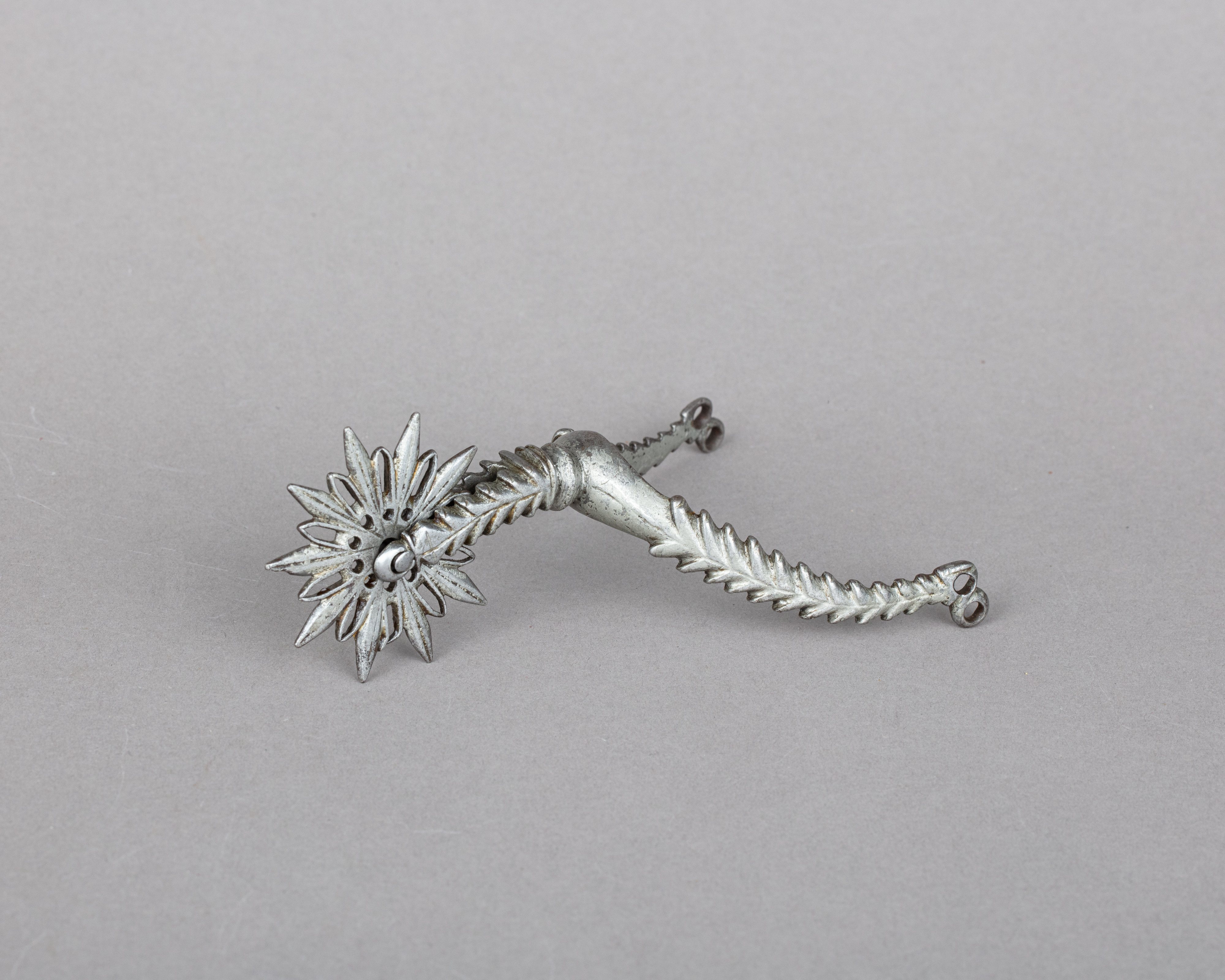
The Rowel Spur: An Aesthetic Archaeology of Power and Precision
The rowel spur, a quintessential artifact of German equestrian heritage, emerges from the archives of Natalie Fashion Atelier as a profound study in the dialectic between force and finesse. Forged from iron alloy and finished with a whisper of tin, this object—often relegated to the functional realm of medieval cavalry—is, in fact, a masterclass in structural tension. Its form is a paradox: a brutal, functional core cloaked in the delicate gleam of a protective coating. The rowel, a star-shaped wheel of sharp points, is not merely a tool of command; it is a geometric statement of radial precision. The iron alloy speaks of weight, of ground, of the unyielding earth. The tin whispers of light, of reflection, of a surface that catches the eye before the hand feels the steel. This isolated artifact, stripped of its historical context, becomes a pure vocabulary for the 2026 couture silhouette: a language of armored softness, of controlled aggression, and of a beauty that is earned, not given.
Materiality as Narrative: The Iron Alloy and the Tin Finish
In the hands of the Atelier, materiality is not a passive state; it is an active narrative. The iron alloy of the German spur is a study in density and durability. It is a material that does not yield easily; it resists, it holds its shape under immense pressure. For the 2026 silhouette, this translates into a structural foundation that is both literal and metaphorical. We consider the iron alloy as the skeletal armature of a garment—the internal boning, the architectural seams, the rigid panels that define a silhouette’s posture. This is not the soft, forgiving drape of a jersey; it is the assertive, unapologetic line of a tailored jacket or a sculpted corset. The iron alloy informs a new language of tailoring: one where the garment’s structure is visible, celebrated, and unashamedly powerful. The seams are not hidden; they are articulated like the facets of a blade. The shoulders are not padded; they are constructed with a precise, angular geometry that evokes the spur’s radial arm.
Conversely, the tin finish introduces a counterpoint of luminous restraint. Tin, historically used to prevent rust, is a material of preservation and of a cool, silvery sheen. It is not ostentatious; it is a subtle, almost lunar glow. In the 2026 haute couture silhouette, this translates into surface treatments that play with light and shadow. We envision liquid metal finishes on silk charmeuse, a tin-leaf appliqué on a matte wool crepe, or a micro-pleated organza that catches the light like the facets of the rowel. The tin is the whisper, the breath, the moment of reflection. It is the oxymoron of the collection: a hard, functional core (the iron) sheathed in a delicate, almost ethereal skin (the tin). This duality is the very essence of the modern couture client—a woman of formidable strength who moves with grace, whose power is not shouted but felt.
Deconstructing the Classical Elegance: The Rowel as a Geometric Motif
The classical elegance of the rowel spur lies not in its ornamentation, but in its absolute functional logic. Every point of the rowel is a vector of intention. The central axis is a point of stillness; the radiating points are points of action. For the 2026 silhouette, we deconstruct this geometry into a modular system of design. The rowel becomes a repeat pattern for laser-cut leather, a three-dimensional embellishment on a structured bustier, or a negative-space cutout in a floor-length gown. The key is to maintain the tension between the center and the periphery.
Consider a cocoon coat in a heavy, iron-gray wool. The silhouette is monolithic, a single, powerful volume. Yet, at the shoulder, a series of rowel-inspired cutouts are laser-engraved, revealing a lining of tin-shot silk. The garment is no longer a simple shape; it becomes a dialogue between interior and exterior, between the hidden and the revealed. The classical elegance of the spur is thus deconstructed into a contemporary narrative of exposure and concealment. The points of the rowel are not aggressive; they are points of entry for the eye, moments of visual release in an otherwise controlled form.
2026 Silhouettes: The Armored Silhouette and the Fluid Counterpoint
The 2026 high-end silhouette, as informed by the German rowel spur, bifurcates into two distinct yet complementary archetypes: the Armored Silhouette and the Fluid Counterpoint.
The Armored Silhouette is a direct descendant of the spur’s structural integrity. It is characterized by sharp, angular shoulders that extend beyond the natural line, evoking the rowel’s radial arms. The waist is cinched with a sculpted corset of iron-alloy boning, visible through a sheer, tin-finished overlay. The skirt is a column of structured fabric, perhaps a double-faced wool, that falls with geometric precision. This is not a silhouette that moves; it is a silhouette that commands. The color palette is austere: iron grays, oxidized blacks, and the pale silver of tin. The texture is a study in contrast: the matte density of wool against the slick, reflective surface of a patent leather or a liquid metal finish. The key piece is a tailored jumpsuit with a built-in, rowel-inspired belt that functions as both a structural element and a decorative motif. The belt is not a soft leather; it is a rigid, metal-like composite, shaped into a series of interlocking points that echo the spur’s star.
The Fluid Counterpoint is the necessary antithesis. It is the tin finish made manifest in fabric. This silhouette is characterized by liquid draping, by asymmetric volumes, and by a sense of movement that is almost ethereal. The fabric is a heavy silk crepe or a micro-pleated metallic jersey that catches the light like the facets of a polished tin surface. The silhouette is long, lean, and seemingly effortless, yet it is anchored by subtle structural details—a hidden seam, a weighted hem, a single, sharp cutout at the hip that references the rowel’s geometry. The key piece is a floor-length gown with a single, dramatic sleeve that is constructed from a series of overlapping, rowel-inspired panels. The panels are attached only at the shoulder and the wrist, allowing them to float and shift with the wearer’s movement, creating a kinetic sculpture of light and shadow. This is the armored whisper, the power that is felt, not seen.
Conclusion: The Art of Controlled Tension
The German rowel spur, in its isolated aesthetic archaeology, offers the 2026 couture collection a profound lesson in the art of controlled tension. It is an object that exists in a state of perfect equilibrium: the brute force of the iron alloy balanced by the delicate preservation of the tin; the aggressive radial geometry balanced by the stillness of the central axis. For Natalie Fashion Atelier, this translates into a collection that is not about softness or hardness, but about the precise relationship between them. The 2026 silhouette is a study in architectural fluidity, where every line is intentional, every surface is a narrative, and every garment is a testament to the enduring power of a single, perfectly conceived object. The client who wears this collection does not simply wear a dress; she wears a manifesto of materiality, a geometry of intent, and a silhouette that is both a shield and a revelation.