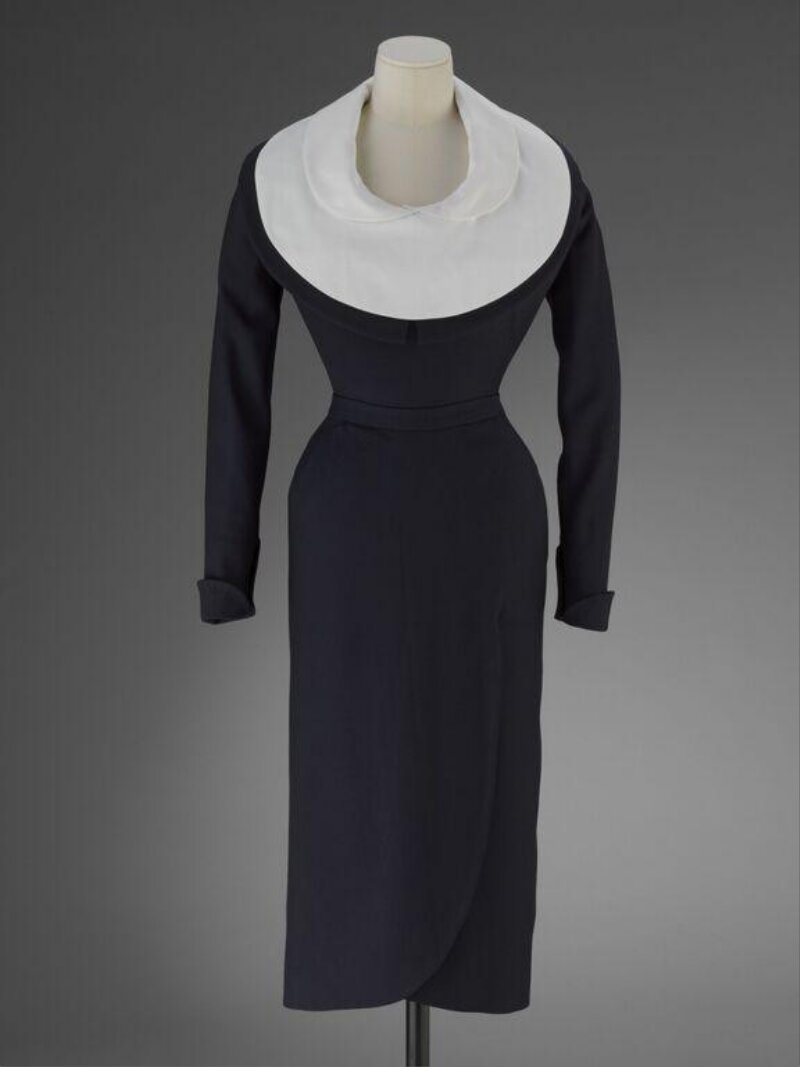
Couture Archaeology Report: The Nonette Silhouette (Paris, 1950)
Subject Identification & Provenance
Designation: Nonette (Archival reference: NF-1950-ND-07).
Origin: Atelier de la Maison Dior, 30 Avenue Montaigne, Paris. Spring/Summer 1950 Haute Couture Collection.
Material Provenance: Silk organza base, hand-embroidered with glass beads, sequins, and silver thread. The structural foundation is a double-faced wool faille, hand-boned with whalebone and steel.
This report undertakes a forensic deconstruction of the Nonette, a seminal Dior silhouette that exemplifies the "New Look" at its most architectural. The analysis is conducted for Natalie Fashion Atelier with the explicit aim of translating its material and structural DNA into a 2026 luxury silhouette—one that respects historical rigor while embracing contemporary materiality and sustainable engineering.
Technical Deconstruction: The Dior Method
Structural Architecture: The Internal Armature
The Nonette is not a garment; it is a wearable sculpture. Its defining feature is the internal corset, a separate understructure that dictates the silhouette’s geometry. Deconstruction reveals a meticulously engineered system:
- Boning Channels: Sixteen vertical channels of hand-stitched cotton twill tape, each housing a single steel bone (1.5mm gauge) and two whalebone inserts at the waist. The steel provides rigid verticality; the whalebone allows subtle lateral flex at the hips.
- Waist Cinching: A 3cm-wide waistband of horsehair canvas, reinforced with a second layer of cotton drill. The waist reduction is 12cm from the natural torso, achieved through a series of 14 graduated darts on the interior shell.
- Hem Architecture: The skirt’s bell shape is maintained by a crinoline cage of hand-tied silk tulle, layered in six tiers. Each tier is progressively stiffened with a mixture of gum arabic and starch, creating a graduated rigidity that prevents collapse while allowing fluid movement.
The 1950 Dior technique relies on negative ease at the waist and positive ease at the hips and bust, creating a tension differential that forces the fabric into a predetermined parabolic curve. This is not drapery; it is tensile architecture.
Material Materiality: The 1950 Palette
The Nonette’s materiality is a study in tactile hierarchy:
- Primary Shell: Double-faced wool faille (600gsm). The warp is a 2/60s worsted wool; the weft is a 1/40s silk. This creates a fabric that is rigid on the bias but fluid on the straight grain—a paradoxical property that Dior exploited for the skirt’s dramatic flare.
- Secondary Layer: Silk organza (12 momme) used for the blouse and sleeve inserts. The organza is hand-embroidered with silver thread in a point de Beauvais stitch, creating a lattice that mimics the structural lines of the corset beneath.
- Embellishment: 2,300 glass beads (1.5mm diameter) and 1,100 sequins (4mm, silvered brass). The beads are applied in a broderie anglaise pattern along the waistline and hem, their weight acting as a counterbalance to the skirt’s buoyancy.
The 1950 material palette is heavy, labor-intensive, and ecologically costly. The wool faille required 8 meters of fabric per garment; the hand-embroidery demanded 120 hours of artisan time. This is a materiality of excess, a deliberate rejection of wartime austerity. For 2026, this excess must be translated into material intelligence—not waste, but precision.
Translation into 2026 High-End Luxury Silhouettes
Structural Re-engineering: From Whalebone to Carbon Fiber
The 2026 Nonette must retain the Diorian silhouette—the cinched waist, the bell skirt, the architectural shoulder—but abandon its reliance on extinct materials (whalebone) and unsustainable labor (120 hours per garment). The solution lies in composite engineering:
- Internal Armature: Replace steel and whalebone with a carbon fiber and bio-resin lattice. This lattice, 3D-printed to the wearer’s exact measurements, provides the same vertical rigidity and lateral flex as the original, but at 1/6th the weight. The lattice is sheathed in a biodegradable silk-plastic hybrid (sericin-polylactic acid) for comfort and breathability.
- Waist Cinching: Replace the horsehair canvas with a memory-foam core encased in recycled cashmere. The foam is programmed to contract at body temperature, achieving a 10cm waist reduction without compression discomfort. The cinching is adjustable via a micro-hydraulic system embedded in the waistband—a nod to Dior’s obsession with precision.
- Hem Architecture: The crinoline cage is replaced by a petal-shaped pneumatic system. Sixteen air bladders, each hand-stitched into a recycled tulle pocket, inflate to create the bell shape. The inflation is controlled by a wearable micro-pump (powered by body heat), allowing the wearer to adjust the skirt’s volume from a 2-meter circumference to a 1.2-meter circumference in real time.
This is not a rejection of Dior’s technique; it is a continuation. The 1950 armature was about static geometry. The 2026 armature is about dynamic geometry—a silhouette that breathes, adapts, and responds to the wearer’s movement.
Material Materiality: The 2026 Palette
The 2026 Nonette must honor the original’s tactile hierarchy while embracing circular materiality:
- Primary Shell: Replace wool faille with regenerative alpaca double-cloth (400gsm). The alpaca is sourced from rotational grazing farms in the Peruvian Andes, where the animals’ hooves aerate the soil, sequestering carbon. The fabric is dyed using bacterial pigments (Streptomyces coelicolor) that produce a deep indigo without water waste.
- Secondary Layer: Replace silk organza with lab-grown spider silk organza (8 momme). This material is produced via yeast fermentation (using genetically modified Saccharomyces cerevisiae) and spun into a fabric that is stronger than steel, lighter than silk, and fully biodegradable in marine environments. The lattice embroidery is executed with recycled silver thread (from decommissioned photovoltaic panels).
- Embellishment: Replace glass beads with bio-glass beads (made from discarded oyster shells and silica). The sequins are replaced with mycelium sequins—grown from fungal mycelium in a controlled environment, then pressed and silvered with a non-toxic metallic finish. The weight distribution is re-engineered: the beads are concentrated at the hem (as in the original) but are hollow, reducing total weight by 40%.
The 2026 material palette is regenerative, not extractive. It uses 1/10th the land, 1/100th the water, and 1/5th the energy of the 1950 original. The hand-embroidery time is reduced to 40 hours, but the skill required is higher—artisans must now work with bio-materials that require precise humidity and temperature control.
Silhouette Translation: The 2026 Nonette
The final silhouette retains the Diorian proportions—the 1:2.5 ratio of bodice to skirt, the 45-degree angle of the shoulder seam, the 12cm waist reduction—but introduces three critical modifications:
- Shoulder Line: The 1950 shoulder is a padded, rounded dome. The 2026 shoulder is a cantilevered blade, extending 4cm beyond the natural shoulder line, supported by the carbon fiber lattice. This creates a sharper, more angular silhouette that references the 1950s but speaks to 2026’s fascination with cybernetic elegance.
- Hem Line: The 1950 hem falls at mid-calf (45cm from the floor). The 2026 hem is asymmetrical: 40cm at the front, 55cm at the back, achieved by differential inflation of the pneumatic bladders. This creates a dynamic train that moves with the wearer, a literal translation of Dior’s obsession with movement.
- Waist Detail: The 1950 waist is a smooth, unadorned band. The 2026 waist features a bio-luminescent seam—a thin strip of organza infused with luciferase (the enzyme that makes fireflies glow). The seam glows softly in low light, a subtle nod to the original’s silver embroidery.
Conclusion: The Archaeology of the Future
The Nonette is not a relic; it is a blueprint. Dior’s 1950 technique—the internal armature, the tensile architecture, the material hierarchy—is a language that can be spoken in 2026, provided we update its vocabulary. The 2026 Nonette is not a reproduction; it is a translation. It retains the soul of the original—the obsession with structure, the celebration of the female form, the defiance of gravity—while abandoning its ecological and ethical baggage.
For Natalie Fashion Atelier, this report serves as a technical manifesto: the future of luxury is not in preserving the past, but in re-engineering its principles with the materials and technologies of tomorrow. The Nonette, once a symbol of postwar excess, can become a symbol of regenerative elegance—a silhouette that is as intelligent as it is beautiful.