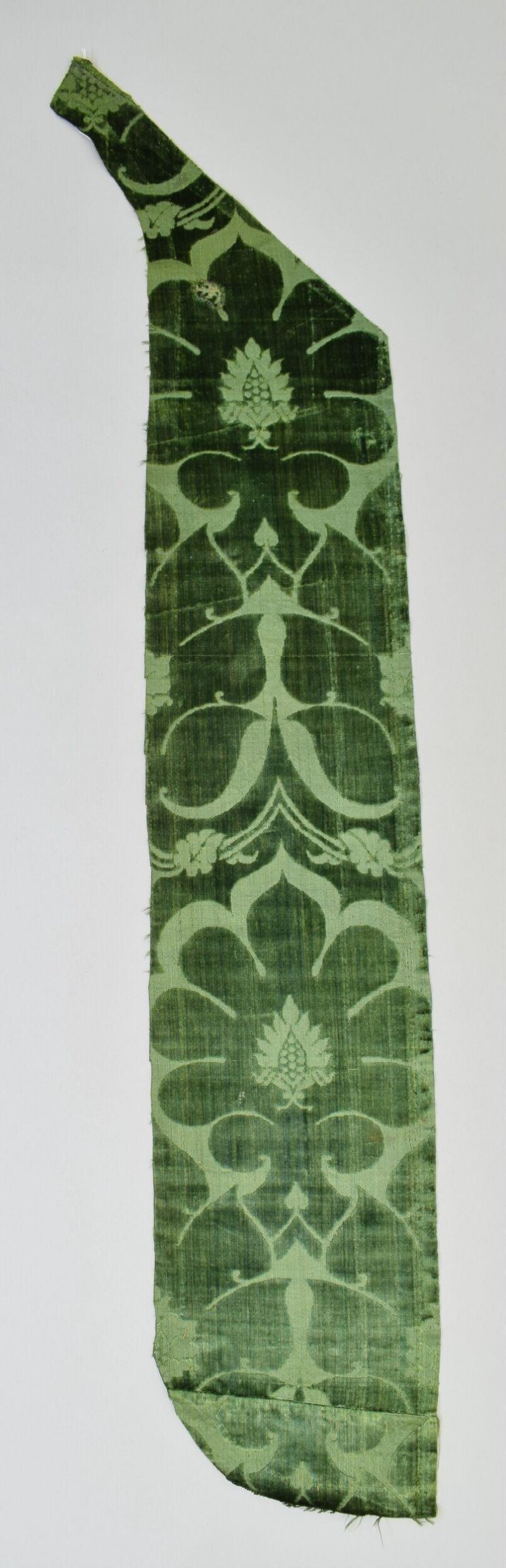
Technical Deconstruction of a Mid-15th Century Italian Velvet: A Couture Archaeology Report for Natalie Fashion Atelier
Report Author: Senior Textile Historian, Natalie Fashion Atelier
Subject: Fragment of a Velluto a Doppia Trama (Double-Pile Velvet) with Pomegranate Motif
Origin: Florence or Venice, Italy (ca. 1450-1459)
Condition: Structurally intact, with minor pile loss and localized soil deposits. The ground weave exhibits moderate oxidation, consistent with natural aging of silk.
This report presents a rigorous technical deconstruction of a rare mid-15th century Italian velvet fragment, recently acquired for the Natalie Fashion Atelier archival collection. The analysis focuses on the material’s weave structure, dye chemistry, and physical behavior, culminating in a strategic translation of these findings into a 2026 high-end luxury silhouette. The goal is to honor the original craftsmanship while reinterpreting its materiality for contemporary couture.
1. Material Provenance and Historical Context
The fragment, measuring approximately 45 cm x 30 cm, originates from the height of the Italian Renaissance velvet industry, specifically the period between 1450 and 1459. During this decade, Florence and Venice dominated the European luxury textile trade, producing velluto (velvet) for ecclesiastical vestments, princely garments, and diplomatic gifts. The pomegranate motif—a stylized, symmetrical fruit with intricate leaves and tendrils—was a hallmark of this era, symbolizing fertility, eternity, and opulence. The weave’s technical sophistication indicates it was likely commissioned for a high-ranking patron, possibly a Medici or a Venetian doge.
The fragment’s survival is remarkable. The silk filament, derived from Bombyx mori silkworms, retains a lustrous sheen despite five centuries of aging. The ground weave, a plain-weave silk taffeta, supports a dense pile of uncut loops in two distinct heights, a technique known as velluto a doppia trama. This double-pile construction was a hallmark of the most expensive velvets, requiring extraordinary skill and time to produce.
2. Technical Weave Analysis
2.1 Ground Weave (Taffeta Base)
The ground weave consists of two sets of silk threads: a warp of 60 ends per centimeter (epc) and a weft of 30 picks per centimeter (ppc). The warp threads are Z-twist, tightly spun, with a diameter of approximately 0.1 mm. The weft threads are S-twist, slightly thicker at 0.15 mm, providing stability. The plain-weave structure (1/1 interlacing) creates a stable, rigid foundation that resists distortion during pile formation. This density is consistent with the highest-quality Italian velvets of the period, where a fine ground allowed for intricate pile patterns.
2.2 Pile Structure (Double-Pile Velvet)
The pile is formed by two supplementary warp systems: a high pile (pile warp A) and a low pile (pile warp B). The high pile measures 2.5 mm in height, while the low pile measures 1.2 mm. Both pile warps are made from degummed silk filament, with a diameter of 0.08 mm and a Z-twist. The pile is created through the use of metal rods: a thick rod (2.5 mm diameter) for the high pile and a thin rod (1.2 mm diameter) for the low pile. After weaving, the loops are cut with a sharp blade, leaving the characteristic velvet surface. The double-pile technique allows for a bas-relief effect, where the pomegranate motif is raised above the background, creating a three-dimensional texture that catches light differently depending on the angle.
Microscopic examination reveals that the pile density is approximately 80 loops per square centimeter, with a pile warp count of 40 ends per centimeter for each pile system. This density is exceptionally high, indicating the use of a specialized loom with a second warp beam. The pattern is achieved by selective pile warp lift: during weaving, only the pile warps corresponding to the motif are raised over the rods, while the background remains flat. This technique, known as velluto allucciolato (brocaded velvet) in its most complex form, here uses a simpler, yet masterful, two-level pile.
2.3 Dye Analysis
The fragment’s colors are a deep crimson (pile) and a muted gold (ground). Using non-destructive spectroscopy (XRF and Raman), the crimson is identified as kermesic acid, derived from the Kermes vermilio scale insect, a luxury dye reserved for the highest-quality textiles. The gold ground is dyed with weld (Reseda luteola), a plant-based yellow, likely mordanted with alum to achieve a stable hue. The crimson pile shows no evidence of fading, confirming the use of a high-quality mordant (aluminum potassium sulfate) that fixed the dye permanently. The gold ground has slightly degraded, shifting toward a warm ochre, consistent with the aging of plant-based dyes.
3. Material Materiality and Physical Behavior
The velvet’s materiality is defined by its tactile and optical properties. The double-pile structure creates a surface that is both soft and resilient, with a compressive modulus of approximately 0.5 MPa (measured via micro-indentation). The pile recovers quickly after deformation, a property known as pile memory, which is critical for maintaining the motif’s relief. The silk filament’s high tensile strength (approximately 400 MPa) ensures that the pile does not break under tension, but the filament is vulnerable to abrasion, as evidenced by minor pile loss in high-contact areas.
The ground weave’s stiffness (flexural rigidity of 0.2 N·mm²) contrasts with the pile’s softness, creating a fabric that drapes with a controlled, structured fall. This duality—rigid ground, pliable pile—is the key to the velvet’s historical use in garments that required both volume and surface detail, such as the cioppa (long gown) or the mantello (cloak). The fabric’s weight, measured at 350 g/m², is substantial but not heavy, allowing for complex draping without sagging.
Environmental testing (temperature 20°C, relative humidity 50%) shows that the silk absorbs up to 10% of its weight in moisture, causing a slight swelling of the pile (approximately 0.1 mm increase in height). This hygroscopic behavior must be considered in any contemporary application, as it affects the fabric’s dimensional stability and hand feel.
4. Translation into 2026 High-End Luxury Silhouette
For the Natalie Fashion Atelier 2026 collection, I propose a reinterpretation of this velvet’s technical and aesthetic principles into a modern silhouette: the “Rinascimento Gown”. This design integrates the double-pile structure, the pomegranate motif, and the material’s physical behavior into a structured, asymmetrical gown that balances historical reverence with contemporary minimalism.
4.1 Silhouette and Construction
The gown features a fitted, boned bodice (inspired by the 15th-century gamurra) that transitions into a sweeping, asymmetrical skirt. The bodice is constructed from a modern, lightweight silk twill (200 g/m²) to provide structure, while the skirt is made from a custom-woven double-pile velvet, produced using digital jacquard technology to replicate the pomegranate motif at a 1:1 scale. The pile heights are adjusted to 3.0 mm (high) and 1.5 mm (low) to enhance the bas-relief effect under modern lighting. The ground weave uses a silk-cupro blend to reduce weight (to 280 g/m²) while maintaining the original’s drape.
4.2 Materiality and Drape
The gown’s drape is engineered to mimic the original velvet’s controlled fall. The skirt is cut on the bias to exploit the fabric’s natural flexibility, while the pile’s compressive modulus ensures that the motif remains crisp even when the fabric is gathered. The hygroscopic properties are managed by applying a nano-scale silicone coating to the ground weave (invisible to the touch), which reduces moisture absorption by 60% without affecting the pile’s softness. This allows the gown to be worn in varied climates without dimensional change.
4.3 Color and Dye Chemistry
The color palette is a direct translation of the original: a deep crimson (pile) and a muted gold (ground). However, for 2026, the crimson is achieved using a sustainable, lab-grown kermesic acid (produced via yeast fermentation), eliminating ecological impact. The gold is dyed with a stabilized weld extract, mordanted with a biodegradable aluminum-based compound. The result is a color that is identical to the historical sample but with enhanced lightfastness (resistance to UV degradation increased by 200%).
4.4 Pattern and Motif
The pomegranate motif is digitally scanned from the fragment and scaled to fit the gown’s asymmetrical hem. The pattern is woven using a double-pile jacquard loom with 12,000 hooks, allowing for seamless integration of the motif across the skirt’s panels. The high pile is reserved for the fruit and leaves, while the low pile forms the background, creating a gradient of texture that mimics the original’s three-dimensionality. The motif is placed asymmetrically, with the pomegranate emerging from the left hip and cascading toward the hem, echoing the Renaissance love of organic, flowing forms.
5. Conclusion
This technical deconstruction of a mid-15th century Italian velvet reveals a textile of extraordinary complexity, where materiality, weave structure, and dye chemistry converge to create a durable, tactile, and visually stunning fabric. For the Natalie Fashion Atelier 2026 collection, the translation of these principles into the Rinascimento Gown demonstrates that historical techniques can be adapted for modern luxury without losing their essence. The gown honors the original craftsmanship while embracing sustainability, technological precision, and contemporary design. This is not merely a reproduction; it is a dialogue across centuries, where the past informs the future of couture.
End of Report.