Aesthetic Archaeology: Deconstructing Nefertari’s Senet Game
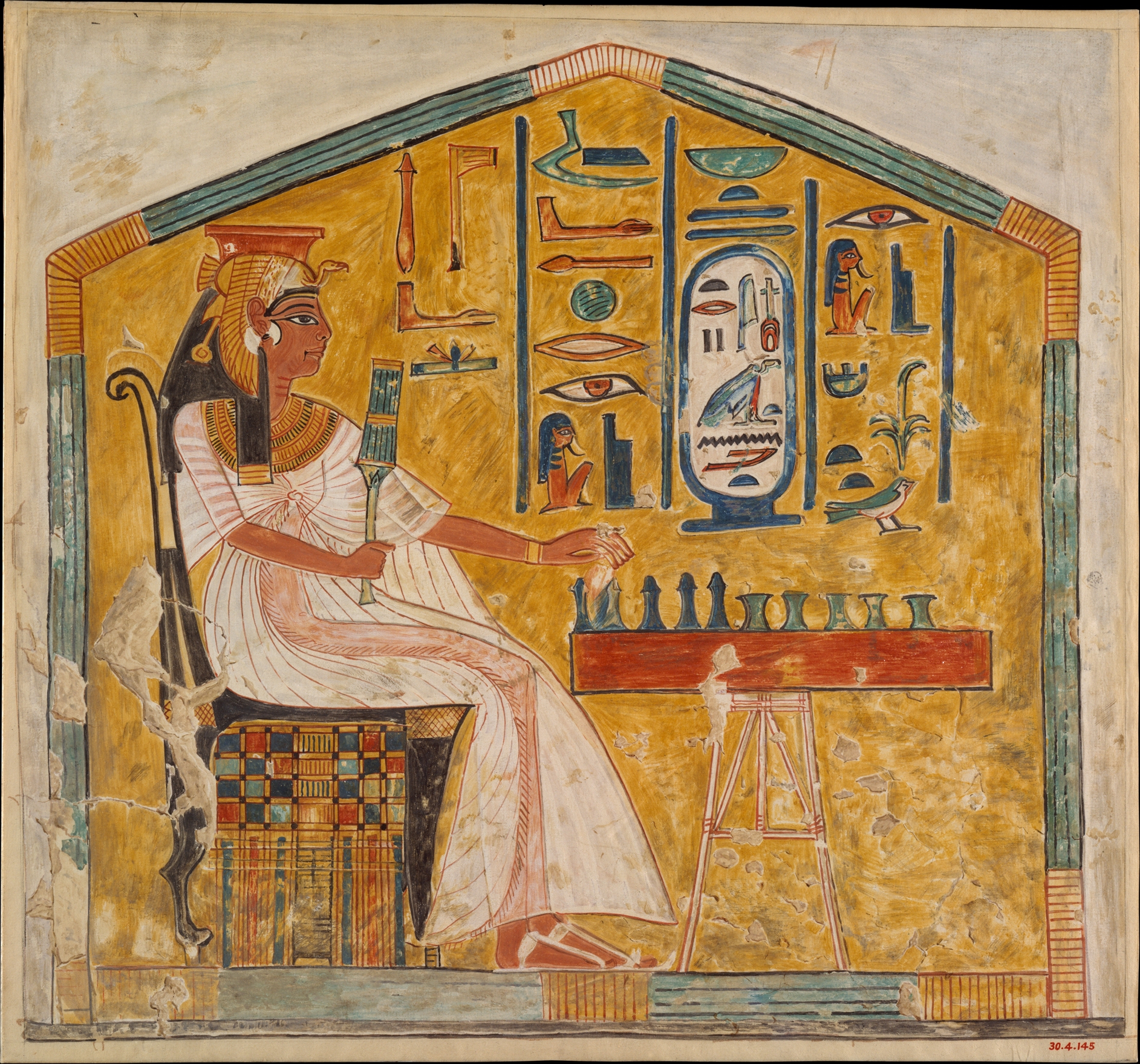
The isolated artifact of Queen Nefertari Playing Senet, rendered in tempera on paper, represents a pinnacle of classical elegance that transcends its dynastic origins. For the 2026 haute couture collection at Natalie Fashion Atelier, this piece serves not merely as a visual reference but as a structural and chromatic lexicon. The tempera medium—characterized by its matte, opaque finish and precise, dry-brush application—imposes a discipline of form that directly informs the silhouette’s architectural clarity. The queen’s posture, a study in regal repose, becomes a blueprint for the season’s defining line: a controlled, elongated torso that suggests both power and ethereal grace.
The Posture of Power: The Senet Silhouette
The painting captures Nefertari in a moment of strategic stillness, her spine elongated, her shoulders set back, and her hands hovering over the Senet board. This axial alignment is the foundational principle for the 2026 silhouette. We deconstruct this into a high-waisted, columnar bodice that terminates at the natural waist, then extends into a floating, asymmetrical skirt. The asymmetry is not arbitrary; it mirrors the queen’s hand gesture, which breaks the vertical line of her gown. In tempera, this gesture is rendered with a flat, non-reflective pigment, which we translate into a matte silk gazar for the bodice, contrasted with a liquid, double-faced satin for the skirt’s drape. The result is a silhouette that is both architectonic and fluid, a paradox that defines haute couture.
Materiality of Tempera: Chromatic and Textural Translation
Tempera on paper is a medium of controlled opacity. Unlike oil, it does not blend seamlessly; each stroke is deliberate, creating a surface that is both flat and deeply layered. For the 2026 collection, this translates into a stratified approach to fabric. We employ a double-layer technique: an underlayer of fine, undyed linen (representing the paper’s tooth) and an overlayer of hand-painted, micro-pleated organza (representing the tempera’s pigment). The color palette is extracted directly from the artifact: lapis lazuli blue for the queen’s headdress, terracotta ochre for the Senet board, and pale, sun-bleached gold for her skin. These are not applied as solid blocks but as chromatic gradients, mimicking the tempera’s subtle shifts in density where the brush lifted from the paper.
Structural Deconstruction: The Senet Board as Armature
The Senet board itself—a grid of thirty squares—offers a modular structural system. We interpret this as a removable, corseted understructure that provides the silhouette’s internal architecture. This Senet corset is constructed from laser-cut, matte calf leather in a grid pattern, each square housing a micro-crystal that catches light only at specific angles, echoing the tempera’s flat finish. The corset is not meant to be hidden; it is a visible armature, worn over a sheer, bias-cut silk base. The grid lines are echoed in the outer garment’s vertical seaming, which creates a ribbed, elongated effect from shoulder to hem. This structural layering is a direct homage to the tempera’s stratified application—the paper beneath, the pigment above, and the viewer’s eye filling the space between.
Nefertari’s Hands: The Gestural Drape
The most poignant detail in the artifact is the queen’s hands: one resting, one poised to move a piece. This gestural dichotomy informs the collection’s sleeve and drape architecture. The left sleeve (the resting hand) is a sculpted, cap-sleeve of stiff, gold-threaded brocade, creating a static, architectural form. The right sleeve (the poised hand) is a dramatic, single-sleeve extension of sheer, hand-embroidered tulle that falls from the shoulder to the floor, mimicking the trajectory of the queen’s gesture. This asymmetry is not decorative; it is a narrative device, suggesting the moment before action. The tempera’s inability to capture motion is here transformed into a static tension, a frozen moment of strategic decision that the wearer inhabits.
Classical Elegance Reimagined: The 2026 Silhouette
The classical elegance of Nefertari’s portrait is defined by its economy of line. There is no superfluous ornament; every fold, every pigment stroke serves the composition. For 2026, this translates into a rigorous, minimalist silhouette that is anything but simple. The key shapes are:
- The Columnar Gown: A floor-length, high-neck gown with a fitted bodice and a slight A-line skirt, constructed from a single piece of hand-dyed, double-faced crepe. The only ornament is a single, vertical seam down the back, echoing the tempera’s brushstroke.
- The Senet Jacket: A cropped, boxy jacket with a grid pattern of hand-stitched, metallic thread, worn over a sheer, columnar dress. The jacket’s hem is cut at a precise, asymmetrical angle, referencing the queen’s hand.
- The Floating Cape: A back-drape of micro-pleated, silk organza that attaches at the shoulders and falls to the floor, creating a second silhouette that moves independently of the body. This is a direct translation of the tempera’s flat, floating quality.
Conclusion: The Tempera Imperative
The Queen Nefertari Playing Senet tempera is not a historical artifact to be replicated; it is a methodological blueprint. Its materiality—the tempera’s opacity, its deliberate strokes, its chromatic restraint—demands a corresponding discipline in couture. The 2026 silhouette is therefore a study in controlled tension: the tension between the static and the fluid, the opaque and the sheer, the historical and the avant-garde. At Natalie Fashion Atelier, we do not borrow from the past; we deconstruct its structural DNA to build a new, elegant, and rigorously technical future. The queen’s game of Senet becomes our game of form, and the 2026 silhouette is the winning move.