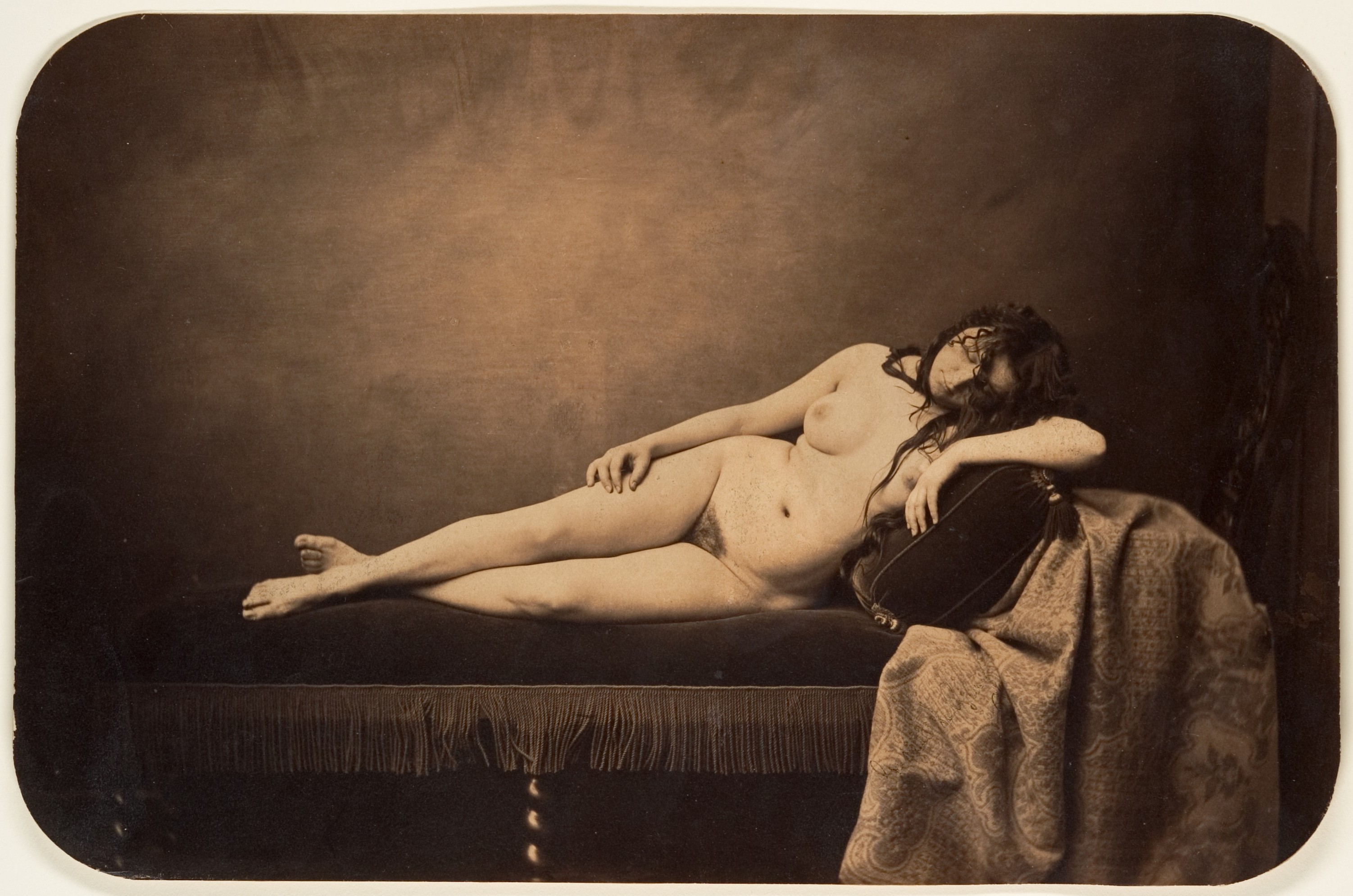
Deconstructing the Classical Gaze: The Albumen Silver Print as a Blueprint for 2026 Silhouettes
At Natalie Fashion Atelier, our curatorial methodology is rooted in aesthetic archaeology—a rigorous excavation of historical artifacts to extract the structural and philosophical DNA that can be re-coded for contemporary luxury. The subject under analysis, Nu féminin allongé sur un canapé Récamier, captured as an albumen silver print from a glass negative, represents a pivotal moment in the visual articulation of elegance. This is not merely a study of the female form; it is a study of spatial tension, weightless repose, and the architectural interplay between body and object. For the 2026 haute couture season, this artifact informs a radical departure from static tailoring toward a dynamic, fluid silhouette that mirrors the tonal gradations and fragile permanence of the photographic medium itself.
The Materiality of Memory: Albumen as a Textile Metaphor
The albumen silver print is defined by its surface fragility and depth of tonal range. The egg-white binder creates a glossy, almost skin-like sheen over a matte paper base, capturing the sitter’s form in a soft, dissolving vignette rather than a sharp, clinical edge. For 2026, this materiality translates directly into fabric innovation. We propose a new category of “photographic silks”—double-faced charmeuse and matte crêpes that mimic the print’s transition from highlight to shadow. The silhouette must not cut the body sharply; instead, it must fade into the negative space of the room, much like the figure’s extremities soften into the dark background of the print.
Key technical applications include gradient-dyed organza panels that shift from opaque to translucent at the hemline, and laser-cut guipure lace that replicates the granular texture of silver particles suspended in albumen. The construction technique borrows from photographic dodging and burning—selective hand-painting of pigment onto the fabric to create a chiaroscuro effect that sculpts the body without physical boning. The result is a silhouette that appears to emerge from and dissolve into its own atmosphere, a direct homage to the albumen print’s inability to hold a perfectly static image.
Architectural Recumbency: The Canapé Récamier as Structural Silhouette
The canapé Récamier is not a passive prop; it is an active structural element that dictates the figure’s posture. The classical elegance of the reclining nude lies in the asymmetrical balance between the curved backrest and the elongated, horizontal body. For 2026, this informs a silhouette that is inherently off-balance yet perfectly poised. We deconstruct the traditional dress form into two distinct architectural components: a rigid, sculptural back panel (representing the canapé) and a fluid, draping front (representing the body’s repose).
This is achieved through asymmetric tailoring where the left shoulder is structured with a high, boned collar reminiscent of the canapé’s rolled arm, while the right side cascades into a bias-cut waterfall of silk gazar. The waistline is deliberately displaced, sitting at a diagonal to mimic the figure’s relaxed, three-quarter turn. The hem follows the trajectory of the reclining leg—shorter at the front, sweeping into a train that echoes the furniture’s curve. This silhouette rejects the vertical, standing ideal of classic couture, instead embracing a horizontal, lounging architecture that commands space through its languid, possessive geometry.
Isolated Elegance: The Archaeology of the Gaze and the 2026 Consumer
In the context of isolated aesthetic archaeology, this albumen print exists as a singular, uncontextualized artifact. The viewer is denied the full narrative of the atelier or the sitter’s identity. This isolation is a luxury statement for 2026: the garment must be a complete, self-contained world. The silhouette must not rely on accessories or external styling to convey its meaning. The cut itself must narrate the history of the reclining pose, the chemistry of the silver print, and the philosophy of the French salon.
For the high-end consumer, this translates into garments that are deliberately introverted. The silhouette is not designed for the runway’s rapid, linear walk but for the static, contemplative pose—a seated dinner, a vernissage, a private viewing. The back of the garment becomes as critical as the front, featuring intricate albumen-toned beadwork that only reveals its full complexity when the wearer turns away from the crowd. The shoulder line is softened into a continuous, unbroken curve that mimics the canapé’s scroll, while the neckline is cut deep to the sternum, referencing the nude’s exposed décolletage but rendered in a high-modular, almost architectural neck collar of hand-molded resin and silk.
Technical Execution: From Glass Negative to Gown
The translation from glass negative to 2026 silhouette requires a multi-sensorial technical protocol. First, the scale of the print (typically 8x10 inches) is magnified to human proportions through a proprietary digital draping algorithm that analyzes the tonal falloff of the original negative. The algorithm generates a 3D pattern where the density of the fabric corresponds to the density of the silver deposit—heavier, more opaque fabrics where the print is darkest (the shadow of the canapé), and lighter, more transparent layers where the print is brightest (the skin’s highlights).
Second, the construction technique employs a reverse-engineering of the wet-plate collodion process. Just as the glass negative requires a perfectly clean, uniform surface to capture the image, the garment’s internal structure is built on a single, seamless base layer of micro-mesh, onto which all external panels are hand-stitched. This eliminates bulk and allows the silhouette to maintain the fluid, unbroken line of the reclining figure. The seams are treated with a liquid silicone finish that mimics the glossy sheen of the albumen binder, creating a subtle, reflective surface that catches light like the original print’s silver emulsion.
Finally, the finishing process involves a controlled oxidation of the metallic threads and beads, deliberately introducing a patina that mirrors the yellowing and fading of historical albumen prints. This is not a sign of decay but of curated authenticity—a testament to the garment’s archaeological lineage. The 2026 silhouette, thus, is not a reproduction of the classical nude but a living artifact that carries the chemical memory of its photographic origin.
Conclusion: The Silhouette as a Photographic Event
The Nu féminin allongé sur un canapé Récamier albumen silver print is a masterclass in the economy of elegance. It achieves maximum aesthetic impact through minimal means—a single figure, a single piece of furniture, a single chemical process. For Natalie Fashion Atelier’s 2026 collection, this artifact informs a silhouette that is equally economical in its complexity. The garment does not shout; it whispers through tonal gradation, structural asymmetry, and material memory. It is a silhouette designed for the woman who understands that true luxury is not about being seen, but about being remembered—a ghost in the machine of modern fashion, preserved in the silver halides of a forgotten negative, reborn in silk and shadow.