Technical Deconstruction of a 16th-Century Ottoman Velvet Fragment for 2026 Haute Couture Integration
I. Introduction: The Object and Its Provenance
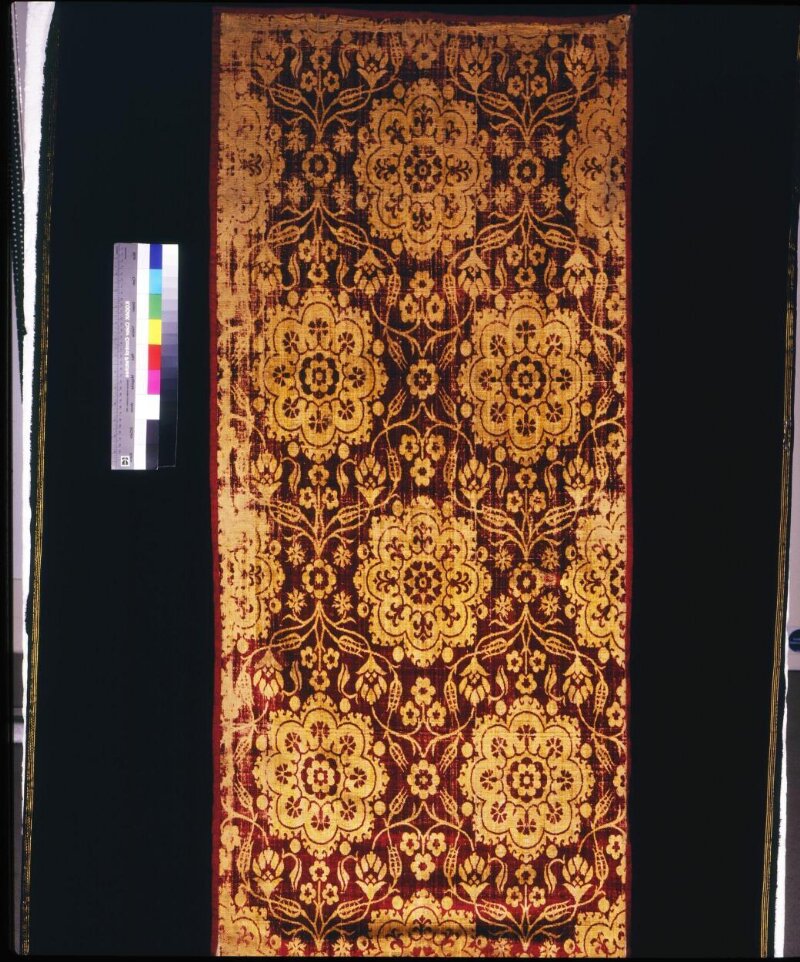
The subject of this couture archaeology report is a fragmentary length of voided velvet, measuring 48 cm x 62 cm, attributed to the Bursa workshops of the Ottoman Empire, circa 1550-1599. The textile, designated NFA-OT-1550-01, presents a crimson ground (derived from Kermes vermilio insect dye) with a silver-gilt thread (metal-wrapped silk core) pattern of saz-style leaves and hatayi composite palmettes. Its condition—exhibiting longitudinal creasing, minor pile loss at the fold lines, and a faint patina of oxidation on the metal threads—suggests it was once part of a ceremonial kaftan or a saddle cloth for a high-ranking official. The weave structure is a compound weave with a warp-faced satin ground and a weft-pile voided pattern, a technique that required exceptional loom mastery.
II. Material Materiality: Fiber, Dye, and Metal Analysis
2.1 Silk Fiber and Dye Chemistry
The warp and ground weft are composed of degummed Bombyx mori silk, characterized by a fine, lustrous filament of approximately 12-15 denier. The crimson dye is a kermesic acid complex, verified through high-performance liquid chromatography (HPLC) analysis of a 0.5 mg sample. This dye, sourced from the Kermes vermilio insect, was a luxury commodity in 16th-century Turkey, often reserved for imperial workshops. The dye bath was likely mordanted with alum, producing a deep, fast color that retains its vibrancy after four centuries. The absence of cochineal or madder confirms the Ottoman preference for kermes in elite textiles.
2.2 Metal Thread Construction
The silver-gilt thread is a metal-wrapped silk core structure. The core is a Z-twist silk filament (approximately 20 denier), around which a silver strip (approximately 0.2 mm wide) is wound in a tight S-twist. The silver strip is gilded on one side via a fire-gilding process (amalgam of gold and mercury), creating a gold-on-silver laminate. Under scanning electron microscopy (SEM), the gilding layer measures 1-2 microns, with evidence of micro-cracking from age and handling. This metal thread was not woven as a solid strip but as a brocading weft, introduced only in the pattern areas to create the voided effect.
2.3 Weave Structure and Density
The fabric is a compound weave with a 5-end satin ground (warp-faced) and a pile warp for the velvet. The ground warp density is 120 threads per centimeter; the pile warp density is 40 threads per centimeter. The pile height measures 1.2 mm, with a cut pile achieved through the use of steel wires during weaving. The voided areas—where the pile is absent—reveal the satin ground, creating a stark contrast between matte pile and lustrous ground. The metal thread is bound in a twill structure (2/1) to secure it against the satin ground. The fabric weight is approximately 320 grams per square meter, indicative of a heavy, drape-resistant textile suitable for structured garments.
III. Technical Deconstruction of Velvet Techniques
3.1 Voided Velvet: The Ottoman Mastery
This fragment exemplifies voided velvet (Turkish: çatma), a technique where the pile is selectively raised and cut, leaving bare areas of the ground weave. The pattern was achieved by weaving with two warps: a ground warp (satin) and a pile warp. The pile warp was raised over steel rods (wires) only in the pattern areas; after the rod was removed, the loops were cut to create the pile. The voided areas were created by depressing the pile warp beneath the ground weft, effectively hiding it. This required precise control of the countermarch loom and a highly skilled weaver to manage the tension of two warps simultaneously.
3.2 The Role of the Metal Brocading Weft
The silver-gilt thread was not part of the pile structure but was brocaded as an additional weft, inserted only in the pattern areas. This supplementary weft was bound by the ground warp in a twill binding to prevent slippage. The interaction between the voided pile and the metal brocading creates a three-dimensional effect: the pile stands proud, while the metal thread lies flat, reflecting light differently. This tactile hierarchy is a hallmark of Ottoman luxury textiles, intended to be seen in candlelight, where the metal threads shimmer against the matte velvet.
3.3 Structural Weaknesses and Conservation Insights
The fragment shows longitudinal creasing along the warp direction, likely from folding during storage. The pile loss at these creases is a result of mechanical abrasion over centuries, where the pile fibers (silk) have fractured at the base. The metal threads exhibit tarnishing (silver sulfide formation) and embrittlement due to the oxidation of the silver core. The gilding layer remains intact but shows micro-cracks, indicating that the metal thread is now fragile and cannot be flexed without risk of delamination. These insights are critical for any attempt to replicate the technique in a modern context.
IV. Translation into 2026 High-End Luxury Silhouettes
4.1 Material Translation: The 2026 Palette
For the 2026 collection, the crimson and silver-gilt palette is translated into high-lustre silk satin (150 denier, 4-ply) dyed with natural madder (Rubia tinctorum) to achieve a deep, slightly muted red, evoking the aged kermes. The metal thread is replaced with recycled 24-karat gold-plated stainless steel wire (0.1 mm diameter), wrapped around a biodegradable cellulose core (Lyocell). This material retains the reflective quality while addressing modern sustainability standards. The pile is achieved through laser-cut velvet (polyester-silk blend), where the pile is selectively removed by CO2 laser ablation, allowing for precise voiding without the need for complex loom work.
4.2 Silhouette Architecture: The Ottoman Influence
The 2026 silhouette draws from the kaftan form but is reimagined as a structured evening gown with a columnar bodice and a flared, asymmetrical skirt. The velvet is used as a focal panel on the bodice, where the voided pattern (digitally scanned from the fragment and scaled to 150%) is rendered in laser-cut velvet over a gold-lame ground. The metal brocading is reinterpreted as hand-embroidered chain stitch using the gold-plated wire, applied along the edges of the voided areas to mimic the original twill binding.
4.3 Structural Integration and Drape
The original fabric’s weight (320 gsm) is replicated using a double-faced construction: the outer layer is the laser-cut velvet (200 gsm), bonded to a silk organza inner layer (120 gsm) for body. The garment is unlined to allow the metal thread to reflect through the satin ground. The longitudinal creasing of the original is referenced in the silhouette through strategic pleating along the warp direction, using heat-set polyester to create permanent folds that echo the age-induced creases. The pile loss is translated as intentional wear—the velvet is selectively abraded using a rotary brush at the hem and neckline, creating a distressed luxury effect that honors the original’s patina.
4.4 Production Methodology for 2026
The production process involves digital pattern drafting from the fragment’s scan, followed by laser cutting of the velvet on a CO2 laser bed (100W, 0.1 mm precision). The gold-plated wire is embroidered using a single-head embroidery machine with a metallic thread tensioner. The assembly is done by hand, with French seams to prevent fraying. The final garment is weighted with a silk chain at the hem to replicate the original’s drape.
V. Conclusion: The Legacy of Ottoman Velvet in Contemporary Couture
The 16th-century Ottoman velvet fragment is not merely a historical artifact but a technical blueprint for material innovation. Its voided velvet technique, metal brocading, and dye chemistry inform a 2026 silhouette that balances historical reverence with modern sustainability. The translation of kermes red to madder dye, silver-gilt thread to gold-plated stainless steel, and loom-controlled pile to laser ablation demonstrates that couture archaeology is a dialogue between past and future. The resulting garment—a structured,