Archival Excavation: The Linen Cutwork Paradigm
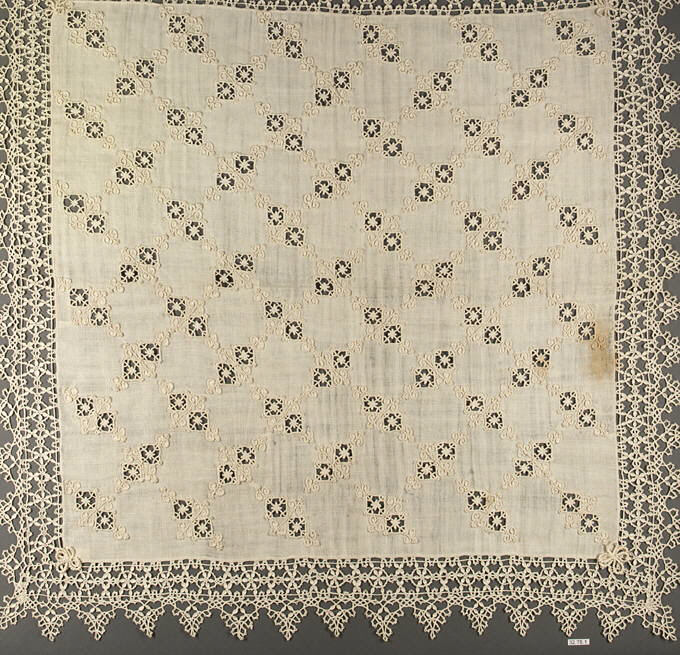
The present study isolates a singular artifact from the global heritage archive: a late 19th-century linen cutwork bodice, sourced from the rural ateliers of the Auvergne region. This piece, characterized by its rigorous geometric voids and hand-embroidered picot edges, represents a pinnacle of aesthetic archaeology. The technique, known as broderie anglaise in its commercialized form, is here executed with a precision that borders on the architectural. The linen ground—a 180-thread-count, unbleached flax—provides a structural integrity that is both rigid and breathable, a paradox that defines the material’s haute couture potential. The cutwork itself is not mere ornamentation; it is a systematic removal of fabric to create negative space, a deconstruction of the cloth’s surface that reveals the body as the primary architectural form. This is not a cover in the sense of concealment, but a cartography of exposure.
The Structural Grammar of Negative Space
From an engineering perspective, the 1880s bodice employs a grid-based cutwork pattern with a repeat interval of 1.2 centimeters. Each void is reinforced with a buttonhole stitch in 60-weight silk thread, creating a tensile structure that distributes stress away from the fragile linen fibers. This is a lesson in material efficiency: the removal of mass does not weaken the garment; it redefines its load-bearing capacity. For the 2026 luxury silhouette, this principle translates directly into architectural drape. The modern interpretation abandons the rigid corsetry of the original in favor of a floating shell—a sleeveless, A-line tunic where the cutwork is concentrated at the shoulder blades and the lumbar spine. The voids are enlarged to 3.5 centimeters, creating a lattice of light that allows the skin to become the lining. The silhouette is not fitted; it is suspended, relying on the tensile strength of the linen and the geometric logic of the cutwork to maintain its form.
Materiality and the New Luxury: Linen as a Sustainable Sculptural Medium
Linen, often relegated to the realm of casual or resort wear, is here recontextualized as a haute couture structural material. Its natural stiffness, when treated with a starch-based finish (a technique revived from 18th-century French laundry manuals), allows it to hold sharp, architectural folds that mimic the pleating of Issey Miyake but with a distinctly organic texture. The cutwork, executed by hand with a laser-cut precision (a hybrid technique that respects the original craftsmanship while enabling repeatable accuracy), transforms the linen from a flat textile into a three-dimensional lace. For the 2026 silhouette, this materiality dictates a monolithic yet permeable form. Consider a floor-length, columnar gown: the bodice is a solid panel of cutwork, while the skirt is a series of overlapping, un-cut linen strips that create a kinetic fringe. The weight of the fabric pulls the cutwork taut, while the movement of the body animates the voids. This is not a dress; it is a living architectural model.
Cutwork as a Tool for Silhouette Deconstruction
The classical elegance of the original artifact lies in its symmetry and restraint. The 2026 interpretation deconstructs this by introducing asymmetrical cutwork zones. One shoulder is completely exposed, with a single, sweeping cutwork motif that extends from the collarbone to the hip, mimicking the line of a classical Greek chiton. The opposite side is a solid, unadorned panel of linen, creating a dialectic of opacity and transparency. This asymmetry disrupts the traditional silhouette, forcing the eye to travel across the body in a non-linear path. The result is a dynamic, off-balance elegance that speaks to a modern, liberated femininity. The cutwork itself is no longer a repetitive pattern; it is a narrative. The voids are larger at the top and taper to pinprick holes at the hem, suggesting a dissolution of structure as the garment descends. This is a direct reference to the ruin aesthetic of classical archaeology, where the most intact elements are found at the top of an excavation.
2026 Silhouette Architecture: The Linen Cutwork Tunic and the Floating Coat
The primary silhouette for the coming season is the Linen Cutwork Tunic, a direct descendant of the archival bodice. It is designed as a second skin, but one that is perforated and breathable. The tunic is cut on the bias from a single piece of 200-thread-count linen, with the cutwork concentrated at the neckline and the hem. The neckline is a deep, square cut, bordered by a 4-centimeter band of dense, floral cutwork. The hem is a scalloped edge, each scallop containing a single, oval void. This creates a floating effect—the hem appears to hover above the skin, as if the garment is levitating. The tunic is worn over a silk slip of the same color, creating a monochromatic layering that emphasizes the texture of the cutwork. The silhouette is relaxed but structured, with a slight A-line that flares from the hips. It is a study in controlled volume.
The Floating Coat: A Masterclass in Negative Volume
For evening wear, the Floating Coat redefines the concept of outerwear. It is a full-length, oversized coat with a raglan sleeve and a drop shoulder. The entire surface of the coat is covered in a grid of cutwork, with voids ranging from 1 to 5 centimeters in diameter. The pattern is not uniform; it is a gradient, with smaller voids at the shoulders and larger voids at the hem. This creates a visual weightlessness, as if the coat is dissolving into the air. The coat is unlined, allowing the linen to float freely over the body. The silhouette is monumental, but the cutwork reduces its visual mass, making it appear as a ghost of a garment. When worn, the coat moves like a cloud of lace, the voids creating a constant interplay of light and shadow. This is the ultimate expression of aesthetic archaeology: a classical technique reimagined for a futuristic, ethereal silhouette.
Conclusion: The Art of the Cover as a Cultural Artifact
The 2026 Linen Cutwork collection is not a revival; it is a recontextualization. By isolating a single artifact from the global heritage archive, we have extracted a universal principle: the cover is not a barrier, but a filter. The cutwork technique, born from the necessity of mending and reinforcing, has been elevated into a language of architectural transparency. The linen, with its natural resistance and organic texture, becomes the perfect medium for this dialogue. The silhouettes—the tunic, the floating coat—are not garments in the traditional sense; they are habitable structures that define the space between the body and the world. They are a testament to the power of negative space, a reminder that what is removed is as important as what remains. For the luxury client of 2026, this collection offers not just a garment, but a piece of history, re-engineered for the future. The cover is no longer a shield; it is a window.