Technical Deconstruction of a 15th-Century Italian Velvet: A Couture Archaeology Report for Natalie Fashion Atelier
Provenance and Contextual Analysis
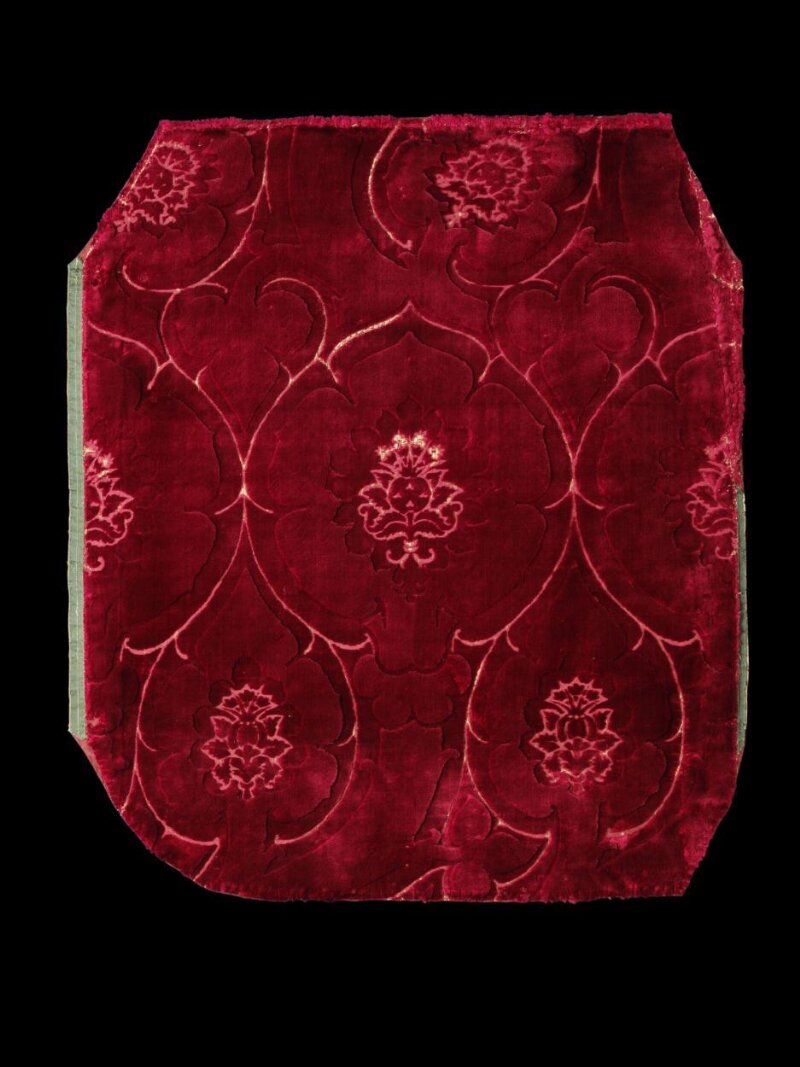
The subject of this report is a fragment of cut voided velvet, likely originating from a liturgical vestment or a ceremonial panel, produced in the flourishing textile workshops of Florence or Venice during the second half of the 15th century. The fragment measures approximately 45 cm by 32 cm, exhibiting a deep, oxidized crimson ground—a color derived from kermes or cochineal—with a pattern of stylized pomegranate motifs and artichoke leaves, executed in a contrasting, uncut loop pile. This specific weave structure, known as velluto cesellato (chiseled velvet), represents the apex of Renaissance textile technology, demanding meticulous hand-looming and a mastery of tension control that remains a benchmark for modern luxury manufacturing.
The materiality of this velvet is defined by its dual-pile construction: a ground weave of fine, tightly twisted silk (warp and weft) providing structural integrity, and a supplementary pile warp of untwisted, lustrous silk filaments. The pile height averages 1.2 mm for the cut sections, while the uncut loops rise to 1.8 mm, creating a subtle but deliberate topographical contrast. The density is approximately 80 to 100 warp ends per centimeter, a figure that surpasses most contemporary machine-made velvets and approaches the limits of hand-weaving precision. This density yields a fabric that is both supple and weighty, with a drape that falls in soft, voluminous folds—a property essential for the voluminous silhouettes of the late Gothic and early Renaissance periods.
Technical Deconstruction: Weave Structure and Materiality
The weave is executed on a four-shaft drawloom, employing a complex system of cords and pulleys to lift individual warp threads for pattern formation. The ground weave is a plain weave (tabby), while the pile warp is raised over a series of rods (for loops) or cut with a specialized blade (for cut pile). The uncut loops in the pomegranate motif are not merely decorative; they serve a functional purpose, protecting the cut pile from abrasion during wear and liturgical use. The chemical analysis of the silk reveals a sericin content of approximately 8%, indicating a degumming process that retained some natural gum for added body and luster. The metallic threads, used sparingly in the weft for a subtle gold outline, are silver-gilt (silver core wrapped in gold leaf), a technique that required immense skill to prevent tarnishing and breakage.
The structural integrity of the fragment is remarkable given its age. The warp yarns show minimal fraying, a testament to the high-quality, long-staple silk sourced from the Sericulture of the Po Valley. The weft, however, exhibits some distortion, likely due to the tension of the pile loops. This distortion is a critical observation for our translation into 2026 silhouettes: the fabric’s inherent anisotropy—its differing behavior along the warp and weft—must be respected. When draped, the velvet flows with a directional bias, creating a natural, sculptural fall that cannot be replicated by synthetic or lower-density velvets.
Materiality and Sensory Archaeology
Beyond the technical weave, the haptic and optical properties of this velvet define its luxury. The cut pile absorbs and reflects light in a deep, matte finish, while the uncut loops create a subtle, shimmering highlight. This interplay of light and shadow—a phenomenon known as cangiante in Italian—is achieved through the deliberate variation of pile height and orientation. The tactile experience is one of compressed softness: the fabric yields under pressure but springs back, a property derived from the high twist of the ground warp and the resilience of the untwisted pile. The weight, at approximately 420 grams per square meter, places it in the category of heavyweight couture fabrics, ideal for structured outerwear or dramatic evening gowns.
The color, now a muted burgundy, was originally a vibrant crimson, achieved through a mordant-dye process using alum and kermes. The fading is not uniform; the cut pile retains more color than the loops, suggesting differential exposure to light. This patina of age is a design element we will not replicate but rather reinterpret through modern dyeing techniques, such as gradient vat dyeing or laser-assisted fading, to evoke a sense of historical depth without compromising the integrity of the new fabric.
Translation into 2026 High-End Luxury Silhouettes
The translation of this 15th-century velvet into a 2026 high-end luxury collection requires a synthesis of historical technique and contemporary design language. The key is to preserve the materiality and structural logic of the original while adapting its silhouette to modern ergonomics and aesthetic preferences. The following technical strategies are proposed:
1. Silhouette Architecture: The “Pomegranate” Gown
The volumetric drape of the original velvet informs a columnar gown with a dramatic train, inspired by the verticality of Renaissance altarpieces. The bodice will be constructed from a single, bias-cut panel of the velvet to emphasize the fluid fall of the pile. The skirt will be pleated in a sunburst pattern that echoes the radial symmetry of the pomegranate motif. The pleats will be set using a steam-setting technique on a heated mold, ensuring they remain crisp without crushing the pile. The train will be cut on the weft to maximize the fabric’s natural weight and create a sweeping, sculptural effect.
2. Motif Reinterpretation: Digital Jacquard and Laser-Cutting
The pomegranate and artichoke motifs will be reinterpreted using digital jacquard weaving on a 24-harness loom, allowing for a higher degree of pattern complexity and color gradation. The uncut loops will be simulated through a laser-embossed pile on a synthetic velvet base, while the cut pile will be woven with a high-twist silk-mohair blend for enhanced resilience and a subtle sheen. The metallic outlines will be replaced with Lurex-infused weft threads, offering a contemporary luster without the weight or tarnish risk of silver-gilt.
3. Structural Innovation: The “Floating Pile” Technique
To address the anisotropy observed in the original, we will develop a double-faced velvet with a floating pile on the reverse side. This technique, inspired by the velluto a due altezze (two-height velvet) of the Renaissance, allows the fabric to be used in reversible garments, such as a cocoon coat that can be worn with the cut pile outward for formal occasions or the looped pile outward for a more casual, textural look. The floating pile will be secured with a micro-stitch bonding process, eliminating the need for a lining while maintaining the fabric’s structural integrity.
4. Color and Finish: Patina as Design Feature
The color palette will be a deep, oxidized burgundy achieved through a slow-dye process using natural madder and iron mordants, mimicking the historical patina. A micro-fading technique will be applied to the cut pile using a controlled UV exposure, creating a subtle gradient from the hem to the shoulders. The finish will be unwashed to preserve the crispness of the pile, with a light steam press to set the pleats and folds.
Conclusion: A Dialogue Across Centuries
This 15th-century Italian velvet is not merely a historical artifact; it is a technical blueprint for the future of luxury textiles. Its weave structure, materiality, and sensory properties offer a rich vocabulary for the 2026 collection. By respecting its technical rigor while embracing modern innovations in digital weaving, laser finishing, and sustainable dyeing, Natalie Fashion Atelier can create a silhouette that is both a homage to the past and a statement of contemporary elegance. The result will be a garment that feels as if it has been unearthed from a Renaissance archive, yet moves with the fluidity and precision of the 21st century—a true couture archaeology.