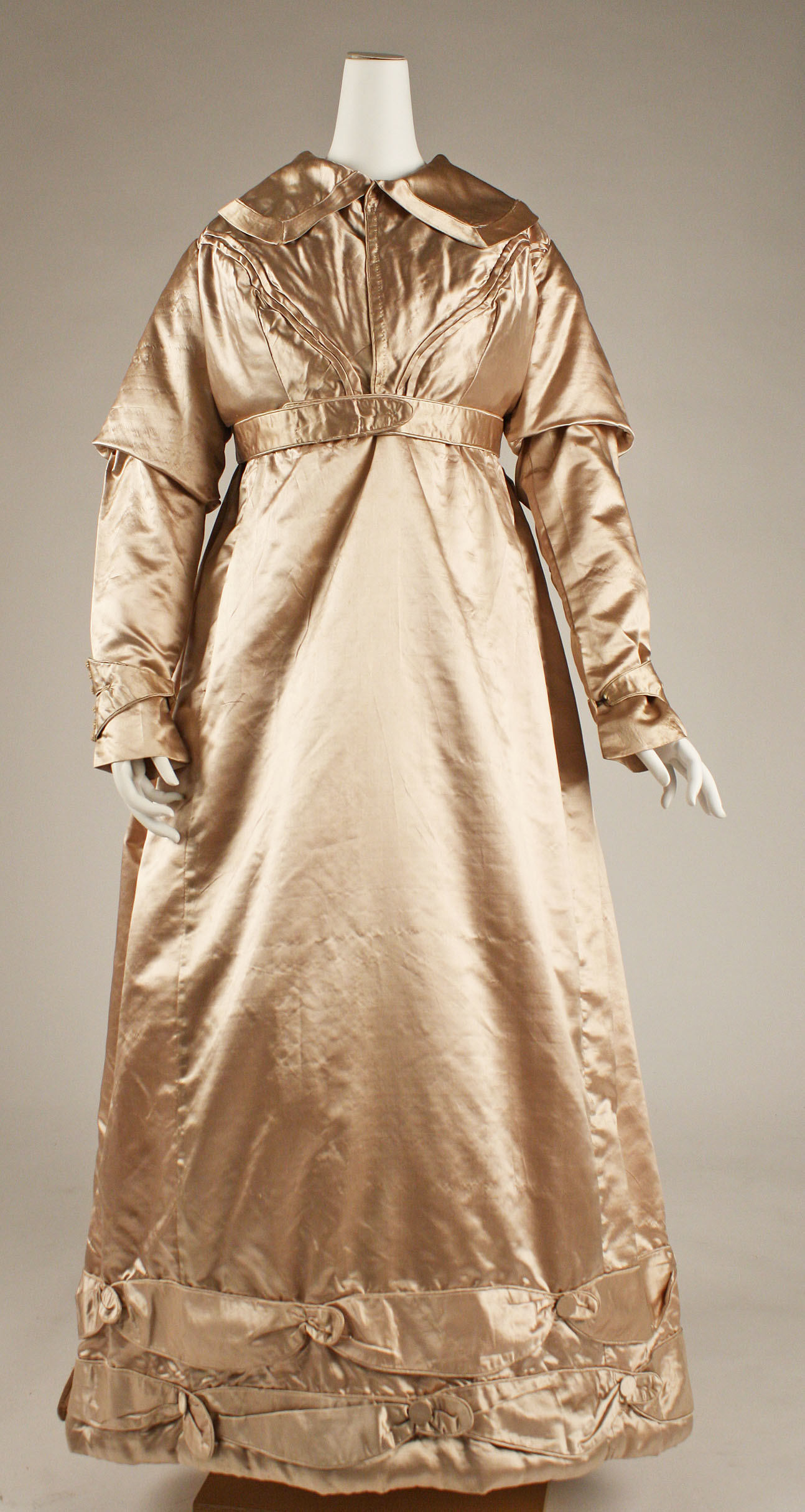
Archaeology of an Isolated Silhouette: The British Pelisse as a Hermeneutic Object
Within the rarefied archive of Natalie Fashion Atelier, certain artifacts demand not merely curation, but a form of aesthetic archaeology. The early 19th-century British pelisse—a long, fitted coat-dress of silk and linen, often isolated in portraiture against austere backgrounds—presents such a case. It exists not as part of a continuous sartorial lineage in Parisian collections, but as a discrete, hermetic masterpiece of applied geometry and temperate materiality. This technical analysis deconstructs its classical elegance not as historical pastiche, but as a generative system of principles. These principles—structural integrity through minimalism, the dialogue of textile densities, and the ethos of the "complete silhouette"—directly inform the conceptual framework for the Atelier's 2026 luxury collections, advocating for a new rigor in form and a profound respect for isolated, intentional beauty.
Structural Deconstruction: The Pelisse as a Study in Enclosed Architecture
The pelisse's elegance is fundamentally architectural. Unlike the flamboyant, externally supported silhouettes of the prior century, it achieves its form through precise cut and internal structure. Its defining characteristic is a long, unbroken line from a high neckline to the hem, creating a columnar effect that is both modest and supremely confident. This is achieved through:
The Princess Seam in Embryo: While not formally named until later, the pelisse often utilized long, vertical seams running from the shoulder or armhole to the hem, bypassing the waist seam. This technique allowed the garment to follow the natural curves of the torso without interruption, creating a sleek, tailored envelope. For 2026, this principle is abstracted into a philosophy of "seam-led shaping." We propose outerwear and column dresses where every seam is load-bearing and formative, eliminating superfluous darts or gathers. The silhouette becomes a map of its own construction, celebrating the precision of the cut rather than disguising it.
The Discipline of the High Closure: Fastened to the throat, the pelisse presents a complete, resolved form from the outset. There is no implied décolletage, no invitation; its luxury is in its self-containment. This informs the 2026 direction towards "total necklines"—high, architectural collars that integrate with the garment's structure, often in rigid yet lightweight linen canvases, creating a portrait-ready frame for the face and asserting a modern, authoritative elegance.
Material Dialectics: The Silk-Linen Matrix and Modern Textile Intelligence
The materiality of the British pelisse—typically a fine silk (taffeta, satin) over a linen lining or interlining—is a masterclass in functional contrast. This is not a mere lining but a critical component of the silhouette's behavior.
Linen as Structural Memory: Linen, with its inherent rigidity and moisture-wicking properties, provided a lightweight yet resilient under-structure. It prevented the silk from collapsing, maintained the integrity of the long vertical lines, and offered practical comfort—a quiet, intelligent luxury. For 2026, this evolves into "conscious substrate" technology. We are engineering bio-based, translucent linen meshes and gossamer-thin, shape-retaining technical linens that act as a second skin, providing memory and form to fluid silks and novel matte jerseys. The inner material is no longer hidden but often revealed through strategic laser-cutting or seam reversals, celebrating the dialogue between support and surface.
Silk as a Luminous Plane: The exterior silk, often in a muted or mineral hue, served as a continuous, luminous plane upon which light plays. Its slight rigidity allowed it to hold the shape granted by the linen, creating a crisp, clean shell. Our 2026 interpretation focuses on "planar textiles." We are developing matte, paper-like silk ottomans and crêpes with a subtle architectural hand, textiles that behave as coherent planes rather than pliable fabrics. They are cut with the grain as a paramount concern, ensuring the fall of light across the body is a calculated element of the design, much like the isolated subject in a British portrait.
From Isolated Archive to 2026 Silhouette: The Applied Hermeneutics
The pelisse’s "isolated" context in portraiture is key to its modern relevance. It stands alone, a complete sartorial statement requiring no accessory or context to validate its elegance. This isolation is a powerful lens for 2026, a year demanding clarity and intention.
The Monolithic Coat-Dress: The primary 2026 silhouette emerging from this study is the redefined coat-dress. It is a single, powerful garment that obviates the need for separates. Cut with the vertical integrity of the pelisse, it features a high, structured neckline, potential military-inspired frogging (abstracted into magnetic closure systems), and a hemline that speaks decisively—either strictly at the knee or flowing to the ankle. It is presented in our material matrix: a paper-silk shell over a technical linen substrate, creating a silhouette that is at once imposing and lightweight, historical and profoundly new.
Silhouette as Environment: Finally, the pelisse teaches that a garment can create its own environment. The 2026 consumer seeks a curated reality, a sense of composed self. Our designs, therefore, embrace "wearable isolation." Voluminous sleeves become personal architectural spaces; a dramatically turned-back cuff in contrasting linen interior focuses attention inward. The garment is not an adapter to the world but a carefully constructed micro-environment for the individual, a direct translation of the pelisse's portrait-ready, self-sufficient elegance.
In conclusion, the British pelisse, through the methodology of aesthetic archaeology, is revealed not as a relic but as a rigorous treatise on form, material intelligence, and self-possessed presentation. For Natalie Fashion Atelier's 2026 vision, it provides the foundational codes: architectural seaming, the dialectic of supportive and surface materials, and the power of the complete, isolated silhouette. This is how heritage informs the future—not through reproduction, but through the extraction and re-synthesis of first principles, resulting in a luxury language that is both intellectually resonant and devastatingly elegant.