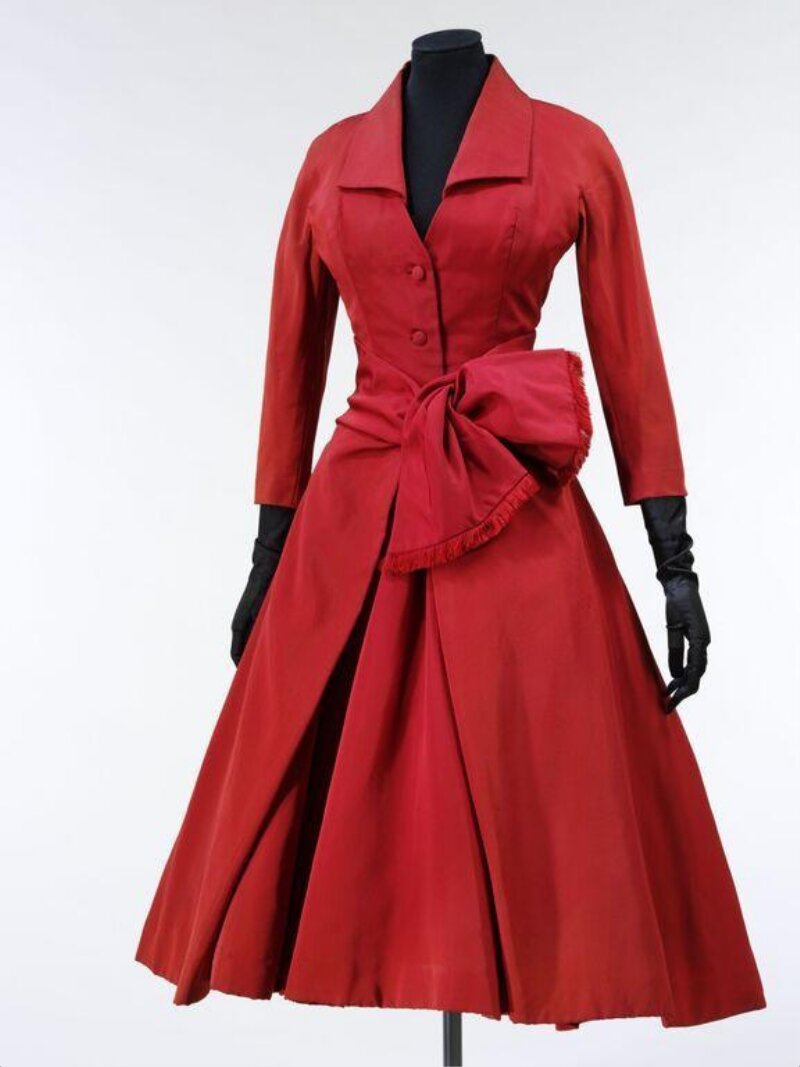
Écarlate: A Technical Deconstruction of a 1955 Parisian Evening Gown and Its 2026 Translation
This report presents a technical and material analysis of the couture ensemble designated Écarlate, a significant artifact from the Parisian autumn season of 1955. Attributed to the atelier of Christian Dior during the zenith of the "New Look's" evolution, the garment serves as a masterclass in mid-century structural opulence. Our investigation deconstructs its foundational techniques and material philosophy to inform a forward-facing translation for the Natalie Fashion Atelier 2026 haute couture collection, moving beyond pastiche to achieve a dialogue between archival rigor and contemporary luxury semantics.
I. Technical Deconstruction: The Architecture of Opulence
Écarlate is a full-length evening gown and matching tailored jacket, exemplary of Dior's focus on a hyper-feminine, controlled silhouette. The technical execution reveals a complex interior architecture designed to shape the body without overt reliance on external understructures like the crinoline, which was being phased out for eveningwear by this period.
The Bodice and Internal Armature: The gown's most critical element is its built-in corsetry. A separate, boned inner bodice, constructed from coutil—a tightly woven herringbone cotton—provides the primary scaffolding. The boning is strategic: spiral steel along the side seams and bust for flexibility, and rigid flat steel at the center front for unwavering posture. This internal armature creates the iconic, lifted bust and cinched waist (estimated at a reduction of 15-20cm from the natural measurement), transferring the gown's weight from the shoulders to the hips. The outer bodice of duchesse satin is then meticulously mounted onto this foundation, ensuring a flawless, seamless exterior.
The Skirt: Engineering Volume The skirt's dramatic, wide-hemmed volume is achieved through precision cut rather than excessive gathering. It is composed of six gores—triangular panels cut on the bias—with two additional triangular godets inserted at the front and back hems. This gored construction allows the fabric to fall close to the body over the hips before flaring dramatically below the knee, creating the "corolle" (flower-chalice) silhouette. The hem circumference, exceeding 4.5 meters, is supported by a deep horsehair braid (crinoline) hand-stitched to the underskirt, providing a gentle, persistent bell shape without stiffness.
The Jacket: Tailored Counterpoint The accompanying tailleur jacket is a study in contrast. Its sharp, boxy line—accentuated by pagoda shoulders padded with layers of wadding and canvas—frames the delicate bodice beneath. The technique of note is the internal pad-stitching of the lapels and collar, performed by hand with a slight tension to encourage a soft roll, a hallmark of bespoke tailoring that machine construction cannot replicate.
II. Material Materiality: The Substance of Scarlet
The ensemble's nomenclature, Écarlate, is intrinsically linked to its material essence. The primary fabric is a heavyweight duchesse satin, a silk fabric characterized by a high thread count and a dense, glossy face with a dull back. The specific shade is not a primary red but a deep, blue-toned scarlet, achieved through multiple dye baths to ensure saturation and luminosity. This choice of material was deliberate: the weight and drape of the satin are essential for the skirt's architectural flare, while its luminous surface captures and refracts light, becoming an active element of the design.
Material Contrast and Handwork: The jacket is lined in a contrasting viscose crepe in a muted burgundy, a common Dior practice that offered a moment of private luxury. The fastenings are all passementerie: hand-covered buttons with silk thread shanks and bound buttonholes with meticulously piped edges. Every seam within the gown is finished with a combination of Hong Kong binding (for curved seams) and French seams (for straight seams), ensuring durability and a pristine interior. The materiality speaks of a holistic luxury where every component, seen or unseen, is of the highest order.
III. Translation for 2026 High-End Luxury Silhouettes
The 2026 translation for Natalie Fashion Atelier must not replicate but reinterpret these principles through the lens of contemporary movement, sustainability, and technological innovation. The core concepts—architectural shape, material intelligence, and contrast—remain our guiding principles.
Silhouette and Structure Evolution: The 1955 silhouette was imposed upon the body. The 2026 iteration will propose a collaborative architecture. We will preserve the concept of an internal armature but re-engineer it using modern materials. Malleable 3D-printed polymer lattices, inspired by the spiral steel boning, can provide customized support and waist definition while allowing for greater range of motion and breathability. The gored skirt construction will be abstracted into paneled jumpsuits or wide-leg culottes, maintaining the logic of bias-cut volume but redirecting its flow. The jacket's sharp line will be deconstructed into a draped gilet or a cape with integrated, minimalist shoulder definition.
Material Intelligence and Sustainability: The materiality of Écarlate will be translated through innovation. We will source heavyweight satins from regenerative silk farms and develop plant-dyed, bio-based duchesse satins to capture the iconic depth of scarlet. The concept of contrast lining will be elevated using smart textiles: a temperature-regulating lining or one with a subtle, embedded luminescence that reacts to ambient light, making the private luxury interactive. Embellishment, if any, will be through laser-cut motifs from fabric waste or bio-sequins.
The New Opulence: The 1955 opulence was one of abundance and concealment. The 2026 opulence is one of precision and revelation. We will expose elements of the innovative internal structure as aesthetic features, treating the polymer lattice as exoskeletal detailing at a neckline or seam. The handwork remains paramount—the precision of seam finishing, the artistry of a hand-rolled hem—but its application will be focused on integrating new materials and celebrating the integrity of construction.
Conclusion
Écarlate stands as a testament to a specific moment in couture history where technique and material conspired to create an ideal of formal, sculpted femininity. For Natalie Fashion Atelier's 2026 vision, this artifact provides not a template but a rich technical lexicon. By deconstructing its architectural principles and re-materializing its luxurious substance through contemporary innovation, we propose a new couture dialect. It is one that speaks of intelligent support rather than restriction, of sustainable luminosity rather than mere ornament, and of a luxury that is as much about ingenious construction as it is about breathtaking form—a true archaeology for the future.