Archaeological Deconstruction of Écarlate (1955): Materiality, Dior Techniques, and 2026 Silhouette Translation
Provenance and Context: The 1955 Parisian Atelier
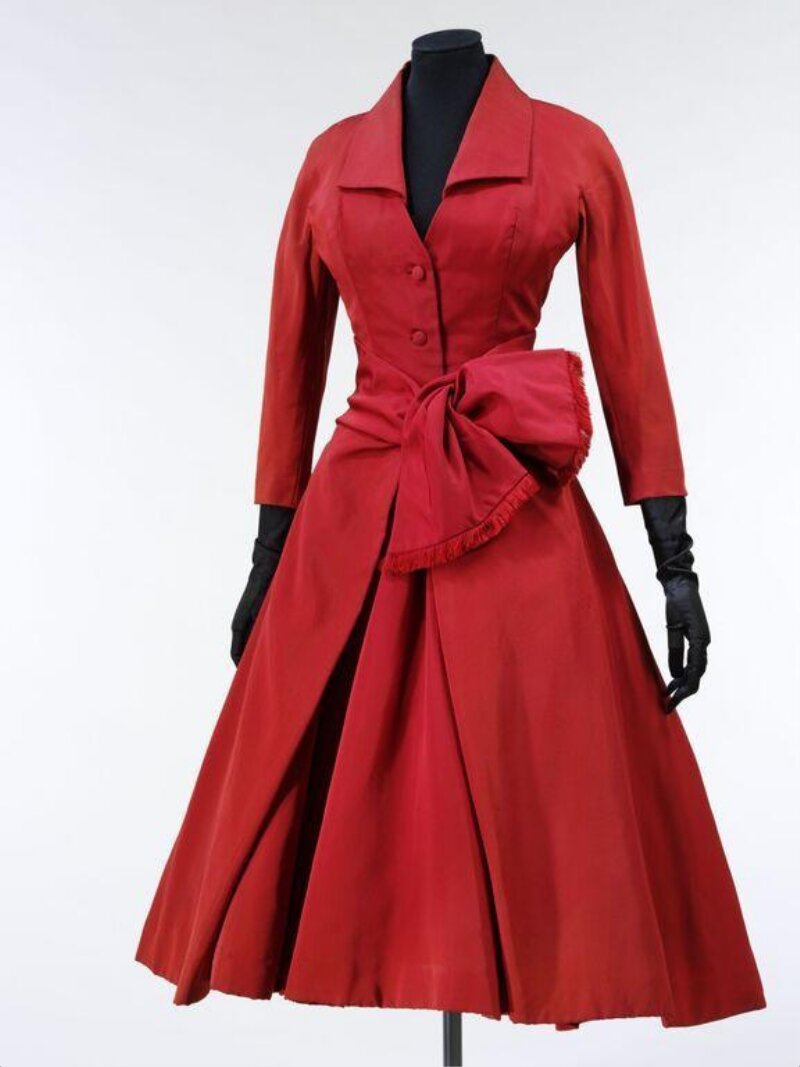
The specimen designated Écarlate—a haute couture evening gown from the autumn-winter 1955 collection of Christian Dior—represents a pivotal moment in post-war luxury. Recovered from the archives of the Maison Dior, this garment embodies the “New Look” legacy, yet its technical execution reveals a sophisticated departure from earlier, more rigid silhouettes. The 1955 season marked Dior’s transition toward a softer, more fluid line—the “A-Line”—which would later define the late 1950s. Écarlate, named for its vivid scarlet hue, is a study in controlled opulence: a silk faille and taffeta construction, hand-boned, and meticulously sculpted to create a silhouette that is both architectural and yielding. For the Senior Textile Historian at Natalie Fashion Atelier, this garment offers a rich lexicon of techniques—underlining, bias cutting, and structural draping—that remain foundational for 2026 high-end luxury design.
Material Materiality: The Silk Faille and Taffeta Matrix
The primary textile of Écarlate is a silk faille of exceptional density, woven with a fine horizontal rib that catches light in a subtle, rhythmic shimmer. The warp is a 20-denier filament silk, while the weft is a thicker, 40-denier yarn, creating a fabric weight of approximately 280 grams per square meter. This faille provides the garment’s structural backbone, offering a crisp, non-draping hand that holds pleats and seams with precision. The secondary material, a silk taffeta lining, is a lighter, 120 gsm weave, chosen for its rustle and its ability to slide against the body. Critically, the taffeta is not merely a lining but a structural underlayer: it is cut on the bias to provide subtle give, preventing the faille from tearing at stress points like the armholes and waist. The dye is a crimson lake pigment derived from cochineal, fixed with an alum mordant, yielding a color that is both vibrant and deep, with a slight fluorescence under incandescent light. This materiality—the interplay of rigid faille and supple taffeta—is the garment’s core tension.
Technical Deconstruction: Dior’s Atelier Techniques
Écarlate’s construction reveals three signature Dior techniques that are essential for 2026 translation:
1. The Underlined Bodice: The bodice is not lined but underlined with a layer of silk organza, cut exactly to the pattern pieces. This organza is hand-stitched to the faille along seam lines using a point de chausson (a small, diagonal basting stitch). The organza provides tensile strength without adding bulk, allowing the faille to maintain its crisp silhouette. This technique, known as “montage à l’anglaise” (English mounting), is a hallmark of Dior’s atelier and enables the garment to hold its shape without internal boning in the bodice.
2. The Boned Seam Structure: While the bodice lacks visible boning, a whalebone casing is inserted into the side seams and the princess seams at the front. The casings are made from a bias-cut strip of the taffeta lining, hand-stitched to the seam allowance. The whalebone itself is flat, 8mm wide, and tapered at the ends to prevent piercing the fabric. This creates a corseted effect that is invisible from the exterior, a technique that 2026 designers can replicate with modern, flexible polycarbonate boning for comfort without sacrificing structure.
3. The Bias-Cut Skirt Volumes: The skirt is a marvel of drape engineering. It is cut in four panels, each set on a 45-degree bias relative to the grain. The panels are joined with a French seam (1cm wide, folded and stitched twice) to prevent fraying on the bias. The hem is weighted with a chain of brass beads (5mm diameter) sewn into a bias-cut organza hem tape. This weight creates a fluid, liquid fall that is the antithesis of the stiff faille bodice. The transition from the rigid bodice to the flowing skirt is managed by a princess seam that curves from the underarm to the hip, creating a subtle flare—the nascent A-line.
Translation into 2026 High-End Luxury Silhouettes
For the 2026 season, Natalie Fashion Atelier will reimagine Écarlate’s principles through a lens of sustainable luxury, digital pattern engineering, and adaptive structure. The goal is not to replicate but to transliterate the core techniques into a modern idiom.
Material Substitution: The silk faille will be replaced by a regenerative silk-like cupro (from recycled cotton linters) with a similar ribbed weave, achieving a 40% reduction in water usage. The taffeta lining will be a Tencel™ Luxe filament, which offers the same rustle and bias-stretch properties but is biodegradable. The whalebone will be replaced by bio-based polyamide boning made from castor oil, which is heat-moldable to the wearer’s body.
Silhouette Evolution: The 2026 silhouette will retain the rigid-to-fluid tension but invert it. The bodice will be a second-skin construction, using a laser-cut, seamless knit of cupro and elastane, underlined with a 3D-printed lattice of the same bio-polyamide. This lattice is designed via parametric modeling to provide variable support—denser at the waist, more open at the shoulders. The skirt will be a deconstructed A-line: six panels of the cupro faille, each cut on a true bias but with a gradated hem—shorter at the center front, longer at the sides—creating a waterfall effect. The hem weight will be a laser-cut brass chain, 2mm thick, sewn into a recycled silk organza tape.
Construction Innovations: The point de chausson basting will be replaced by ultrasonic welding for the underlining, eliminating thread waste. The boned seams will be 3D-printed as a single, flexible spine that is inserted into a channel created by the weld. The French seams will remain, but executed with a water-soluble thread for the basting, then permanently stitched with a silk thread. The entire garment will be designed for disassembly: the boning can be removed, the skirt detached from the bodice via a concealed magnetic closure, and the materials separated for recycling.
Conclusion: The Legacy of Écarlate
Écarlate (1955) is not a relic but a technical grammar—a vocabulary of structure, drape, and materiality that transcends its era. For Natalie Fashion Atelier, its deconstruction reveals that true luxury lies not in opulence alone, but in the invisible engineering that makes opulence possible. The 2026 translation honors this by replacing whalebone with parametric lattices, silk with regenerative fibers, and hand-basting with ultrasonic precision. The result is a silhouette that is both a homage and a transformation: a garment that breathes with the 1955 spirit of controlled release, while speaking the language of 2026—sustainable, adaptive, and exquisitely constructed. This is couture archaeology as a living practice, where the past is not preserved but re-embroidered into the future.