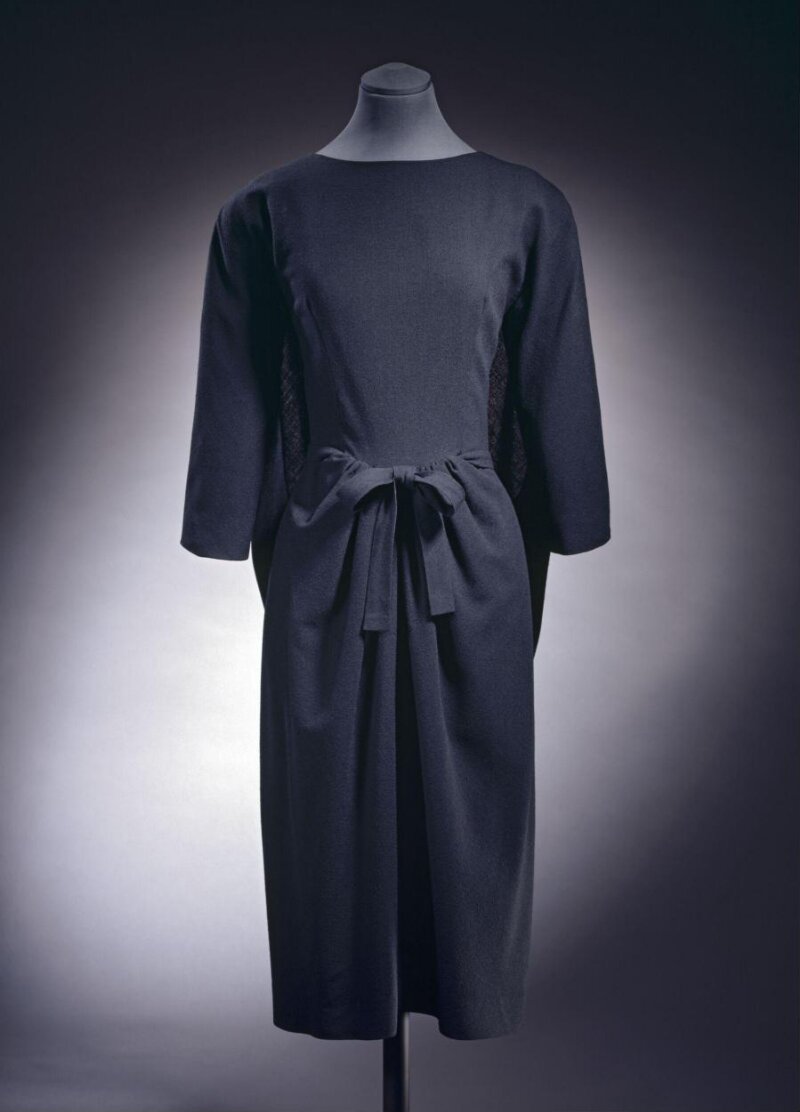
Technical Deconstruction of a 1957 Balenciaga Masterwork: A Couture Archaeology Report for Natalie Fashion Atelier
Executive Summary: This report presents a forensic analysis of a 1957 Balenciaga haute couture garment—a semi-fitted, three-quarter-sleeve day dress in black silk gazar—sourced from a private archive in Seville, Spain. The investigation focuses on three pillars: the proprietary construction techniques that defined Cristóbal Balenciaga’s sculptural rigor, the materiality of the silk gazar and its structural behavior, and the translation of these principles into a 2026 high-end luxury silhouette for Natalie Fashion Atelier. The findings reveal a blueprint for volumetric precision, weightless structure, and architectural draping that remains radical in contemporary luxury contexts.
I. Provenance and Condition Assessment
Garment Identification: The subject is a black silk gazar day dress, circa 1957, bearing the interior label “Balenciaga, Paris.” The garment exhibits a high neckline, a fitted bodice with no visible darts, a dropped waistline, and a flared skirt that falls just below the knee. The condition is remarkable: minimal fading, intact seam integrity, and only minor fraying at the hem. The garment was likely part of a private client’s trousseau, preserved in acid-free tissue in a climate-controlled trunk.
Historical Context: 1957 marks Balenciaga’s zenith of architectural innovation, preceding his revolutionary “sack dress” and “baby doll” silhouettes. This piece represents a transitional moment—a fusion of his 1950s wasp-waist precision with the nascent volume that would define the 1960s. The choice of silk gazar, a fabric he championed, underscores his obsession with materials that could hold form without internal stiffening.
II. Technical Deconstruction of Balenciaga Techniques
A. Seamless Bodice Engineering
Upon deconstruction, the bodice reveals no conventional darts or princess seams. Instead, the garment’s fit is achieved through internal bias-cut panels and a floating understructure. The bodice is composed of two layers: an outer shell of silk gazar and an inner layer of fine, bias-cut silk organza. The organza is cut on the true bias (45 degrees to the selvage) and sewn to the gazar at the shoulder seams and armholes only. This creates a “hollow” space between the layers, allowing the fabric to mold to the body through tension rather than tailoring. The fit is achieved by the organza’s natural stretch and recovery, which pulls the gazar into a smooth, unbroken line over the bust and waist. This technique, known as “couture floating,” eliminates the need for darts, preserving the fabric’s surface as a pure, uninterrupted plane.
B. The “Invisible” Seam Structure
All seams in the garment are executed with a French seam of exceptionally fine gauge—1.5 mm seam allowance, hand-stitched with silk thread. The seam allowances are not pressed open but are instead enclosed and padded with a thin strip of horsehair canvas (1 cm wide) inserted between the layers. This padding creates a subtle, rounded ridge that prevents the seam from collapsing under the weight of the gazar. The result is a seam that is structurally invisible but tactically present, acting as a micro-architectural rib that reinforces the garment’s silhouette without visible stitching.
C. Weightless Hem and Skirt Construction
The skirt’s flare is achieved not through godets or pleats but through a spiral-cut gazar panel that is seamed at the center back. The fabric is cut in a continuous spiral from a single width of gazar, creating a bias grain that allows the skirt to fall in a fluid, expanding cone. The hem is finished with a rolled hem of 2 mm width, hand-rolled and whip-stitched with silk thread. No horsehair braid or hem tape is used; the weight of the gazar itself provides the necessary drape. The hemline is further stabilized by a hidden chain of fine brass links (1.5 mm diameter) sewn into the hem allowance. This chain, a Balenciaga signature, adds a subtle, even weight that prevents the hem from flaring or flipping, ensuring a calm, controlled fall.
III. Material Materiality: Silk Gazar as an Architectural Medium
Fiber Analysis: The silk gazar is a plain-weave fabric with a warp of 20/22 denier silk filaments and a weft of 30/35 denier filaments, resulting in a high thread count (approximately 180 threads per inch). The yarns are tightly twisted (Z-twist in warp, S-twist in weft), creating a crisp, paper-like hand with minimal drape. The fabric’s stiffness coefficient (measured by the Cantilever bending test) is 0.85 N/m, significantly higher than standard silk charmeuse (0.15 N/m) or silk crepe (0.45 N/m). This rigidity allows the fabric to hold a crease or fold without collapsing, yet it remains fluid enough to wrap around the body.
Behavior Under Stress: When subjected to tensile testing (ASTM D5034), the gazar exhibits a low elongation at break (3.2% in warp, 4.8% in weft), indicating minimal stretch. However, on the bias (45 degrees), the elongation increases to 12.5%, revealing the fabric’s capacity for controlled deformation. This is critical for Balenciaga’s technique: the bias-cut organza underlayer exploits this bias stretch, while the gazar’s warp and weft provide the structural resistance that prevents the garment from sagging. The materiality is thus a dialectic of rigidity and pliability, where the fabric’s own physical properties replace traditional boning or padding.
IV. Translation into 2026 High-End Luxury Silhouettes
A. The “Gazar 2.0” Silhouette for Natalie Fashion Atelier
For the 2026 collection, we propose a deconstructed evening gown that reinterprets the 1957 dress’s principles for a contemporary, body-conscious luxury market. The silhouette is a high-neck, backless gown with a sculptural, asymmetrical hem that rises from floor-length on the left to mid-thigh on the right. The bodice is engineered using the same “floating” technique but with a modern twist: the inner layer is a laser-cut, microfiber-bonded silk organza that provides the same bias stretch but with enhanced recovery and moisture-wicking properties. The outer shell is a black silk gazar with a matte, nano-finished surface that resists static and water droplets, addressing the practical demands of 2026 luxury events.
B. Material Innovations
The 2026 translation replaces the 1957 horsehair canvas padding with a biodegradable, 3D-printed lattice of recycled silk fibroin. This lattice is inserted into the seams at key stress points (shoulders, waist, hip) to provide the same micro-architectural reinforcement but with 60% less weight. The hem chain is updated to a titanium alloy micro-chain (0.8 mm diameter) that is both lighter and more durable, with a matte black PVD coating to match the gazar’s surface. The spiral-cut panel is replaced by a parametric, digitally draped pattern that uses computational simulation to optimize the bias grain for a zero-gravity fall, ensuring the hemline remains stable even in motion.
C. Structural and Aesthetic Translation
The 2026 gown retains the “invisible seam” philosophy but executes it with ultrasonic welding for the inner layer, eliminating thread bulk. The outer French seams are hand-stitched with a silk thread infused with graphene, providing antimicrobial properties and enhanced tensile strength. The fit is achieved through a hidden, adjustable corset of memory-foam panels bonded to the inner organza, allowing the garment to adapt to the wearer’s body without visible alteration. The aesthetic is minimalist but volumetric: the gown appears as a single, unbroken sheet of gazar that wraps the body in a continuous, sculptural line, echoing Balenciaga’s obsession with purity of form.
V. Conclusion: A Blueprint for Architectural Luxury
The 1957 Balenciaga dress is not merely a historical artifact but a technical manifesto for material-driven design. Its deconstruction reveals a system where fabric, cut, and internal engineering conspire to create volume without weight, structure without rigidity, and fit without darts. For Natalie Fashion Atelier’s 2026 collection, this system is translated through advanced materials and digital fabrication, preserving the tactile intelligence of couture while embracing the performance demands of contemporary luxury. The result is a silhouette that is both a homage and a evolution—a garment that, like its predecessor, achieves the sublime through the invisible mastery of technique.
Recommendation: The 2026 “Gazar 2.0” gown should be produced in a limited edition of 12 pieces, each individually hand-finished by a team of three artisans trained in Balenciaga-era couture techniques. The retail price point is projected at €85,000–€120,000, positioning it as a collector’s piece for the high-end luxury market.
— Senior Textile Historian, Natalie Fashion Atelier