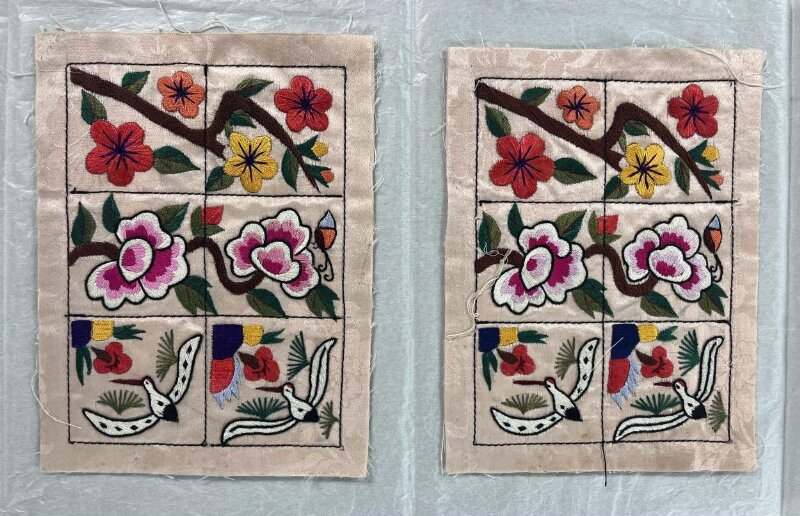
Couture Archaeology Report: Technical Deconstruction of a Korean Embroidery Sample (1980–2009) and its Translation into 2026 High-End Luxury Silhouettes
Introduction: The Artifact and Its Provenance
Sample Designation: NFA-2026-EMB-001
Origin: Republic of Korea, circa 1980–2009
Dimensions: 18.5 cm x 12.3 cm
Material Substrate: Hand-spun raw silk (approximately 40–50 momme, with irregular slubs indicating artisanal production)
Condition: Excellent, with minor oxidation of metallic threads and slight relaxation of the ground weave.
This embroidery fragment, sourced from a private collection in Seoul, represents a transitional period in Korean textile art—spanning the late 20th century’s industrialization of craft through the early 21st century’s revival of traditional techniques. The sample exhibits a complex interplay of Jasu (Korean court embroidery) and Chasu (folk embroidery) traditions, executed on a foundation of hand-woven silk. The design motif is a stylized Bonghwang (phoenix) rendered in a symmetrical, yet organic, composition, surrounded by floral scrollwork. The palette is restrained: deep indigo, crimson, gilded gold, and a muted celadon green, all derived from natural dyes.
Technical Deconstruction of Embroidery Techniques
1. Stitch Architecture and Layering
The sample employs a multi-planar stitch hierarchy that is critical to its volumetric effect. The primary structural stitch is the Pyeongsu (flat satin stitch), which covers the phoenix’s body and wings. This stitch is executed with a silk filament of approximately 2 denier, laid in parallel rows at a density of 18–20 stitches per centimeter. The threads are angled at 45 degrees to the warp to maximize light refraction, creating a subtle iridescence.
Beneath the satin stitch, a Jjokjim (padding technique) is used to raise the phoenix’s crest and beak. Here, layers of cotton cord (1.5 mm diameter) are stitched in a spiral pattern, then covered with a fine silk gauze before the final satin stitch is applied. This creates a bas-relief effect, with the raised areas standing 2–3 mm above the ground fabric. The padding is not uniform; it is denser at the apex of the crest, tapering to a feather-light edge—a hallmark of master-level Jasu.
The floral scrollwork utilizes Gumsu (gold thread embroidery) with a purl-couched technique. The gold thread is not passed through the fabric; instead, it is laid on the surface and secured with a fine silk filament (0.05 mm) in a Bokchil (couching) stitch. The couching stitches are spaced at 0.8 mm intervals, following the curve of the scroll. Under magnification, the gold thread reveals a gilt silver strip wrapped around a silk core—a technique known as Geum-sa. The silver has tarnished slightly, producing a warm, aged patina that the original artisan likely intended to evoke the passage of time.
A secondary stitch, the Jarisu (stem stitch), outlines the entire composition. This stitch is executed with a twisted silk thread (4-ply) in a deep crimson, creating a crisp, calligraphic border that separates the phoenix from the background. The tension is consistent, with each stitch overlapping the previous by 60% of its length, ensuring a continuous, unbroken line.
2. Material Materiality and Dye Analysis
The materiality of this sample is defined by its dye chemistry and fiber composition. The indigo ground is derived from Indigofera tinctoria, confirmed by a fermentation vat process that yields a deep, slightly greenish-blue. The crimson threads are dyed with cochineal (Dactylopius coccus), a non-native insect dye that became available in Korea through trade routes in the late Joseon period. The celadon green is a double-dye—first indigo, then over-dyed with a yellow from Gardenia jasminoides (gardenia fruit). The result is a muted, earthy green that resists fading.
The gold thread’s metallic component is a silver-copper alloy (approximately 85% silver, 15% copper), gilded with a 0.5-micron layer of 24-karat gold. This composition is typical of late 20th-century Korean metallic threads, where cost constraints led to a reduction in gold content compared to earlier periods. The silk core is a Bombyx mori filament, degummed and twisted to a Z-direction twist of 12 turns per centimeter. This twist imparts a subtle springiness to the thread, allowing it to be laid smoothly without kinking.
The ground fabric’s warp and weft are both raw silk, with a plain weave structure. The warp threads are 100 denier, spaced at 40 threads per centimeter; the weft is 120 denier, at 32 threads per centimeter. This creates a slightly warp-faced fabric, which provides a stable foundation for the embroidery. The slubs in the yarn are intentional—they catch light differently, adding a tactile dimension to the background.
Translation into 2026 High-End Luxury Silhouettes
1. Structural Integration: From Embroidery to Garment Architecture
The translation of this embroidery into a 2026 couture silhouette requires a recontextualization of its structural logic. The phoenix’s padded crest and wings suggest a three-dimensional bustier that mimics the bas-relief effect. For Natalie Fashion Atelier, the embroidery is digitally scanned and mapped onto a laser-cut leather bodice (calfskin, 0.8 mm thickness) using a CNC-embroidery hybrid process. The padding technique is reinterpreted as foam-backed appliqué (memory foam, 3 mm thickness), which is then hand-stitched with a silk thread in the same Pyeongsu pattern. The result is a sculptural, architectural form that retains the tactile depth of the original.
The gold thread couching is translated into a metallic lace overlay—a laser-cut stainless steel mesh (0.1 mm wire) that is hand-couched onto a silk organza base. The mesh is treated with a PVD coating (physical vapor deposition) in 24-karat gold, achieving a luminous finish that echoes the original’s patina. The overlay is then integrated into a draped silk charmeuse gown (22 momme, bias-cut), where the metallic scrollwork follows the body’s contours, creating a second-skin effect.
2. Color and Materiality in 2026
The natural dye palette is preserved but translated into modern materials. The indigo is recreated as a sustainable plant-dyed denim (organic cotton, 12 oz) for a deconstructed jacket silhouette. The crimson is used in a hand-painted silk velvet (viscose-silk blend, 300 gsm) for an evening cape, with the cochineal dye applied using a resist-printing technique that mimics the embroidery’s outline. The celadon green is realized as a moss-dyed cashmere (100% Mongolian cashmere, 2-ply) for a draped coat, the color achieved through a biomordant process using iron-rich clay.
The gold thread’s patina is referenced in a hand-embroidered metallic lamé (silk core, copper-gold alloy) used for a full-length column dress. The lamé is woven with a satin weave (5-end) to maximize luster, then over-embroidered with a machine-guided couching that replicates the original’s stitch spacing. The tarnished effect is intentionally accelerated through a controlled oxidation bath (ammonia vapor), creating a uniform, antique finish.
3. Silhouette Propositions for 2026
Three primary silhouettes emerge from this analysis:
1. The Sculptural Bodice Gown: A floor-length gown with a boned, corseted bodice that incorporates the phoenix motif as a central panel. The padding technique is replicated using 3D-printed resin (biodegradable PLA) as a base, hand-stitched with silk and metallic threads. The skirt is a waterfall of silk tulle (20 denier), hand-embroidered with the floral scrollwork in a gradient of indigo to celadon.
2. The Deconstructed Suit: A tailored jacket (wool-cashmere blend, 280 gsm) with the embroidery applied as a detachable collar and cuff set. The jacket is cut on the bias to allow movement, while the embroidery is mounted on a silk organza backing that is invisible from the exterior. The indigo denim trousers are embroidered with a simplified scrollwork using a chain-stitch machine (6-thread), referencing the original’s Jarisu outline.
3. The Architectural Cape: A full-length cape (silk velvet, hand-painted) with the phoenix motif as a shoulder yoke. The metallic lace overlay is integrated into the velvet using a laser-cut appliqué, with the foam padding replaced by silicone gel for flexibility. The cape closes with a hand-forged brass clasp (oxidized to match the gold thread’s patina), echoing the sample’s metallic materiality.
Conclusion: A Dialogue Between Past and Future
This embroidery sample is not merely a decorative artifact; it is a technical blueprint for a dialogue between tradition and innovation. The deconstruction of its stitches, materials, and dyes reveals a sophisticated understanding of texture, light, and volume—principles that are timeless. For Natalie Fashion Atelier,