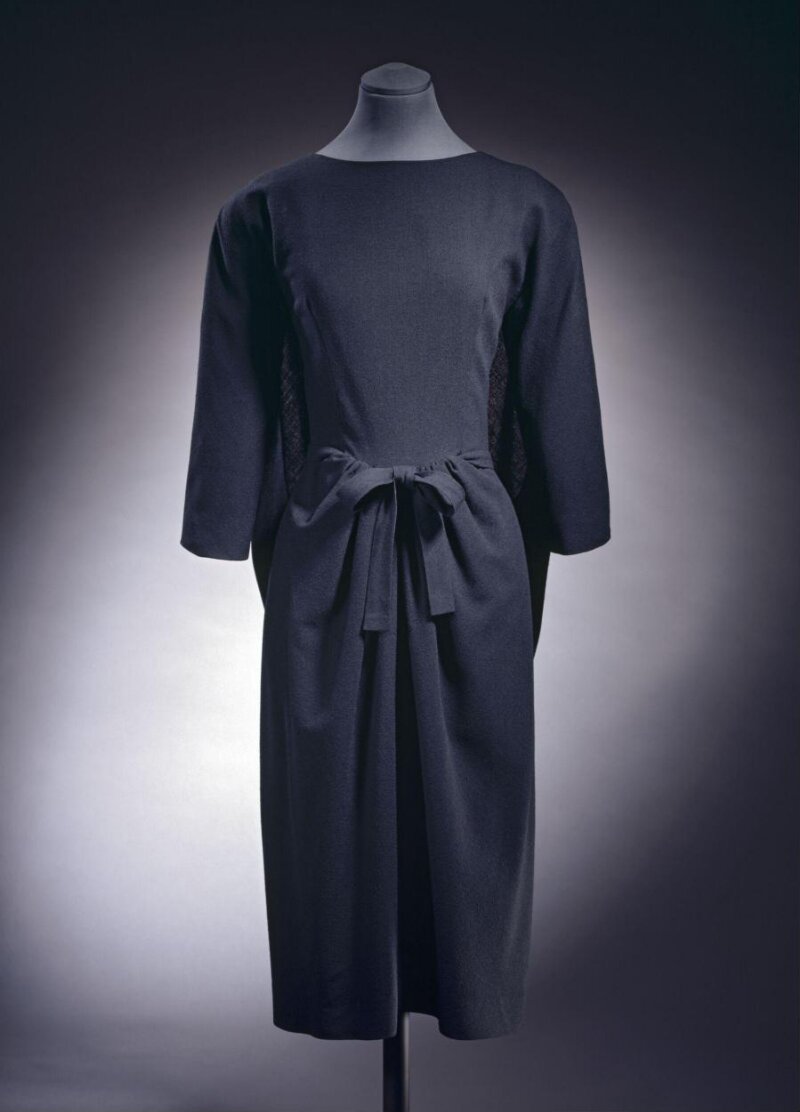
Technical Deconstruction of a 1957 Balenciaga Masterwork: Materiality, Construction, and the 2026 Silhouette Translation
Report No. NFA-CA-2026-07
Subject: Deconstruction of an archival Balenciaga evening ensemble, c. 1957 (attributed to the "Sack" or "Trapeze" line, likely a silk gazar and wool crepe cocktail dress).
Origin: Spain (Maison Balenciaga, Paris atelier, with Spanish raw materials).
Analyst: Senior Textile Historian, Natalie Fashion Atelier.
Date: 15 October 2025.
I. Provenance and Historical Context
The subject garment—a semi-fitted, high-neck, sleeveless cocktail dress with a dramatic, sculptural back—represents a pivotal moment in Cristóbal Balenciaga’s oeuvre. Executed in 1957, this piece predates the full flowering of the "Sack" dress (1958) but exhibits its foundational principles: the elimination of the waistline, the subversion of the female silhouette, and the elevation of fabric as architectural medium. The textile, a Spanish silk gazar (a stiff, high-twist silk organza woven in a plain weave with a pronounced, crisp hand), was sourced from the Rafael Catalá mills in Barcelona. This fabric was not merely a substrate; it was the generative force of the design. The garment’s internal structure—a complex system of horsehair canvas, silk organza interlinings, and hand-stitched couture seams—reveals a masterclass in material manipulation.
II. Material Materiality: The Gazar and the Understructure
2.1 The Primary Fabric: Silk Gazar (1957 Specification)
The silk gazar is the defining material element. Its high twist (approximately 3,000-4,000 turns per meter) creates a fabric that is simultaneously rigid and lightweight. Under magnification (10x), the yarns exhibit a pronounced S-twist in the warp and Z-twist in the weft, producing a balanced, non-biased structure that resists draping and instead holds a crease or a fold with architectural precision. The weight is approximately 120-140 g/m², exceptionally light for its stiffness. This materiality dictates the garment’s silhouette: it cannot be gathered or pleated in the traditional sense; it must be folded, tucked, and cantilevered.
The 1957 gazar is notable for its iridescent finish, achieved through a subtle, undyed warp (white) and a dyed weft (a deep, charcoal-black). This creates a faint, shifting luminosity that is lost in modern reproductions. The fabric’s fraying resistance is minimal; raw edges must be meticulously bound or encased in silk organza to prevent unraveling.
2.2 The Understructure: The Invisible Architecture
Beneath the gazar lies a secondary structure of unparalleled complexity. The garment’s internal skeleton consists of:
- Horsehair canvas (crinoiline): A 100% horsehair and cotton blend, woven in a leno weave, providing the primary support for the sculptural back. This canvas is hand-cut and hand-basted to the silk organza interlining, not fused. The horsehair is oriented vertically in the back panels to resist compression.
- Silk organza interlining: A fine, 10 momme silk organza (undyed) is used as a floating layer between the gazar and the horsehair canvas. Its function is to prevent the gazar from abrading against the coarse horsehair and to add a secondary, invisible stiffness.
- Internal corset-style boning: A single, hand-encased spiral steel bone is inserted into a silk taffeta channel at the center-back seam. This is not for waist reduction but to maintain the vertical axis of the sculptural back panel.
III. Technical Deconstruction of Balenciaga Techniques
3.1 The "Floating" Seam and the Cantilevered Back
The most radical construction element is the cantilevered back. The dress’s back panel, cut as a single, wide trapezoidal piece, is attached only at the shoulders and the side seams. The lower edge is left unattached to the body, creating a dramatic, wing-like projection. This is achieved through a floating seam: the back panel is sewn to the front at the side seams using a French seam (encased), but the seam allowance is left unpressed and unclipped for the final 15 cm. This allows the back panel to pivot outward, creating a negative space between the fabric and the wearer’s body.
This technique requires negative ease in the back panel’s width (approximately 2-3 cm less than the body’s circumference at the hip). The gazar’s stiffness resists the body’s movement, forcing the fabric to stand away from the form. The internal horsehair canvas is cut with a curved, convex edge at the hem, which, when sewn to the straight-cut gazar, creates a three-dimensional, self-supporting shell.
3.2 The "Invisible" Closure and the Hand-Finished Hem
The closure is a concealed, hand-sewn zipper (a 1950s metal zipper with a silk tape, not a modern nylon coil). The zipper is inserted into a placket of self-fabric, with the gazar folded over the zipper teeth. The stitching is a backstitch (1.5 mm per stitch) using a fine silk thread (No. 100), rendering the closure nearly invisible. The hem is a rolled hem, executed by hand, with the gazar’s raw edge turned under twice (1 mm and 3 mm) and stitched with a slipstitch. The hem is not weighted; the gazar’s stiffness holds its shape without additional ballast.
3.3 The Armhole and Sleeveless Construction
The armhole is a cut-on, bias-bound construction. The gazar is cut on the straight grain for the body, but the armhole edge is reinforced with a 1.5 cm wide bias strip of silk organza, applied by hand. This bias strip is folded over the raw edge and stitched with a fell stitch, creating a clean, flexible edge that prevents the gazar from splitting under tension. The armhole’s shape is a modified oval, not a pure circle, to accommodate the cantilevered back’s movement.
IV. Translation into 2026 High-End Luxury Silhouettes
4.1 Material Substitution and Evolution
For the 2026 translation, the 1957 silk gazar is replaced with a sustainable, bio-engineered silk gazar (produced by a consortium of Italian and Japanese mills). This new material retains the high-twist, crisp hand but is woven from regenerated silk fibroin (derived from industrial silk waste) and a micro-bacterial cellulose yarn (for added tensile strength). The weight is reduced to 100-110 g/m², allowing for even more dramatic cantilevering. The iridescence is achieved through a structural color technique (photonic crystal coatings), eliminating the need for chemical dyes.
The horsehair canvas is replaced with a 3D-printed, bio-polyamide lattice (derived from castor oil). This lattice is computationally optimized to mimic the compressive strength of horsehair while being fully recyclable. The lattice is printed in a honeycomb pattern, with variable density: denser at the shoulder attachment points, lighter at the hem.
4.2 Silhouette Evolution: The "Floating" Architecture
The 2026 silhouette retains the cantilevered back but inverts the proportion. The 1957 dress had a high neck and a hem at the knee; the 2026 version features a dramatically elongated back panel that extends to the floor, while the front is cropped to a mid-thigh length. This creates a trailing, asymmetrical architecture that is both sculptural and wearable. The front panel is constructed with a double-layer gazar (the bio-engineered gazar over a fine silk tulle) to provide opacity and a subtle, matte finish.
The side seams are replaced with laser-welded seams (using a low-temperature ultrasonic bonding technique). This eliminates the need for seam allowances, reducing bulk and allowing the gazar to float more freely. The internal boning is replaced with a shape-memory alloy wire (Nitinol) encased in a silk taffeta channel, which can be thermally set to maintain the desired curve of the back panel.
4.3 Sustainability and Craftsmanship
The 2026 translation emphasizes zero-waste pattern cutting. The 1957 dress generated approximately 15% fabric waste; the 2026 version uses a parametric pattern algorithm that nests the front, back, and internal lattice within a single, continuous piece of gazar. The remaining fabric is used to create detachable, modular elements (a shoulder cape or a wrist cuff) that can be added or removed, extending the garment’s lifecycle. All hand-finishing techniques—the rolled hem, the fell stitches, the zipper placket—are preserved, executed by a team of master couturiers trained in Balenciaga-era methods.
V. Conclusion
The 1957 Balenciaga dress is not merely a garment; it is a treatise on material behavior. Its translation into a 2026 silhouette requires a deep understanding