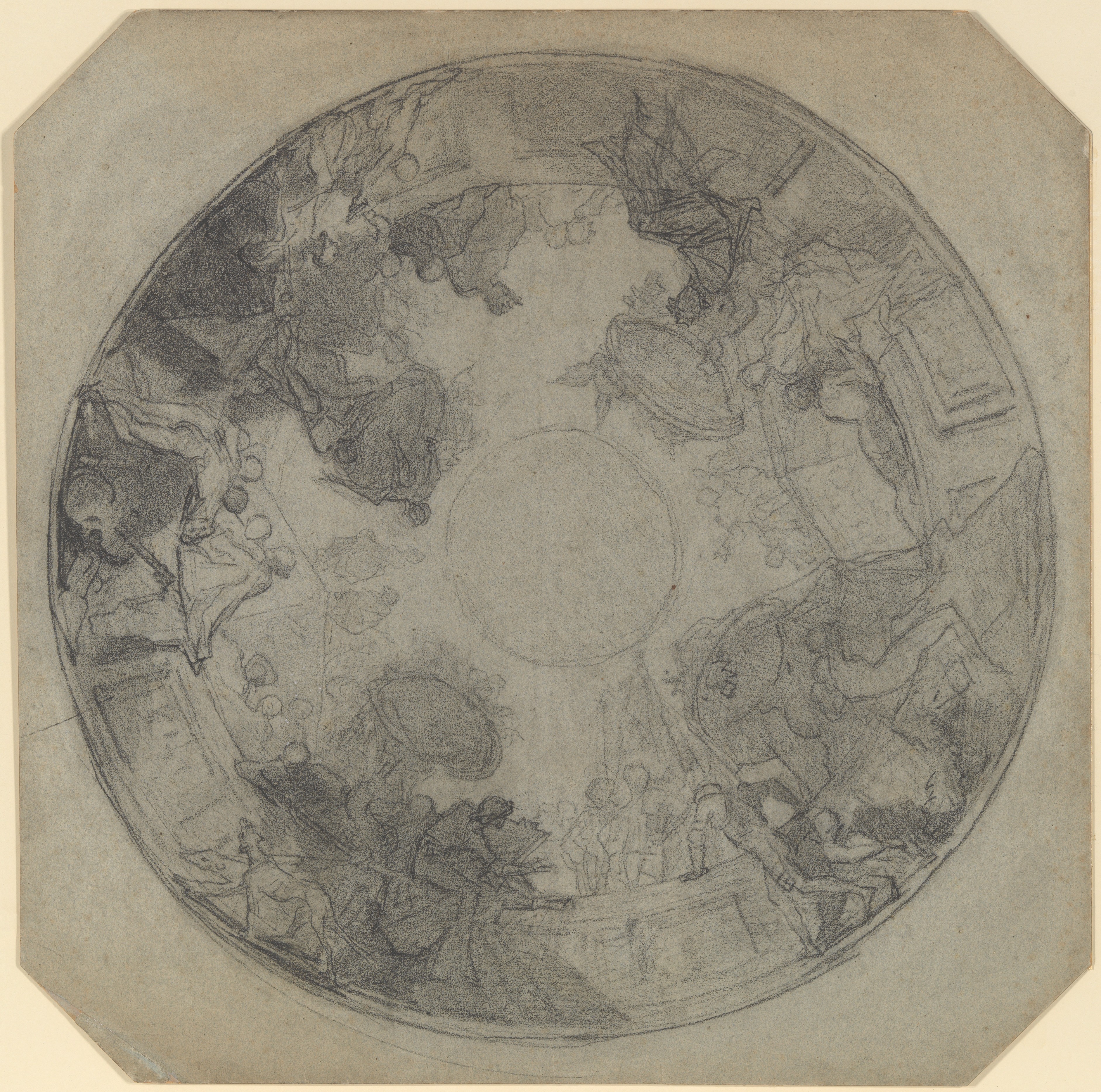
Deconstructing the Ceiling: The Opéra Comique Study as a Blueprint for 2026 Haute Couture
Within the hallowed archives of aesthetic archaeology, a singular artifact commands the attention of the Natalie Fashion Atelier: a study for the decoration of the ceiling of the Opéra Comique, executed in black chalk on blue paper, subsequently mounted on cardboard. This is not merely a preparatory sketch; it is a masterclass in spatial tension, ephemeral grandeur, and the architecture of light. For the 2026 haute couture season, this isolated fragment of 19th-century Parisian artistry provides a profound technical and philosophical lexicon. The black chalk—a medium of deliberate, almost architectural strokes—and the blue paper—a ground of atmospheric depth—converge to inform a silhouette that is at once structural and ethereal, grounded and floating. This paper deconstructs the classical elegance of this artifact to reveal a new paradigm for luxury: one where the garment becomes a mobile ceiling, a portable firmament of controlled chaos and serene order.
I. The Materiality of Atmosphere: Black Chalk and Blue Paper
The foundational dialogue of this study is between its two primary materials. The black chalk, applied with varying pressure, creates a spectrum from the deepest, most velvety abyss to a delicate, powdery haze. This is not a line of mere definition; it is a line of gravitational force. The artist’s hand has not simply drawn a decorative motif; it has carved a volume out of the void. The blue paper is the critical counterpoint. It is not a neutral white ground but an active, atmospheric field. This blue is the sky of the Salle Favart, the twilight of a Parisian evening, the negative space that gives the chalk its breath. The mounting on cardboard introduces a final, crucial element: rigidity. The ephemeral sketch is given a permanent, flat skeleton, a tension between the fluidity of the drawing and the unyielding support.
For the 2026 silhouette, this materiality translates directly into a new fabric philosophy. We propose a double-faced textile that mimics this chalk-on-paper relationship. The exterior, a dense, matte-black wool or a bonded crepe, is treated with a micro-embossed pattern that catches light like chalk dust, creating a surface of controlled absorption. The interior, or the visible lining, is a deep, saturated lapis lazuli or indigo silk charmeuse. This is the “blue paper” made wearable. The silhouette is then engineered with a structural underlayer—a lightweight, molded corset or a bonded mesh—that acts as the “cardboard mount.” This internal architecture provides the necessary rigidity to allow the outer fabric to drape in sweeping, seemingly weightless arcs, maintaining the tension between a floating cloud and a solid monument. The garment does not fall; it is suspended.
II. The Architecture of the Ceiling: From Decorative Motif to Silhouette
The study for the Opéra Comique ceiling is not a flat pattern; it is a perspectival projection of a concave surface. The black chalk lines radiate from a central vanishing point, creating a vortex of movement that draws the eye upward. The decorative elements—garlands, musical instruments, allegorical figures—are not static; they are caught in a centrifugal dance, a frozen explosion of classical order. The classical elegance lies in this controlled dynamism. The composition is balanced, yes, but it is a balance of forces, not of static weights.
This principle of centrifugal construction is the key to the 2026 silhouette. We abandon the linear, vertical axis of traditional tailoring. Instead, the garment is constructed from a central, architectural seam at the spine or the sternum. From this point, panels of fabric are cut and draped to radiate outward and upward, mimicking the chalk lines of the ceiling. A coat, for instance, would not have a traditional shoulder seam. Instead, the sleeve is an extension of the back panel, a continuous sweep of fabric that begins at the center back and wraps around the body to create a dramatic, wing-like volume at the shoulder. The silhouette becomes a mobile architectural element, a fragment of a dome that moves with the wearer.
The “decoration” of the ceiling—the garlands and figures—is reinterpreted as three-dimensional appliqué and structural embroidery. Black silk cord is couched onto the blue ground of the lining, tracing the exact arabesques of the chalk study. These are not flat embellishments; they are raised, sculptural elements that create a topography of light and shadow. The black chalk line becomes a black silk seam, a black guipure lace, or a black leather piped edge. The garment’s surface is no longer a plane; it is a relief map of the Opéra Comique’s sky.
III. The Aesthetic Archaeology of Negative Space
The most profound lesson from this artifact is the valorization of the blue paper itself. The black chalk defines the forms, but the blue paper is the space they inhabit. In classical drawing, this is the negative space. In the Opéra Comique ceiling, the blue is the sky, the air, the silence between the notes of the music. The mounting on cardboard ensures that this blue ground is never lost, never overwhelmed by the black lines.
For 2026, this translates into a silhouette that is defined as much by its voids as by its volumes. We introduce the concept of the architectural cut-out, not as a mere decorative hole, but as a deliberate, structural void. A gown might feature a long, sweeping train of black wool, but with a precise, geometric panel removed from the back, revealing the blue silk lining beneath. This is not a slit; it is a negative space window, a direct reference to the blue paper that grounds the chalk drawing. The garment’s silhouette is then a dialogue between the opaque black mass and the translucent blue void.
Furthermore, the mounting on cardboard suggests a flatness that contains depth. This informs a new approach to tailoring: the flat-constructed, three-dimensional garment. The pattern pieces are designed to be cut and assembled on a flat surface, but with engineered darts, pleats, and folds that, when worn, spring into a complex, volumetric form. The garment, like the mounted drawing, is a two-dimensional object that contains a three-dimensional illusion. The classical elegance is in the precision of this illusion, the mastery of the transition from flat to form.
IV. The 2026 Silhouette: A Mobile Firmament
The final synthesis is a silhouette that is both a tribute to the past and a radical proposition for the future. The Natalie Fashion Atelier 2026 collection, inspired by this isolated study, presents the Opéra Silhouette: a high-waisted, architectural form that flares dramatically from a central, rigid core. The shoulders are extended and asymmetrical, mimicking the radiating lines of the chalk. The hem is not a straight line but a dynamic, undulating curve, echoing the concave edge of a ceiling. The color palette is strictly dichotomous: the deep, absorbent black of the chalk and the luminous, atmospheric blue of the paper, with occasional accents of a pale, chalky white for the highlights.
The garment is a portable piece of aesthetic archaeology. It carries the weight of the Opéra Comique’s history, the tension of the artist’s hand, and the serenity of the Parisian sky. It is not a costume; it is a habitable drawing. The wearer becomes the central vanishing point, the figure around whom the entire composition revolves. The classical elegance is not in a literal reproduction of a rococo motif, but in the underlying structural logic: the balance of forces, the dialogue between mass and void, the tension between the ephemeral sketch and the permanent mount. This is the future of haute couture: a rigorous, intellectual engagement with the past, yielding a silhouette that is timeless, technical, and deeply, profoundly Parisian.