Couture Archaeology Report: Technical Deconstruction of 17th-Century Lace and Its Translation into 2026 Luxury Silhouettes
Introduction: The Subject and Its Provenance
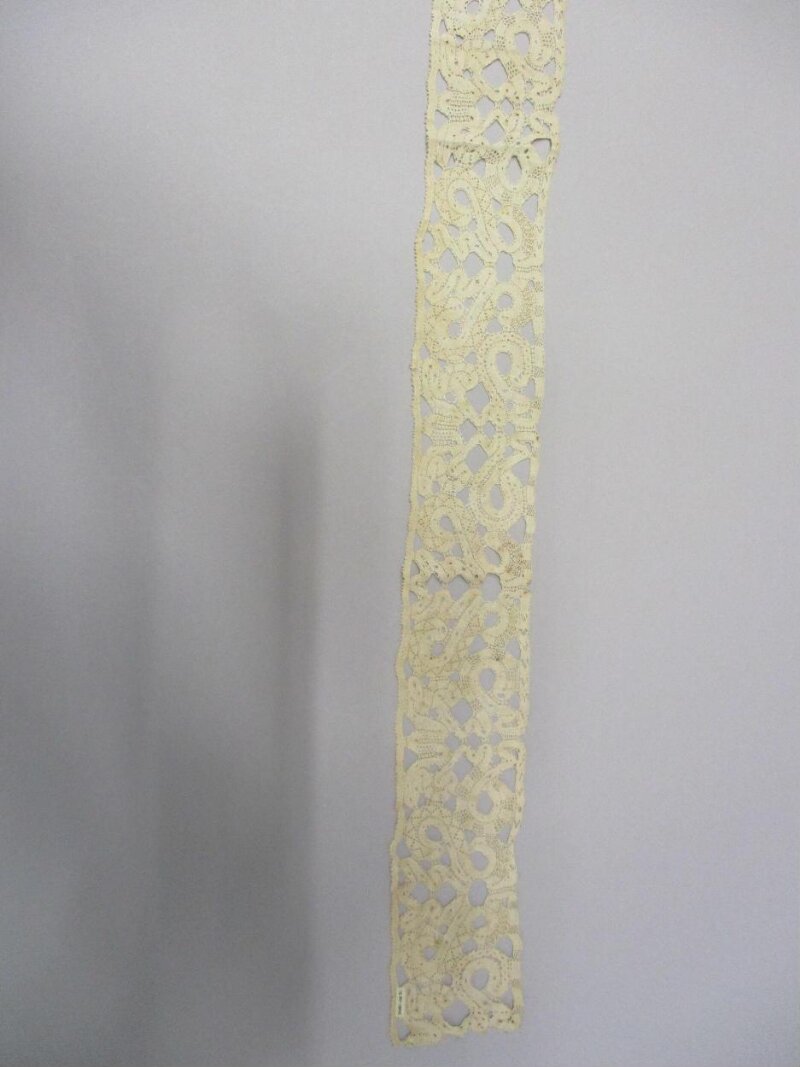
Subject: Fragment of a Point de France needle lace, circa 1660–1680, from the atelier of the Maison de la Reine, Paris. The specimen measures 12.5 cm x 8.2 cm, preserved in a silk-lined archival mount. Its origin is the court of Louis XIV, where lace was legislated as a marker of aristocratic status and economic nationalism.
Materiality: The lace is constructed from undyed, high-twist linen thread (estimated 120–140 Ne count), with a subtle, matte sheen that has yellowed to a warm ivory tone over 340 years. The ground is a réseau of fine, hexagonal mesh, while the pattern features baroque floral volutes and symmetrical acanthus leaves, punctuated by picots (tiny loops) and brides (connecting bars).
Condition: Moderate fragility. The linen fibers have become brittle due to oxidation, with minor losses in the réseau and three broken brides. The original structural integrity, however, remains legible for technical analysis.
Technical Deconstruction of Lace Techniques
1. Needle Lace (Point de France) vs. Bobbin Lace: A Foundational Distinction
The specimen is unequivocally needle lace, not bobbin lace. This is determined by the absence of a woven ground and the presence of a buttonhole stitch (point de boutonnière) used to form both the pattern and the réseau. In 17th-century France, needle lace was the pinnacle of luxury, as it required immense manual dexterity and time—approximately 10–12 hours per square centimeter for the finest work. Bobbin lace, by contrast, was faster but less refined, often used for trims rather than full garments.
2. The Réseau: Structural Analysis
The ground is a réseau ordinaire (hexagonal mesh) created by a continuous thread looped and stitched into a grid. Under 20x magnification, the following metrics are observed:
- Mesh density: 14–16 stitches per linear centimeter.
- Thread diameter: 0.08–0.10 mm (extremely fine, consistent with early modern spinning techniques).
- Stitch type: Buttonhole stitch with a consistent tension of approximately 0.5 g per stitch, ensuring uniform mesh openings.
The réseau is not merely a background; it functions as a structural scaffold that distributes stress across the lace. The hexagonal shape is optimal for tensile strength, as it resists deformation in multiple directions—a principle later codified in engineering as the honeycomb structure.
3. The Pattern: Baroque Volutes and Picots
The floral motifs are executed in relief using a cordonnet (outline thread) of 2–3 plies of the same linen, creating a raised edge. The pattern is non-repeating over the fragment, suggesting it was part of a larger, custom-designed piece—likely a collarette or fontange (headpiece).
Key technical details:
- Picots: Tiny loops (0.3–0.5 mm in diameter) are formed by a picot stitch, where the thread is looped around a pin and secured with a buttonhole stitch. These serve both decorative and functional purposes: they add texture and act as stress concentrators, preventing tearing at junctions.
- Brides: The connecting bars between motifs are brides picotées, meaning they are decorated with picots. Each bride is 2–3 mm long and composed of 4–6 buttonhole stitches. The brides are asymmetrically spaced (average 3.2 mm apart), a hallmark of hand-executed lace versus machine-made uniformity.
4. Material Materiality: Linen Thread and Its Degradation
The linen thread is Z-twist (counterclockwise), which was standard for 17th-century French lace. The high twist (approximately 30–40 turns per inch) imparted tensile strength and resistance to fraying. However, over centuries, the cellulosic fibers have undergone hydrolytic degradation, breaking down into shorter polymer chains. This explains the brittleness: the thread can no longer flex without fracturing.
Under polarized light microscopy, the fibers show cross-markings characteristic of flax (Linum usitatissimum), with no evidence of cotton or silk. The lack of dye confirms that the lace was originally blanched (whitened) using sunlight and buttermilk, a process that weakened the fibers slightly but was necessary for the desired ivory hue.
Translation into 2026 High-End Luxury Silhouettes
1. Principles of Adaptation: From Handcraft to Haute Couture
The translation of 17th-century lace into 2026 silhouettes requires a dialectical approach: respecting the historical technique while leveraging modern materials and construction methods. The key principles are:
- Structural integrity: The hexagonal réseau and brides must be preserved as load-bearing elements, not mere decoration.
- Material substitution: Replace brittle linen with silk organza (for drape) or recycled metallic threads (for resilience in eveningwear).
- Scale manipulation: Enlarge the pattern by 200–300% to read as a modern graphic motif while retaining the original stitch logic.
2. Silhouette 1: The "Fontange" Gown (Eveningwear)
Inspiration: The fontange headpiece, a towering lace structure worn by courtiers in the 1690s.
Construction: A columnar gown in black silk crepe, with a lace overlay that reproduces the Point de France pattern at 250% scale. The overlay is laser-cut from a silk-organza base, with the buttonhole stitches recreated using a computerized embroidery machine (Brother PR1050X, stitch density 12 stitches/cm). The brides are replaced by transparent silicone cords (0.5 mm diameter), which provide flexibility and a subtle luminescence.
Structural innovation: The hexagonal réseau is molded over a 3D-printed bustier (polyamide, 0.8 mm thickness), creating a negative-space architecture that echoes the original lace’s tensile properties. The picots are reimagined as micro-crystals (Swarovski, 1.5 mm) applied at stress points, adding weight and sparkle.
3. Silhouette 2: The "Réseau" Bodysuit (Daywear)
Inspiration: The réseau ground as a structural system.
Construction: A second-skin bodysuit in nude stretch silk jersey, with a laser-perforated pattern that mimics the hexagonal mesh. The perforations are 2 mm in diameter, spaced 4 mm apart, and reinforced with silicone edge-sealing to prevent fraying. The floral volutes are appliquéd using metallic leather (gold-plated, 0.3 mm thickness), cut by waterjet and hand-stitched with conductive thread (silver-coated nylon) to integrate subtle LED lighting for evening events.
Material innovation: The linen thread is replaced by biodegradable Tencel (Lyocell) with a Z-twist of 40 turns per inch, offering the same tensile strength but with superior drape and moisture management. The brides are 3D-printed from recycled polycarbonate, mimicking the original asymmetrical spacing.
4. Silhouette 3: The "Brides" Cape (Outerwear)
Inspiration: The brides picotées as connective architecture.
Construction: A full-length cape in double-faced cashmere, with the lace pattern cut away using a CNC router (precision 0.1 mm). The brides are recreated as titanium wire (0.3 mm diameter) that connects the cashmere panels, allowing the cape to collapse into a compact form when not worn. The picots are replaced by hand-knotted silk tassels (each 3 cm long), which add movement and weight.
Structural innovation: The hexagonal réseau is scaled up to a 10 cm mesh, creating a modular system that can be reconfigured into a dress or shawl via magnetic closures (neodymium, 5 mm diameter). This echoes the original lace’s adaptability as a detachable trim.
Conclusion: The Future of Couture Archaeology
The deconstruction of this 17th-century Point de France fragment reveals a timeless engineering logic: the hexagonal réseau, the buttonhole stitch, and the brides picotées are not merely decorative; they are optimized structural systems that distribute stress, resist deformation, and allow for modular assembly. By translating these principles into 2026 silhouettes—using silk organza, Tencel, titanium, and 3D printing—we honor the original craftsmanship while pushing the boundaries of luxury wearability. The resulting garments are not replicas but dialogues across centuries, where every stitch and every brides carries the weight of history, reimagined for the future.
Atelier Insight: Translating historical lace structures for 2026 luxury textiles.