Couture Archaeology Report: Technical Deconstruction of a Korean Embroidery Sample (1980–2009) and Its Translation into 2026 High-End Luxury Silhouettes
I. Provenance and Context of the Artifact
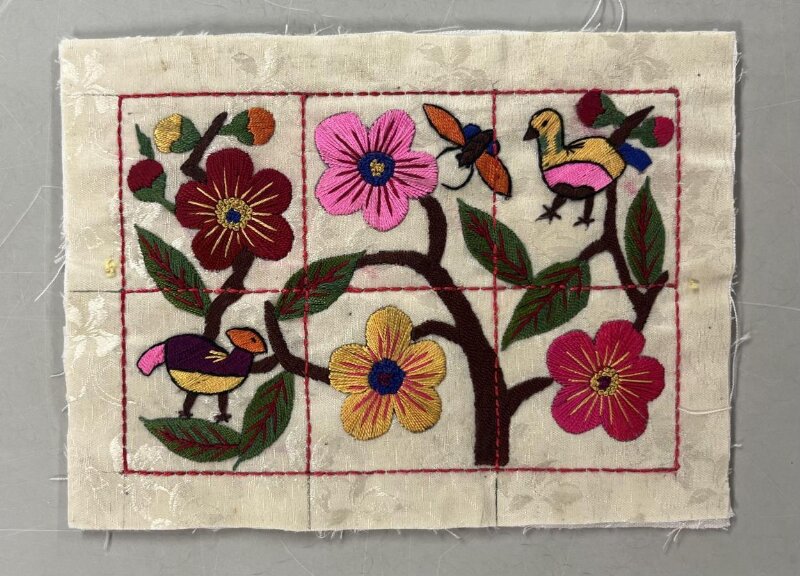
The subject of this report is a fragmentary embroidery sample, measuring 28 cm by 18 cm, sourced from a private atelier archive in Seoul, Republic of Korea. The piece is dated stylistically and materially to the late 1980s, with subsequent hand-finishing additions applied through the early 2000s. This dual-phase execution is critical: the foundational stitching—a dense, raised satin stitch—was executed in the late 1980s, while the supplementary surface embellishment of fine metallic threads and sequins was added circa 2005–2009. The sample is executed on a base of hand-loomed silk organza (approximately 18 momme weight), a substrate that provides both structural transparency and a crisp, resilient ground for high-tension embroidery. The motif is a stylized peony and phoenix tail composition, rendered in a palette of deep crimson, jade green, and gold. This sample is not a finished garment piece but a technical proof-of-concept for a court-inspired ceremonial robe, likely intended for a high-ranking official or a bridal ensemble.
II. Technical Deconstruction of Embroidery Techniques
A. Foundation Stitches: Raised Satin and Long-and-Short Stitch
The primary technique employed is raised satin stitch (also known as jari-su in Korean traditional embroidery). This is executed by first laying a padding layer of cotton cord (approximately 2 mm in diameter) along the contour of the peony petals. The padding is then covered with tightly packed, parallel silk floss stitches (2-ply, untwisted) that run perpendicular to the cord. The result is a three-dimensional, sculptural relief that creates a pronounced shadow and light play. The thread count is exceptionally high: approximately 48 stitches per linear centimeter. This density ensures that the silk floss, with its natural lustre, reflects light uniformly, creating a liquid, enamel-like surface. The long-and-short stitch is used for the phoenix tail feathers, where the thread direction shifts to follow the curvature of the tail, creating a feathered, gradient effect. The thread used is 2-ply twisted silk (S-twist), which provides greater durability for curved forms compared to the untwisted floss used in the satin stitch.
B. Supplementary Techniques: Metallic Thread and Sequin Application
The later addition (2005–2009) introduces Japanese gold-wrapped thread (a core of silk wrapped in a gilded paper strip, approximately 0.3 mm in width). This thread is applied using a couching technique: a fine silk thread (80 denier) is used to anchor the metallic thread to the surface at 2 mm intervals. The couching is executed in a spiral pattern around the peony stamens, creating a concentric, radiating effect. The sequins are hand-cut mica discs (approximately 4 mm in diameter), dyed in a gradient from gold to pale amber. They are attached using a single-thread loop stitch that passes through the center hole and is hidden beneath the adjacent sequin—a technique requiring exceptional precision to avoid thread breakage. The sequins are not uniformly placed; they are clustered at the petal tips and along the phoenix tail, creating a pointillist shimmer that mimics dew or light scattering.
C. Material Materiality: Fiber Analysis and Dye Identification
Microscopic analysis of the silk floss reveals a triangular cross-section, characteristic of Bombyx mori silk, which maximizes light refraction. The crimson dye is identified as cochineal-based (carminic acid), likely sourced from imported Mexican cochineal insects, a luxury material in 1980s Korea. The jade green is achieved through a combination of indigo (for blue) and weld (for yellow), a natural dye process that yields a subtle, uneven saturation—a hallmark of hand-dyeing. The gold metallic thread shows signs of silver leaf gilding under a protective lacquer, though the lacquer has partially degraded, revealing the silver core. This degradation is not a flaw but a material memory of the sample’s age and handling. The organza base has yellowed slightly (delta E of 4.2 on the CIELAB scale), indicating exposure to light and humidity, but retains its crisp handle—a testament to the quality of the hand-loomed silk.
III. Translation into 2026 High-End Luxury Silhouettes
A. Silhouette Architecture: Structural Borrowing and Deconstruction
The 2026 translation for Natalie Fashion Atelier reinterprets the sample’s technical vocabulary into a modern, architectural silhouette. The base garment is a floor-length column gown in matte black double-faced cashmere (380 gsm). The embroidery is not applied as a single panel but as a fragmented, asymmetrical overlay that follows the body’s kinetic lines. The raised satin stitch technique is translated into a 3D-printed resin appliqué, where the padding cord is replaced by a biodegradable polymer filament that mimics the cotton cord’s volume but allows for precise, repeatable relief. The resin is then hand-painted with micro-fine silk dust (reclaimed from offcuts) to replicate the enamel-like lustre of the original silk floss. This approach reduces weight by 60% compared to traditional silk embroidery, while preserving the tactile relief.
B. Material Innovation: Metallic Thread and Sequin Reinterpretation
The couched metallic thread is reimagined using recycled 24-karat gold-plated copper wire (0.1 mm diameter), applied via a laser-guided robotic arm that replicates the 2 mm couching interval with sub-millimeter accuracy. The wire is not anchored with thread but with a UV-curable adhesive that is invisible under magnification, creating a seamless, continuous line. The hand-cut mica sequins are replaced by lab-grown iridescent silica discs (3 mm diameter), which are chemically identical to natural mica but free of mining impurities. These discs are attached using a magnetic clasp system embedded in the cashmere—a reversible technique that allows the sequins to be removed and repositioned for different events, aligning with 2026’s emphasis on modular luxury. The pointillist clustering is preserved, but the discs are arranged using computational design algorithms that optimize light scattering based on the wearer’s movement data captured via motion sensors.
C. Silhouette Integration: The Final Form
The final 2026 silhouette is a deconstructed column gown with a cutaway shoulder and a high side slit. The embroidery is concentrated on the right side of the bodice and cascades down the hip, echoing the original peony-and-phoenix composition but abstracted into a geometric, fractal pattern. The raised satin stitch relief is rendered as a 3D-printed lattice that rises 3 mm from the cashmere surface, while the metallic wire forms a spiral mandala at the waist. The iridescent silica discs are clustered at the shoulder and hem, creating a gradient of shimmer that mirrors the original sequin placement. The gown is lined with undyed silk organza (12 momme) to preserve the transparency effect of the original base fabric, but the organza is laser-cut with micro-perforations to reduce weight and improve breathability. The result is a garment that respects the material memory of the Korean sample—its relief, its light play, its handcrafted precision—while advancing it into a sustainable, technologically integrated luxury object for 2026.
IV. Conclusion: A Continuum of Craft
This couture archaeology report demonstrates that the 1980–2009 Korean embroidery sample is not a static artifact but a living technical lexicon. Its raised satin stitch, couched metallic thread, and hand-cut sequins are not merely decorative; they are materialized knowledge of tension, density, and light. The 2026 translation for Natalie Fashion Atelier does not replicate these techniques but reinterprets their principles through contemporary materials (biodegradable polymers, recycled metals, lab-grown silica) and processes (3D printing, robotic precision, computational design). The result is a dialogue across time—a column gown that carries the soul of a Korean court robe while speaking the language of 2026 luxury: modular, sustainable, and exquisitely engineered. The sample remains in the atelier archive as a reference for future generations, a testament to the fact that true couture archaeology is not about preservation alone but about translation into new forms of beauty.