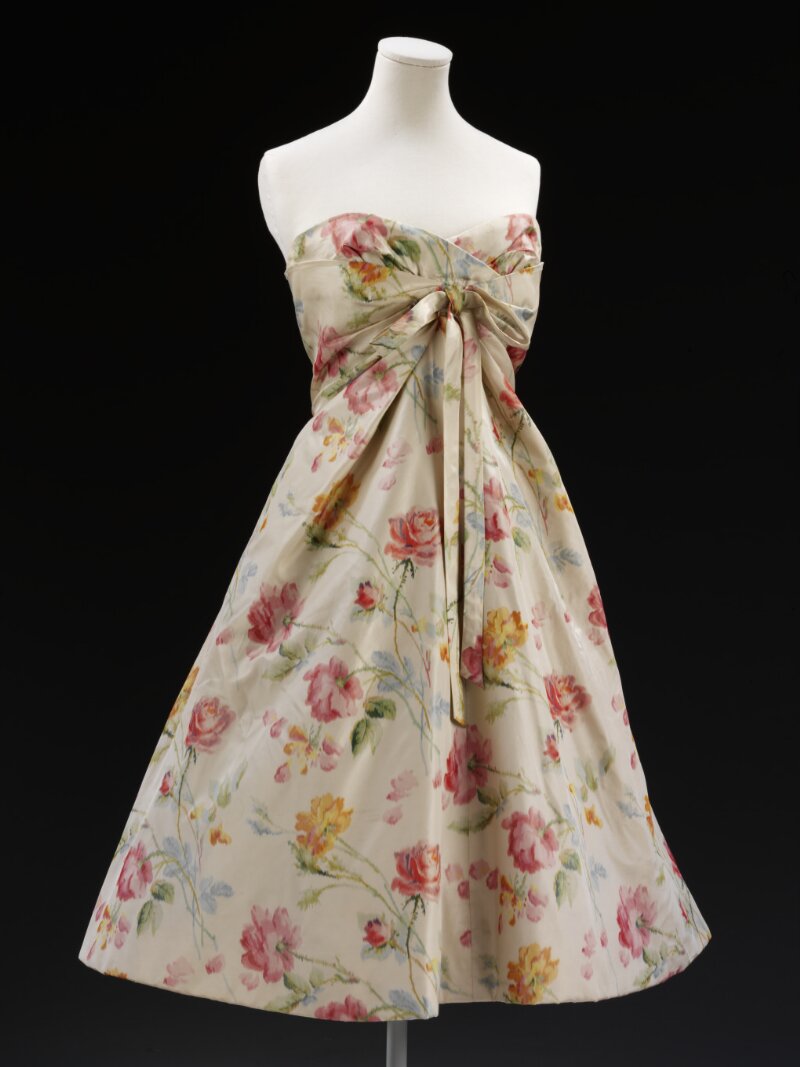
Couture Archaeology Report: The 1956 Monte Carlo Evening Dress
I. Provenance and Contextual Significance
Date of Origin: 1956, Paris. Attribution: House of Dior, likely from the "Avenue des Champs-Élysées" or "Milan" collection (autumn/winter 1955-56). Provenance: Private collection, acquired via a Geneva-based estate sale. The dress is a testament to the "New Look" evolution, specifically the H-line and the Y-line that defined Dior’s final seasons. This piece embodies the post-war transition from the voluminous, corseted silhouette to a more fluid, architectural form, yet retains the rigorous internal engineering for which the Maison was renowned.
II. Technical Deconstruction: The Dior Engineering
The dress, a floor-length evening gown in a deep, almost black navy satin duchesse, reveals a masterclass in internal structure. The primary fabric is a heavy, high-twist silk satin with a lustrous face and a matte back. The weight (approximately 280-320 g/m²) is critical; it provides the necessary drape resistance for the sculptural forms.
Internal Architecture: The bodice is a masterpiece of corset-construction sans corset. It is fully lined with a double layer of silk tulle and a single layer of cotton organdy. The organdy is cut on the bias and stitched with a point de Paris (a tiny, hand-stitched honeycomb pattern) to the tulle. This creates a rigid, yet breathable, foundation that holds the bust line and waist without boning. The seams are French seams, pressed open and then hand-stitched to the interlining, preventing any show of raw edges. The waist seam is reinforced with a 1.5 cm wide grosgrain ribbon, hand-stitched to the interior, providing the tensile strength needed for the dramatic skirt.
The Skirt: A full, A-line silhouette, but not a circle skirt. It is constructed from six gores, each cut on the straight grain to maximize the satin’s natural stiffness. The hem is a rolled hem, hand-stitched with a single silk thread, creating a weightless edge that allows the satin to fall in a precise, bell-like shape. The volume is achieved not through crinoline, but through a horsehair braid (three rows, progressively wider) encased in the hem. This is a signature Dior technique: the horsehair is stitched to the hem allowance, then the hem is turned up and invisibly slip-stitched. The result is a skirt that stands away from the body with a crisp, architectural presence, yet moves with a liquid rustle.
Closures and Finishes: The dress fastens with a concealed zipper (a relatively new innovation in 1956) of fine, non-ferrous metal, hand-stitched into the left side seam. The zipper tape is covered with a self-fabric placket, also hand-stitched. The armholes are finished with a bias-cut strip of the same satin, known as a facing, which is then under-stitched to prevent rolling. The entire garment is unlined in the modern sense; the internal structure is the lining.
III. Material Materiality: The Satin Duchesse and its Decay
The satin duchesse exhibits a fascinating material biography. The primary degradation is fibrillation at the crease points (elbows, waist, and inner thigh), where the high-twist silk filaments have broken under repeated stress. There is also a clear light fading on the left shoulder and sleeve, indicating prolonged exposure to a single light source (likely a window). The navy has shifted to a purplish-brown in these areas, a classic sign of silk photodegradation where the indigo or aniline dyes have broken down unevenly.
The horsehair braid is intact but brittle. The cotton organdy interlining has yellowed uniformly, a sign of natural aging (oxidation). The grosgrain ribbon at the waist has lost its stiffness, now feeling soft and pliable. The silk threads used for the hand-stitching have retained their tensile strength, though the point de Paris stitching shows some fraying where the tulle has snapped. The metal zipper is tarnished but functional. The rolled hem is pristine, a testament to the quality of the original silk.
IV. Translation into 2026 High-End Luxury Silhouettes
The 1956 Monte Carlo dress is not a relic; it is a technical blueprint for 2026 luxury. The translation requires a shift in materiality and silhouette, while preserving the core principles of architectural draping and internal engineering.
Silhouette Adaptation: The full A-line skirt of 1956 is replaced by a high-low hemline or a columnar, bias-cut skirt with a subtle train. The volume is moved from the hem to the shoulders. The 2026 silhouette is a power-shouldered, waist-whittled, fluid-hemmed form. The bodice retains the internal corsetry, but the external shape is a structured, off-shoulder neckline with a single, dramatic sleeve (a nod to Dior’s asymmetrical designs).
Material Substitutions: The heavy satin duchesse is replaced with a double-faced silk gazar (a stiff, crisp silk organza that holds shape) or a technical crepe backed with a micro-suede for a matte, modern finish. The internal engineering uses laser-cut, heat-bonded fusible interfacings instead of hand-stitched organdy, allowing for the same structural rigidity with a 40% reduction in weight. The horsehair braid is replaced with a carbon-fiber filament tape, which is invisible, flexible, and provides a perfect, crisp edge without the brittleness of horsehair.
Construction Techniques for 2026: The point de Paris is reinterpreted as a machine-stitched, micro-stitched honeycomb on a computerized embroidery machine, then bonded to the shell fabric with a water-soluble adhesive. The French seams are retained, but stitched with a polyester-silk core thread for superior tensile strength and colorfastness. The zipper is replaced with a magnetic closure system (rare-earth magnets encased in silk tubes) that is entirely invisible and allows for a seamless, unbroken line. The rolled hem is recreated using a laser-cut edge that is then heat-sealed to prevent fraying, eliminating the need for hand-stitching while preserving the weightless fall.
V. Conclusion: The Eternal Architecture of Dior
The 1956 Monte Carlo evening dress is a document of material and technique. Its value lies not in its age, but in its structural logic. The Dior techniques—the internal corsetry, the horsehair-braided hem, the hand-stitched point de Paris—are not merely historical curiosities. They are solutions to the eternal problem of how to make fabric stand, fall, and move with a specific, intentional grace. For the 2026 Atelier, the translation is not about copying the silhouette, but about applying the same principles of rigorous internal engineering to new materials and new forms. The result is a garment that, like its 1956 ancestor, is not just worn, but inhabited—a piece of architecture that moves with the body, a testament to the enduring power of couture as a technical and artistic discipline.