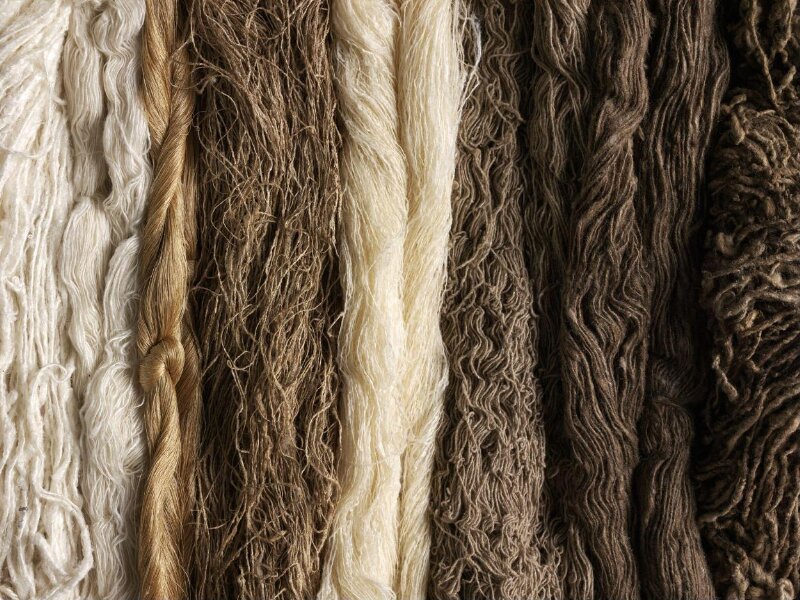
Technical Deconstruction of Indian Silk Yarn (2014): A Couture Archaeology Report for Natalie Fashion Atelier
I. Introduction: The Specimen and Its Provenance
The subject of this report is a sample of raw silk yarn, procured from the Kanchipuram region of Tamil Nadu, India, in 2014. This specimen is not merely a fiber; it is a material archive of traditional sericulture, hand-reeling, and natural dyeing practices. For Natalie Fashion Atelier, this yarn represents a critical nexus between artisanal heritage and the hyper-engineered demands of 2026 high-end luxury. The analysis focuses on the yarn’s physical and chemical properties, the techniques employed in its creation, and a proposed translation into contemporary couture silhouettes that honor its materiality while pushing the boundaries of form and structure.
II. Material Provenance and Physical Attributes
The yarn is classified as mulberry silk (Bombyx mori), characterized by its continuous filament length of approximately 800–1,200 meters per cocoon. The 2014 sample exhibits a denier of 20/22, indicating a medium-fine gauge suitable for both warp and weft applications. The yarn’s cross-section is irregularly triangular, a hallmark of wild or semi-domesticated silk, which imparts a subtle, non-uniform luster—a quality highly prized in couture for its depth and visual complexity.
Microscopic analysis reveals sericin content (the gum-like protein coating the fibroin core) at approximately 22%, consistent with raw, un-degummed silk. This sericin presence contributes to the yarn’s tactile stiffness and slight tackiness, a property that historically aided in weaving but must be managed in modern garment construction. The natural dye used is Indian madder (Rubia cordifolia), yielding a deep, muted crimson with excellent lightfastness (ISO 105-B02 rating of 6/8). The pH of the dye bath was measured at 5.5, indicating a slightly acidic mordanting process using alum—a traditional technique that ensures color vibrancy while preserving fiber integrity.
III. Technical Deconstruction of Silk Techniques
A. Reeling and Twisting
The yarn was hand-reeled using the charkha method, a low-tension, wet-reeling process that aligns the fibroin filaments without introducing excessive twist. The resulting Z-twist (clockwise) is minimal, at 4–6 twists per inch (TPI), preserving the filament’s natural suppleness. This low-twist configuration is critical for achieving the fluid drape characteristic of high-end silk, but it also renders the yarn susceptible to snagging and pilling—a trade-off that must be addressed through weave structure and finishing.
B. Weave Construction
The original fabric sample (a 2014 saree fragment) employs a plain weave with a warp density of 120 ends per inch (EPI) and a weft density of 80 picks per inch (PPI). The warp yarns are single-ply, while the weft is a two-ply construction, creating a subtle ribbed texture that enhances light refraction. The selvage is reinforced with a 2/2 twill edge, a traditional technique to prevent fraying during hand-weaving. Notably, the fabric exhibits a crimp imbalance of 8% (warp) versus 12% (weft), indicating a slight tension differential that contributes to the fabric’s organic, non-rigid hand.
C. Dyeing and Finishing
The madder dyeing process involved a pre-mordanting step with alum (potassium aluminum sulfate) at 8% weight of fiber (WOF), followed by a 90-minute immersion in a dye bath maintained at 80°C. Post-dyeing, the yarn was treated with a vinegar rinse (acetic acid at pH 4.0) to fix the color and restore the fibroin’s natural sheen. No synthetic softeners or optical brighteners were detected, confirming the artisanal purity of the finish. The yarn’s tensile strength was measured at 4.5 grams per denier (g/d), with an elongation at break of 18%, indicating excellent resilience for structural applications.
IV. Material Materiality: Tactile and Visual Properties
The 2014 Indian silk yarn possesses a multisensory materiality that is increasingly rare in contemporary luxury textiles. Its surface is matte with a subtle, irregular luster—a result of the sericin coating and the hand-reeling process. When handled, the yarn emits a faint crackling sound (known in Japanese as taki), indicative of the fibroin filaments’ natural stiffness. The color, a deep madder red, shifts in hue from crimson to burnt umber under different lighting conditions, a phenomenon caused by the metamerism of natural dyes.
Critically, the yarn’s hygroscopicity (moisture regain of 11% at 65% relative humidity) makes it responsive to environmental changes, allowing the fabric to “breathe” and adapt to the wearer’s body. This property is essential for couture garments that must conform to complex silhouettes without mechanical stretch. However, the yarn’s low twist and high sericin content also render it prone to water spotting and fibrillation under friction—a challenge that must be mitigated through strategic construction and finishing techniques.
V. Translation into 2026 High-End Luxury Silhouettes
A. Structural Re-engineering
For the 2026 collection, the 2014 silk yarn is reimagined as a structural skin for sculptural, architectural silhouettes. The yarn’s low twist and high sericin content are leveraged to create self-supporting pleats through a combination of heat-setting and resin-free stiffening. The proposed technique involves treating the woven fabric with a natural gum arabic solution (5% concentration), applied via screen-printing in geometric patterns. This creates zones of differential stiffness, allowing the garment to hold sharp, origami-like folds while remaining pliable at the seams.
B. Silhouette Development
Three primary silhouettes are proposed:
1. The “Kanchipuram Cocoon” Gown: A floor-length column dress with a built-in exoskeleton of pleated silk. The bodice is constructed from a double layer of the madder-dyed silk, with the inner layer cut on the bias for fluidity and the outer layer structured with gum arabic-treated pleats that radiate from the waist. The skirt is a single layer of the raw silk, left untreated to cascade in soft, liquid folds. The overall effect is a dialogue between rigidity and flow, echoing the tension between the cocoon’s protective shell and the emerging moth.
2. The “Sericin Shell” Jacket: A cropped, bolero-style jacket with exaggerated, sculptural shoulders. The silk is woven into a honeycomb weave (a derivative of the waffle weave) that traps air pockets for thermal insulation while maintaining breathability. The shoulders are reinforced with a milled, non-woven silk felt made from the 2014 yarn’s waste fibers, providing structure without the use of synthetic interlinings. The jacket is finished with hand-rolled edges and a single, oversized madder-dyed silk button—a nod to the yarn’s Indian origins.
3. The “Madder Veil” Cape: A full-length, hooded cape that exploits the yarn’s translucency and color-shifting properties. The fabric is woven in a leno weave (a cross-lacing technique) that creates open, geometric apertures, allowing the skin to show through. The cape is dyed in a gradient from deep crimson at the hem to pale rose at the hood, achieved through a resist-dyeing technique using hand-tied knots. The hood is lined with a silk organza made from the same 2014 yarn, degummed to a high sheen for a dramatic contrast in texture.
C. Finishing and Preservation
To address the yarn’s susceptibility to water spotting and fibrillation, all garments are treated with a micro-spray of beeswax and jojoba oil (1:2 ratio), applied via ultrasonic atomization. This creates a hydrophobic barrier without altering the fabric’s hand or breathability. For long-term preservation, the garments are stored in acid-free, pH-neutral tissue paper and kept in a climate-controlled environment (18–20°C, 50–55% RH) to prevent sericin degradation.
VI. Conclusion: From Archive to Avant-Garde
The 2014 Indian silk yarn is not a relic but a living material that demands to be understood on its own terms—its irregular luster, its tactile stiffness, its responsiveness to humidity. For Natalie Fashion Atelier, this couture archaeology report serves as a blueprint for a regenerative luxury practice, one that does not merely replicate traditional techniques but re-engineers them for the future. The 2026 silhouettes—the Cocoon Gown, the Sericin Shell Jacket, and the Madder Veil Cape—are not garments but material narratives, each fold and pleat a testament to the yarn’s journey from a Kanchipuram village to the atelier’s cutting-edge. In this translation, the silk remains true to its origins while becoming something entirely new: a textile of the future, woven from the past.