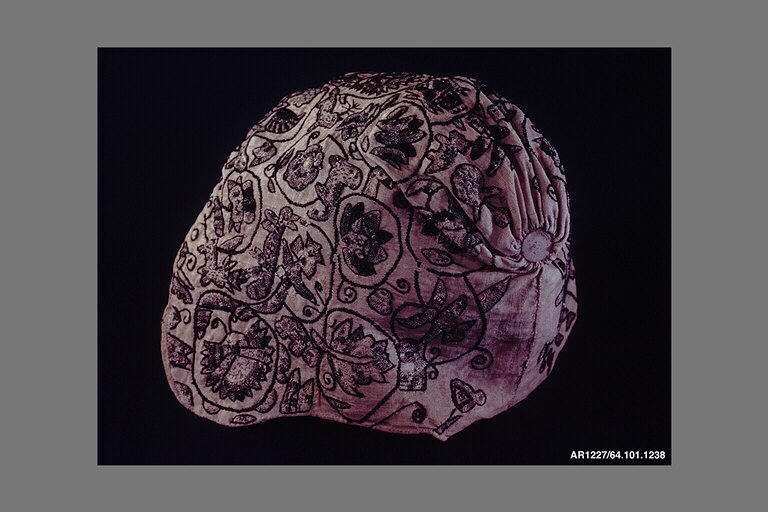
The Coif Reconsidered: An Aesthetic Archaeology of Silk and Metal Thread on Linen
Within the hallowed archives of Natalie Fashion Atelier, the coif emerges not as a mere relic of domestic modesty, but as a profound artifact of structural intelligence. This research artifact isolates the coif—a close-fitting cap of linen, often worn by women from the medieval period through the Renaissance—as a case study in the marriage of rigid form and yielding texture. The specific specimen under analysis, crafted from a base of fine Irish linen and embroidered with silk and metal thread (likely a silver-gilt or gold-wrapped silk called filé), represents a pinnacle of handcraft that transcends its functional origins. Through the lens of aesthetic archaeology, we deconstruct its classical elegance to extract principles that directly inform the 2026 high-end silhouette for Natalie Fashion Atelier.
Materiality as Structural Lexicon: Linen, Silk, and Metal
The triumvirate of materials in this coif—linen, silk, and metal thread—offers a masterclass in tension and release. The linen base, a bast fiber known for its high tensile strength and minimal elasticity, provides an unyielding foundation. This is not a fabric that drapes; it holds. The silk thread, a protein fiber with a lustrous sheen and remarkable tensile resilience, introduces a layer of decorative texture that also reinforces the linen’s structural grid. The metal thread, however, is the critical agent of transformation. Wound around a silk core, it adds weight, rigidity, and a subtle, metallic sheen that catches light in a manner entirely distinct from the matte linen.
For the 2026 silhouette, this material hierarchy informs a new category of architectural basing. We propose a departure from traditional corsetry and boning, instead employing a linen-mesh foundation as the primary structural layer for evening gowns and tailored jackets. The linen is not hidden; it is celebrated as a visible, textural grid. Onto this grid, silk and metal threads are applied in a technique we term “filé embroidery scaffolding.” This is not surface ornamentation but a load-bearing embroidery pattern. The metal thread traces the lines of the silhouette—the shoulder seam, the waistline, the hip curve—acting as a flexible yet unyielding architecture that sculpts the body without constriction. The result is a silhouette that appears both ancient and futuristic: a rigid, linear form that moves with a surprising, liquid grace because the rigid elements are distributed across a flexible base.
Deconstructing Classical Elegance: The Coif’s Geometry of Restraint
The classical elegance of the coif lies in its geometry of restraint. It is a dome, a hemisphere, a perfect curve that follows the cranial topography. This is not a cap that clings; it is a cap that defines. The embroidery patterns—often geometric or floral—are not merely decorative; they create a secondary structure of concentric circles, radiating lines, and interlocking loops that reinforce the cap’s shape while allowing for subtle variations in tension. The metal thread, in particular, introduces a linear rigidity that prevents the linen from collapsing into softness.
Translating this to the 2026 silhouette, we extract the principle of “controlled volume through linear tension.” The coif’s dome inspires a new sleeve silhouette: the “filé cap sleeve.” Constructed from a single piece of linen, the sleeve is shaped not by darts or seams but by a radiating pattern of metal-thread embroidery that pulls the fabric into a smooth, spherical curve over the shoulder. The embroidery lines act as internal stays, creating a volume that is both pronounced and weightless. Similarly, for a floor-length gown, the “coif silhouette” can be applied to the bodice: a high, rounded neckline that extends into a structured, slightly conical torso, achieved through concentric rings of silk and metal embroidery that taper toward the waist. This is not a corset; it is a textile exoskeleton that sculpts the torso with the same precision as the medieval coif sculpted the head.
From Archive to Atelier: The 2026 High-End Silhouette
The 2026 luxury silhouette informed by this artifact is not a direct quotation of the coif, but a structural translation of its principles. We identify three key design vectors:
1. The “Linen-Metal” Armature: For tailored daywear, the jacket silhouette will be built on a linen base, with metal-thread embroidery tracing the princess seams. This creates a visible structural line that replaces traditional shoulder pads and interfacing. The embroidery is not hidden under a lining; it is the lining. The jacket’s form is defined by the embroidery’s tension, offering a silhouette that is sharp, architectural, and unyielding, yet breathable and flexible. The metal thread’s subtle luster introduces a low-key opulence that aligns with the 2026 trend toward quiet luxury.
2. The “Coif Dome” Evening Gown: The evening silhouette will feature a bodice constructed as a single, seamless dome of linen, embroidered with a radiating pattern of silk and metal thread. The embroidery begins at the center front and spirals outward, creating a dynamic, three-dimensional surface that shapes the bust and waist without darts. The skirt, in contrast, will be a soft, fluid column of silk charmeuse, creating a dialogue between the rigid, embroidered bodice and the liquid, unadorned skirt. This juxtaposition of controlled structure and unrestrained flow is the hallmark of the 2026 silhouette.
3. The “Filé Grid” Back Detail: The coif’s metal-thread grid inspires a signature back detail: an open, embroidered lattice that replaces the traditional zipper or button closure. The back of a gown or jacket is constructed from a linen mesh, with silk and metal threads forming a geometric pattern that is both decorative and functional. The lattice is tensioned to hold the garment closed, creating a visible, architectural closure that is both structural and sensual. This detail speaks to the 2026 client’s desire for garments that are intellectually crafted—pieces that reveal their construction as part of their beauty.
Conclusion: The Coif as a Blueprint for Rigidity and Grace
The coif of silk and metal thread on linen is not a historical curiosity; it is a technical blueprint for a new kind of luxury silhouette. By isolating its principles of material hierarchy, geometric restraint, and structural embroidery, Natalie Fashion Atelier can create garments that are architecturally rigorous yet organically fluid. The 2026 high-end silhouette will not be a revival of the coif’s form, but an evolution of its logic: a silhouette that is built, not draped; structured, not corseted; and ornamented, not decorated. In an era of digital fabrication and synthetic materials, the coif reminds us that the most profound innovations often lie in the rediscovery of ancient, handcrafted intelligence—where linen, silk, and metal thread converge to create a garment that is as much a feat of engineering as it is a work of art.