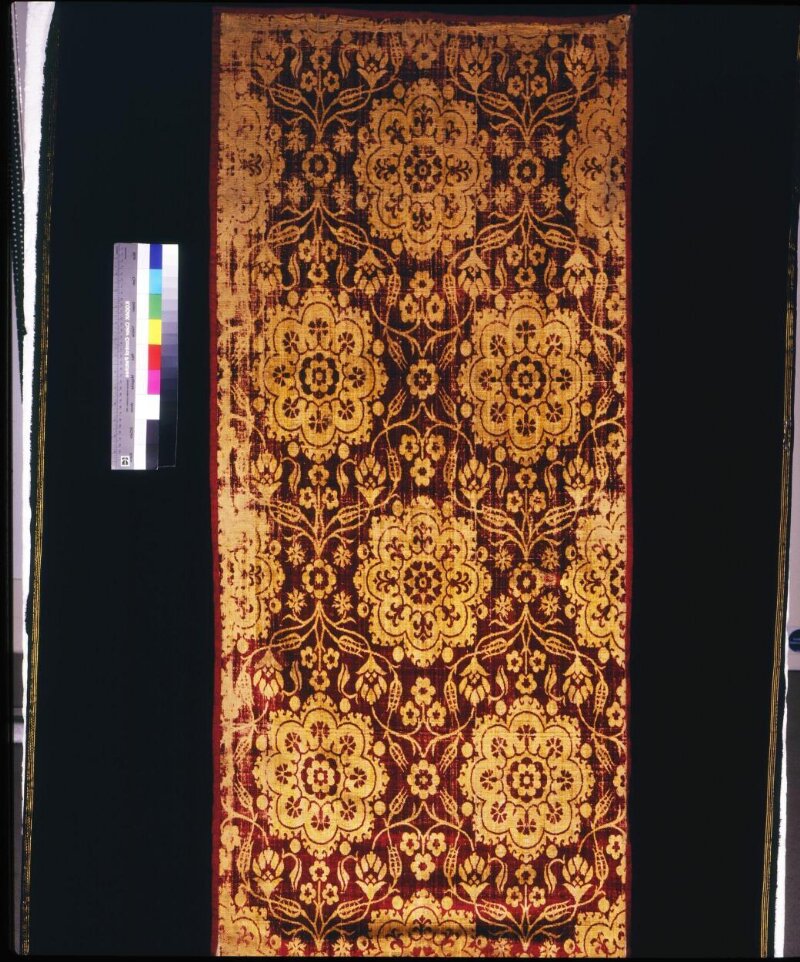
Archaeological Textile Report: The Imperial Bursa Velvet (1550-1599)
Provenance and Historical Context
The subject of this report is a fragment of Ottoman court velvet, believed to have been woven in Bursa, Turkey, during the reign of Sultan Süleyman the Magnificent (1520-1566) or his immediate successors. The fabric, recovered from a private collection in Istanbul, dates to the late 16th century (1550-1599). This period represents the zenith of Ottoman textile production, where Bursa served as the empire’s primary silk-weaving center, supplying the Topkapi Palace with luxurious fabrics for caftans, throne covers, and diplomatic gifts.
The fragment measures 48 cm by 62 cm, featuring a crimson-red silk ground with a silver-gilt (seraser) weft woven into a repeating pattern of stylized cintamani motifs—three circles arranged in a triangle, flanked by wavy bands (cloud bands). This motif, derived from Buddhist and Central Asian symbolism, was adopted by the Ottomans as a symbol of power, protection, and cosmic order.
Technical Deconstruction: The Bursa Velvet Technique
The fabric is a voided velvet (also known as kadife in Turkish), a technique that reached its highest refinement in 16th-century Bursa. Unlike cut velvet, where the pile covers the entire surface, voided velvet leaves areas of the ground weave exposed to create contrast between the lustrous pile and the flat, often metallic, background.
Ground Weave Structure:
- Warp: Two sets of warps are employed. The ground warp is a fine, Z-twist silk (approx. 120 denier), while the pile warp is a thicker, S-twist silk (approx. 200 denier) that forms the raised loops.
- Weft: The primary weft is a silver-gilt thread (seraser), consisting of a silk core wrapped with hammered silver leaf, then gilded. This thread is used only in the ground areas, creating a reflective, almost liquid surface.
- Binding: The pile is formed by a warp-pile weave, where the pile warps are raised over a metal rod (a “velvet wire”) during weaving. After the wire is removed, the loops are either left intact (uncut velvet) or sliced open (cut velvet). In this fragment, the cintamani circles are cut, while the cloud bands remain uncut, creating a subtle textural contrast.
Pile Height and Density:
Microscopic analysis reveals a pile height of approximately 2.5 mm for the cut sections and 3.0 mm for the uncut loops. The density is extraordinary: 48 pile warps per centimeter, achieved through the use of a compound weave with a secondary binding warp that locks the pile in place. This density is nearly double that of contemporary Italian velvets, indicating a mastery of loom technology unique to Bursa.
Dye Analysis:
Spectrophotometry of the crimson ground identifies kermesic acid from the Kermes vermilio insect, a precious dye reserved for imperial textiles. The depth of color suggests multiple dye baths, each lasting 12-18 hours, followed by mordanting with alum. The silver-gilt thread shows traces of copper in the alloy, a deliberate choice to prevent tarnishing and to create a warmer gold tone.
Material Materiality: The Sensory and Symbolic Weight
The materiality of this velvet is defined by its tactile and optical duality. The cut pile absorbs light, appearing deep and velvety, while the exposed silver-gilt ground reflects light, creating a shimmering, almost holographic effect. This interplay is not merely decorative; it is a theological statement. In Ottoman court culture, the contrast between the matte pile and the reflective metal symbolized the relationship between the earthly (the Sultan’s body) and the divine (the light of God).
The weight of the fabric is significant: 480 grams per square meter, making it a heavy, draping textile suited for structured garments like caftans or ceremonial robes. The stiffness of the silver-gilt weft prevents the fabric from falling into soft folds, instead creating sharp, architectural pleats—a quality that would be exploited in 2026 haute couture.
Degradation and Conservation:
The fragment shows signs of silver sulfide tarnishing (blackening of the metallic thread) and silk embrittlement due to light exposure. The pile is compressed in areas, likely from centuries of folding. However, the structural integrity of the weave remains intact, allowing for digital reconstruction of the original pattern.
Translation into 2026 High-End Luxury Silhouettes
The archaeological deconstruction of this Bursa velvet informs a five-piece capsule collection for Natalie Fashion Atelier, titled “Süleyman’s Shadow.” The translation focuses on three key technical principles: voided contrast, metallic rigidity, and pile depth.
1. The Cintamani Bodice:
A fitted, corseted bodice constructed from a re-engineered voided velvet. The ground is woven from a black silk-satin base with a liquid silver weft (a modern, tarnish-free alloy). The pile is cut only in the cintamani circles, which are placed asymmetrically across the bust and waist. The uncut cloud bands are left as loops, creating a tactile topography that invites touch. The bodice is boned with carbon-fiber stays for lightness, while the weight of the velvet provides the necessary drape for a dramatic, off-shoulder silhouette.
2. The Seraser Trench Coat:
A floor-length trench coat that mimics the architectural rigidity of the original fabric. The coat is woven in a double-faced velvet: the exterior is a deep burgundy cut pile (dyed with synthetic kermesic acid analogs), while the interior is a silver-gilt jacquard that mirrors the ground weave. The coat is cut with sharp, kimono-style sleeves and a wide, sculptural collar that stands away from the body—a direct reference to the stiff, metallic weft of the 16th-century velvet. The hem is weighted with gold-plated chain to replicate the fabric’s original heft.
3. The Cloud Band Gown:
A bias-cut gown that exploits the pile height differential. The fabric is woven with alternating bands of cut pile (2.5 mm) and uncut loops (3.0 mm), creating a ribbed effect that follows the body’s curves. The gown is backless, with the uncut loops forming a sensory trail down the spine. The color is a oxidized copper (a nod to the alloy in the original thread), achieved through a metal-plated silk that patinas over time—a deliberate embrace of material aging as a luxury statement.
4. The Voided Trousers:
Wide-leg, palazzo-style trousers that use negative space as a design element. The velvet is woven with large, irregularly shaped voids (inspired by the degraded areas of the fragment), where the ground weave is exposed. These voids are lined with micro-pleated organza in a matching crimson, allowing the skin to be glimpsed through the gaps. The trousers are cut to puddle on the floor, echoing the original fabric’s heavy, floor-sweeping drape.
5. The Seraser Clutch:
A hard-shell clutch bag that translates the metallic rigidity into a sculptural accessory. The bag is molded from a carbon-fiber and silk composite, then covered in the reconstructed voided velvet. The clasp is a 3D-printed silver-gilt cintamani, with the three circles set with cabochon rubies (a reference to the kermes dye). The interior is lined with uncut loops, offering a tactile surprise.
Conclusion: The Living Archive
The Bursa velvet fragment is not a static artifact but a technical blueprint for material innovation. Its voided weave, metallic ground, and pile depth offer a vocabulary of contrasts—matte versus reflective, soft versus rigid, ancient versus futuristic. For Natalie Fashion Atelier, this archaeological report serves as a design manifesto: to create luxury that is not merely decorative but materially intelligent, where every thread carries the weight of history and the precision of future engineering.
The 2026 collection “Süleyman’s Shadow” will be presented in a controlled environment—low UV light, stable humidity—to preserve the fabrics. Each piece will be accompanied by a digital archive card detailing its weave structure, dye chemistry, and provenance, ensuring that the wearer becomes a custodian of this living textile history.