From Carthage to Couture: The Gold and Glass Pendant as Architectural Silhouette
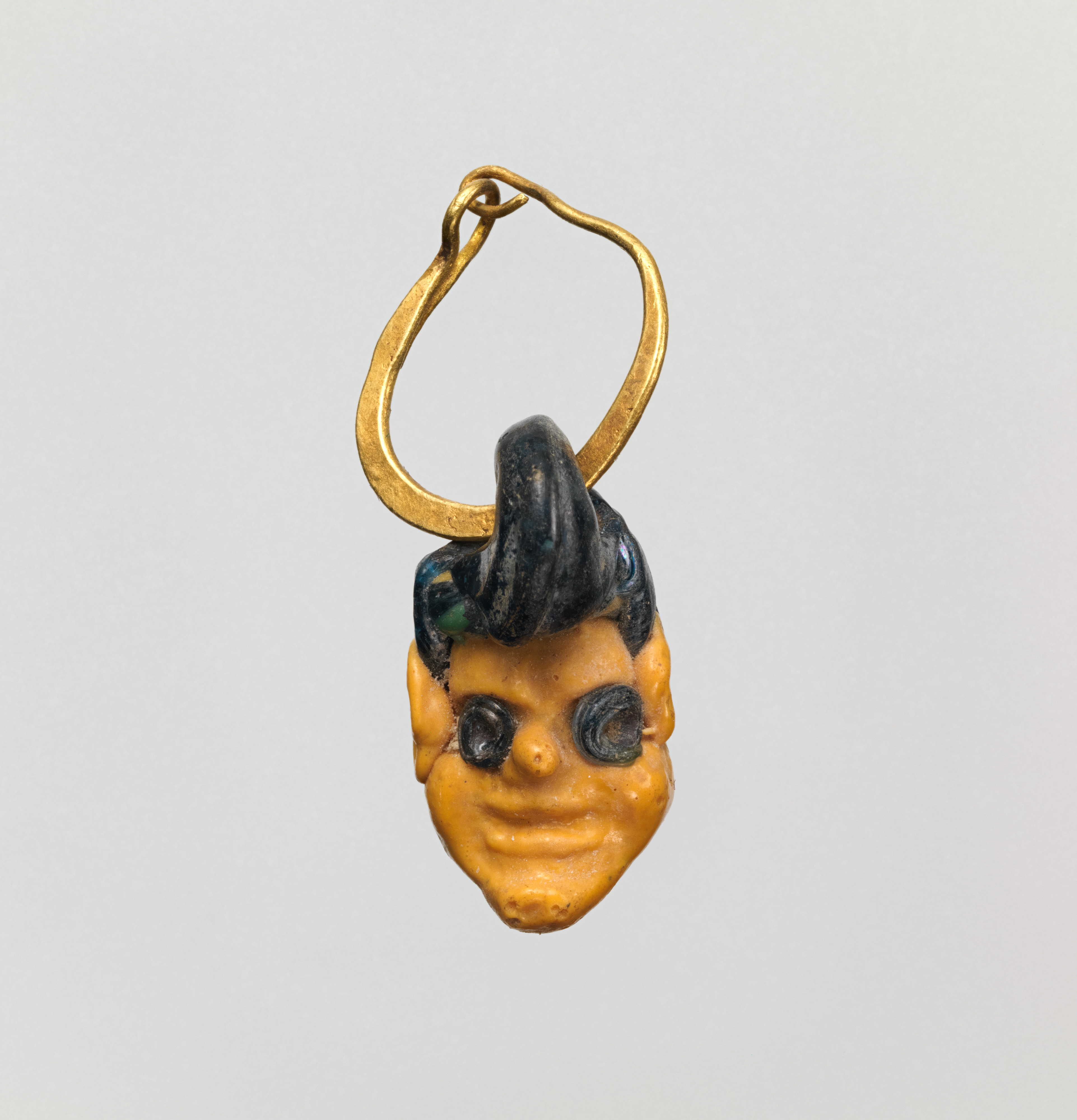
The artifact in question—a gold earring terminating in a glass head pendant, attributed to the Phoenician or Carthaginian sphere (circa 6th–3rd century BCE)—represents a masterclass in material tension. Its constituent elements, noble gold and fragile glass, are not merely decorative but serve as a dialectic between permanence and ephemerality, weight and luminosity. For Natalie Fashion Atelier, this piece is not an accessory; it is a structural manifesto for the 2026 haute couture season. This research deconstructs the earring’s classical elegance and translates its core principles—pendulous asymmetry, chromatic contrast, and suspended mass—into high-end silhouettes that redefine the female form.
I. Aesthetic Archaeology: The Grammar of the Pendant
The Phoenician goldsmith’s technique involved granulation and filigree to create a hollow or sheet-gold frame, into which a hand-formed glass head was inserted. The glass, often deep cobalt, emerald, or amber, was rendered through core-forming or mosaic methods, producing a face with stylized features. The result is a micro-architecture: a rigid gold cage containing a liquid-seeming, translucent core. The pendant’s weight is concentrated at the lowest point, creating a natural sway that alters the ear’s geometry with every movement.
For the 2026 silhouette, this principle of controlled gravity is paramount. The earring does not rest; it hangs. It pulls the eye downward, elongating the neck and framing the jawline. In couture, this translates to garments that borrow the same pendulous logic: fabrics that drape from a fixed point, weighted at the hem or shoulder, creating a dynamic line that shifts with the wearer’s gait. The glass head’s opacity—its refusal to be fully transparent—becomes a metaphor for layered revelation. The 2026 collection will employ sheer silks over opaque panels, mimicking the glass’s ability to catch light while concealing its interior.
II. Materiality as Structural Language: Gold and Glass in Fabric
The gold in the earring is not merely a precious metal; it is a structural armature. Its rigidity contrasts with the glass’s fragility, creating a dialogue between hardness and vulnerability. For the atelier, this informs the use of metallic thread embroidery and gilded structural boning. Gold Lurex or fine gold-plated chain is woven into bodices to create a cage-like effect that supports softer fabrics—chiffon, organza, or double-faced satin. The glass head, meanwhile, is reinterpreted through resin-encased crystal or lacquer-finished polymer pendants, suspended from gold filigree collars or sewn directly into necklines as sculptural focal points.
The chromatic pairing is equally deliberate. The deep blue or green glass against yellow gold produces a high-contrast jewel tone that is both ancient and futuristic. For 2026, this translates to a palette of midnight sapphire, emerald noir, and amber topaz, set against warm gold and bronze accents. The silhouette itself borrows the earring’s asymmetry: one-shouldered gowns, single-sleeved jackets, and hemlines that drop lower on one side than the other. This is not arbitrary asymmetry but a calculated imbalance, mirroring the earring’s off-center weight distribution.
III. The Pendant Silhouette: From Ear to Body
The most direct translation of the earring into a 2026 silhouette is the pendant dress. This garment is constructed with a single, heavy focal point—a large glass or resin pendant—suspended from a gold chain that wraps around the neck or shoulder. The pendant’s weight pulls the fabric into a cowl or a deep V-neckline, creating a vertical line that elongates the torso. The dress itself is cut from a single piece of bias-cut silk, its hem weighted with gold beads or small glass drops to echo the earring’s terminal mass.
For evening wear, the caged bustier is a direct reference to the gold filigree. A structured corset of gold-toned metal mesh or embroidered tulle encases the torso, with a single glass pendant suspended at the sternum. The pendant is removable, allowing the garment to transition from day to night. The silhouette is architectural: the bustier provides a rigid frame, while the pendant introduces a soft, organic movement. This duality—control and release—is the earring’s core lesson.
IV. Craftsmanship and the 2026 Atelier
The Phoenician earring required specialized artisans: a goldsmith for the frame, a glassworker for the head. For the 2026 collection, Natalie Fashion Atelier collaborates with glassblowers, metalworkers, and embroiderers to produce bespoke components. Each pendant is handcrafted, with the glass head’s interior containing a tiny gold bead that rattles softly—an auditory echo of the earring’s movement. The gold chains are hand-linked, and the filigree is executed using lost-wax casting techniques adapted from antiquity.
The silhouette construction itself borrows from historical tailoring: the pendant dress uses a bias cut that requires minimal seams, allowing the fabric to flow like molten glass. The caged bustier is built over a stays-and-boning foundation, referencing 18th-century corsetry but updated with modern elastic and lightweight metals. The result is a garment that feels both ancient and hyper-contemporary—a time-traveling artifact.
V. The 2026 Silhouette: A Synthesis
In summary, the Gold earring with glass head pendant informs the 2026 haute couture silhouette through three mechanisms:
1. Pendulous Asymmetry: Garments are designed with a single, heavy focal point—a pendant, a weighted hem, or a one-sided drape—that creates a dynamic, off-center line. This mimics the earring’s natural sway and elongates the figure.
2. Material Contrast: The juxtaposition of rigid gold and fragile glass is translated into fabric pairings: structured metallic mesh against fluid silk, or embroidered gold thread against transparent organza. The contrast creates visual tension and depth.
3. Chromatic Architecture: The deep jewel tones of the glass head—cobalt, emerald, amber—are used as primary colors, with gold serving as a structural accent. The palette is both opulent and restrained, evoking the Mediterranean sun on ancient glass.
The final silhouette is a wearable artifact: a garment that carries the weight of history while remaining utterly modern. It is not a costume but a reinterpretation of classical elegance through the lens of 21st-century craftsmanship. The earring’s lesson is that beauty lies in the tension between materials, in the balance of weight and lightness, and in the audacity to hang a glass face from a gold thread—and call it jewelry. For 2026, Natalie Fashion Atelier calls it couture.