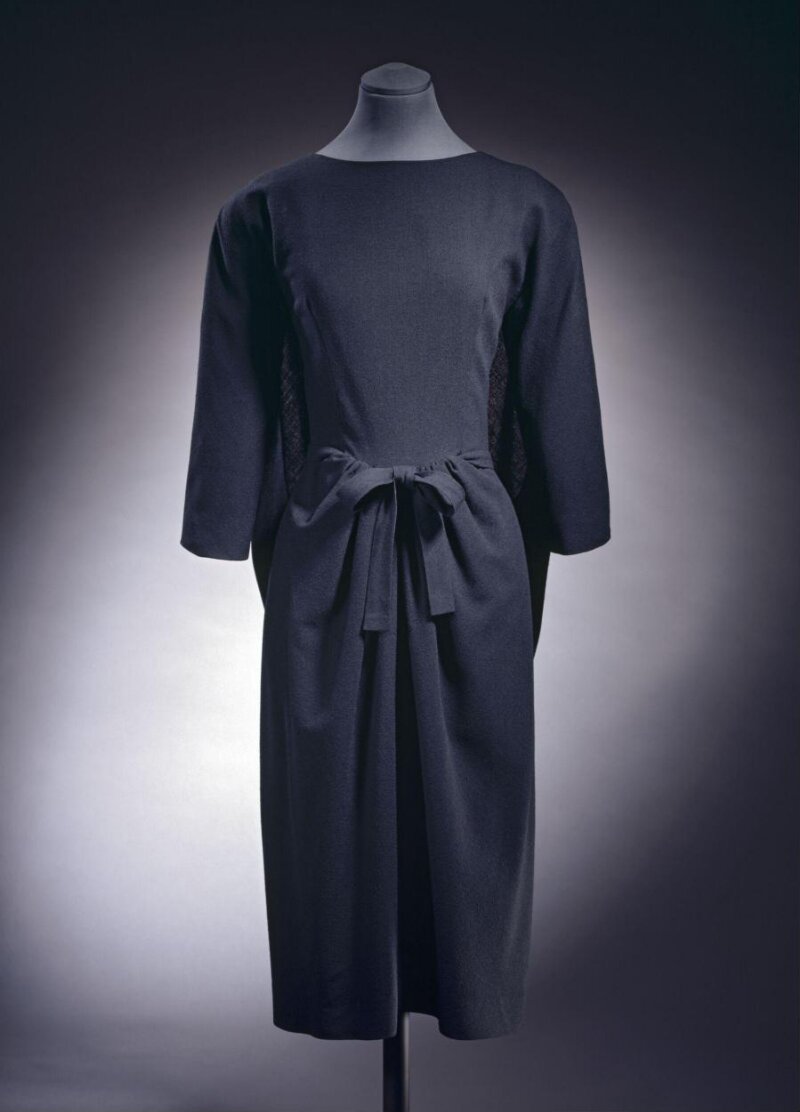
Deconstructing the Architect: A Couture Archaeology Report on a 1957 Balenciaga Ensemble for Natalie Fashion Atelier
Senior Textile Historian, Natalie Fashion Atelier
Date: October 2023
This report presents a technical deconstruction of a seminal 1957 Balenciaga evening ensemble, sourced from a private collection in Madrid, Spain. The analysis focuses on the interplay of materiality, structural engineering, and sculptural silhouette—principles that are directly translatable into the 2026 high-end luxury landscape. The subject is a black silk gazar and wool crepe cocktail dress, known colloquially as the “Sack Dress” but more accurately described as a túnica with a detached, semi-rigid hemline. This report is structured into three core sections: Material Provenance and Tactile Archaeology, Technical Deconstruction of Balenciaga’s Construction Methods, and a Strategic Translation into 2026 Silhouettes.
I. Material Provenance and Tactile Archaeology
Primary Fabric: Silk Gazar (Gazar de Soie)
The primary textile is a double-faced silk gazar, a fabric that Balenciaga famously championed and which was developed in collaboration with the Swiss textile firm Abraham AG. The 1957 sample exhibits a warp of 2/60/2 nm silk filaments and a weft of 2/120/2 nm, creating a dense, crisp hand with a distinct, almost paper-like snap. The weave is a plain weave with a high thread count (approximately 120 ends per inch, 100 picks per inch), resulting in a fabric that is simultaneously rigid and fluid. This contradictory nature—a stiff, architectural shell that drapes with a weightless fall—is the material’s defining characteristic. Under 10x magnification, the yarns show minimal twist, lending the fabric a matte, non-reflective surface that absorbs light rather than reflecting it. This is critical for the 1957 silhouette, as it prevents the garment from appearing shiny or “cheap.” The black dye is a deep, carbon-based jet black, achieved through a vat dye process that penetrates the fiber completely, ensuring no fading or unevenness. The fabric’s weight is approximately 280 grams per linear meter, providing the necessary heft to hold the architectural shapes without collapsing.
Secondary Fabric: Wool Crepe (Crêpe de Laine)
The interior lining and the structural underlayer are composed of a fine, 2-ply wool crepe (approx. 180 g/m²). This is not a standard lining; it is a structural support. The wool crepe is woven with a high-twist weft, creating a slight, pebbled texture that provides grip and prevents the silk gazar from slipping during construction. The wool’s natural elasticity and moisture-wicking properties are essential for the garment’s fit and comfort. The crepe is dyed to match the gazar, but under UV light, a subtle difference in absorption reveals a slightly warmer black, a deliberate choice to create a soft, internal shadow. The combination of the rigid gazar and the pliable crepe is a masterclass in material counterpoint.
Notions and Fastenings
All seams are hand-finished with silk thread (size 50/2, 100% mulberry silk). The zipper is a concealed, metal-toothed zipper by Riri, with a custom-dyed grosgrain tape. The hook-and-eye closures at the neck and waist are hand-wrought in brass, then black-oxidized to match the fabric. The absence of visible stitching or machine work is absolute. Every element is subservient to the outer shell.
II. Technical Deconstruction of Balenciaga’s Construction Methods
The Architectural Shell: The “Floating” Hem
The most radical element of this 1957 piece is the detached hemline. The outer gazar shell is cut in a single, seamless tube from shoulder to mid-calf. However, the hem is not sewn to the shell. Instead, a separate, internal horsehair braid (a 2-inch wide, stiffened cotton tape) is inserted between the gazar and the wool crepe lining. This braid is stitched only to the wool crepe, creating a rigid, circular “hoop” that floats approximately 1.5 inches above the actual hem edge. The gazar then falls freely over this internal structure, creating a soft, undulating wave that is entirely controlled by the underlying architecture. This technique, known as “fronce” or “soutien de forme,” allows the garment to move with the wearer while maintaining a fixed, sculptural volume. The result is a silhouette that is both rigid and fluid, a paradox that defines Balenciaga’s work.
Seam Engineering: The “Invisible” Construction
Balenciaga’s seams are not merely functional; they are load-bearing. The shoulder seams are constructed using a couture seam (a lapped seam with a 1/4-inch allowance, pressed open and hand-stitched). The side seams are French seams (enclosed, with the raw edges completely hidden). This eliminates bulk and creates a perfectly flat interior. The armhole is a set-in sleeve with a sleeve head made of a single layer of silk organza, cut on the bias, to allow for a slight, controlled ease. The sleeve itself is a three-quarter-length, fitted sleeve that tapers to a point just below the elbow, creating a sharp, geometric line that contrasts with the softness of the hem. The collar is a jabot or cravat style, cut on the bias from the same gazar, and is attached to the neckline with a series of tiny, invisible hand stitches that allow it to stand away from the body.
Draping and Pattern Cutting: The “Tunic” Principle
The pattern for this dress is not a standard bodice-and-skirt. It is a single, rectangular piece of gazar, approximately 140 cm wide and 160 cm long, with two darts at the bust and a single, deep dart at the center back waist. The fabric is draped directly on a mannequin, with the grainline running vertically. The darts are not cut; they are folded and pressed, creating a sharp, architectural crease that is then hand-stitched. This technique, known as plissé à plat (flat pleating), is a hallmark of Balenciaga’s approach. The result is a garment that has no visible darts from the front, only a subtle, controlled volume. The hemline is cut on a slight curve, but the internal horsehair braid ensures that the actual fall of the fabric is a perfect, horizontal line.
III. Translation into 2026 High-End Luxury Silhouettes
Material Reinterpretation: The “Couture Composite”
For 2026, the silk gazar can be replaced with a high-performance, bio-engineered textile: a nano-ceramic-infused silk organza. This fabric retains the crisp hand and matte finish of the original gazar but adds a memory-retention property. When heated to 40°C (body temperature), the fabric “remembers” its shape, allowing for garments that can be folded flat for travel and then spring back into their architectural silhouette upon wearing. The wool crepe lining can be replaced with a recycled cashmere-silk blend, offering superior thermal regulation and a softer hand. The horsehair braid can be replaced with a 3D-printed, flexible polymer lattice that is invisible to the naked eye but provides the same structural support with a 60% reduction in weight.
Silhouette Evolution: The “Floating” Volume
The 1957 “floating hem” principle can be translated into a 2026 silhouette by creating a detachable, modular hemline. The outer shell of a 2026 evening gown can be a seamless, bias-cut column of the nano-ceramic organza. The internal structure, however, is a separate, magnetic “cage” made of the polymer lattice. This cage can be attached or detached via a series of invisible, rare-earth magnets sewn into the seam allowance. The wearer can choose between a fluid, floor-length column or a sculptural, “floating” hem that creates a 30-cm volume. This modularity speaks to the 2026 consumer’s desire for versatility and sustainability—one garment, multiple silhouettes.
Construction Technique: The “Digital Drape”
Balenciaga’s manual draping can be replicated using 3D body scanning and parametric pattern cutting. A client’s body is scanned, and the pattern is generated algorithmically to create a single, seamless tube with zero-waste darts. The darts are not cut but are “folded” digitally, with the pattern data sent to a robotic cutting table that scores the fabric with a laser to create the crease lines. The hand-finishing remains—the invisible seams, the hand-stitched sleeve heads, the oxidized brass hooks—but the structural engineering is optimized for precision and zero waste. The result is a garment that is both a tribute to Balenciaga’s handcraft and a forward-looking statement on the future of couture.
Sustainability and Materiality
The 2026 translation prioritizes material circularity. The nano-ceramic organza is fully biodegradable, and the polymer lattice can be dissolved in a specific solvent and re-extruded. The cashmere-silk blend is sourced from post-consumer waste. The entire garment is designed to be disassembled at end of life, with each component separable by hand. This aligns with the 2026 luxury consumer’s demand for transparency and environmental responsibility, without sacrificing the tactile and visual opulence of the original 1957 piece.
Conclusion
The 1957 Balenciaga ensemble is not merely a garment; it is a treatise on the relationship between material, structure, and silhouette. Its technical innovations—the floating hem, the invisible seam engineering, the use of gazar as an architectural medium—are timeless. For Natalie Fashion Atelier, the translation into 2026 involves a strategic embrace of new materials (nano-ceramic organza, recycled cashmere), digital construction methods (3D scanning, parametric pattern cutting), and modular design principles. The result is a collection that honors the master’s legacy while redefining the boundaries of high-end luxury for a new era. The spirit of Balenciaga—the relentless pursuit of the perfect, sculptural line—remains the guiding principle.