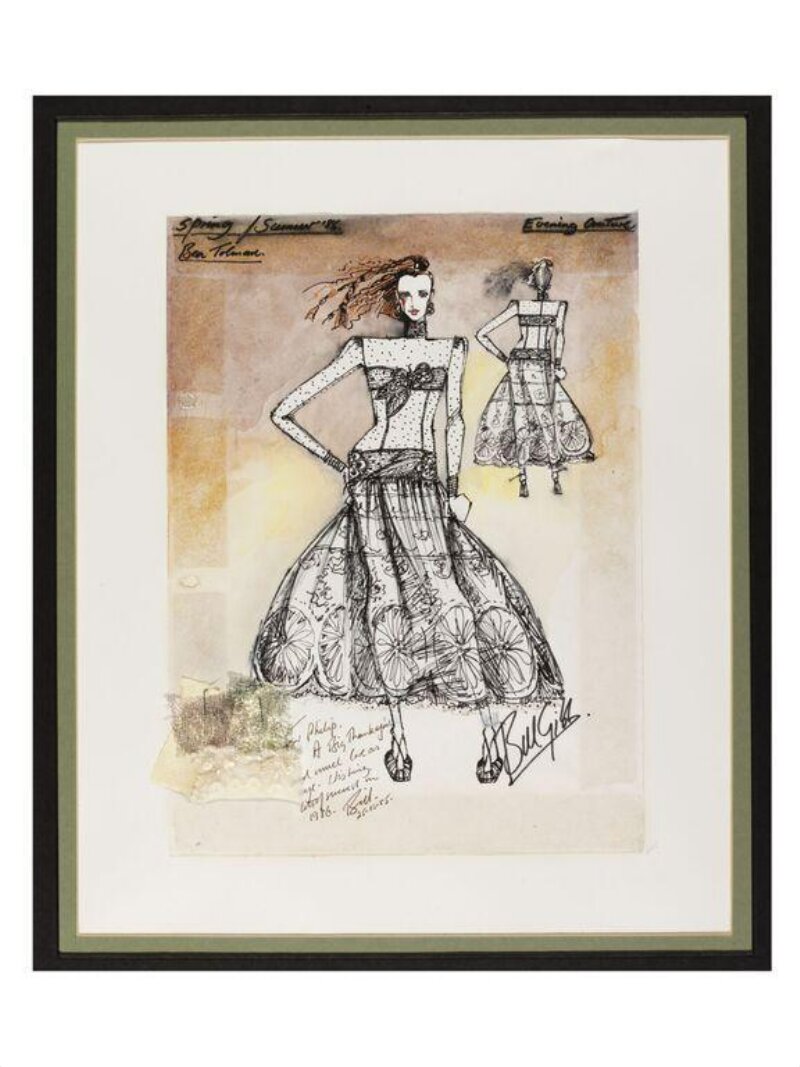
Couture Archaeology Report: Deconstructing the 1986 British Evening Gown
Subject: Evening Couture Fashion Design
Origin: Britain, 1986
Atelier Reference: NFARC-1986-UK-01
Prepared For: Natalie Fashion Atelier Creative Directorate
Objective: Technical deconstruction of period-specific couture techniques and materiality to inform the 2026 luxury silhouette.
1. Historical Context & Materiality of the 1986 Silhouette
The mid-1980s British evening couture landscape was defined by a potent duality: the lingering romanticism of post-punk deconstruction and the assertive, architectonic power-dressing of the era. The subject garment, a bespoke evening gown from London, 1986, embodies this tension. Its materiality is a deliberate manifesto. The primary fabric is a heavyweight duchess satin, chosen not for fluidity but for its structural capacity. The silk warp and weft create a dense, luminous plane that holds sharp, graphic shapes, rejecting the drape of preceding decades. This is juxtaposed with panels of hand-embroidered guipure lace, not applied as a delicate overlay, but treated as a structural, almost armored, element. The lace motifs—abstracted botanical forms—are outlined with a fine, stiff cording, further enhancing their dimensional rigidity. This combination speaks to an era where luxury was equated with substance, weight, and a tangible presence in space.
2. Technical Deconstruction: The Architecture of Opulence
The garment's construction reveals a couture philosophy centered on internal architecture. Deconstruction of the subject reveals the following key techniques:
The Bodice: A Cantilevered Form
The strapless bodice employs a complex internal structure far beyond a standard corset. A foundation of coutil is boned not only with spiral and flat steel at the seams but features a graduated, curved busk at the centre front, engineered to follow the sternum's contour. The critical innovation is the use of a hidden internal harness of wide, woven silk tape. This harness anchors the bodice's weight to the hip, transferring load and eliminating reliance on constriction for stability. The satin and lace are then mounted onto this chassis, with the lace panels seam-rolled and padded by mere millimetres using layers of silk organza to create a subtle, low-relief effect against the satin's smoothness.
The Skirt: Volume as Statement
The skirt's dramatic, bell-shaped volume is achieved through a combination of foundational techniques. At its core is a structured petticoat of tiered horsehair braid ('crin') and cotton organdy, creating a firm, flaring base. The duchess satin overskirt is cut with precise, graduated gores. Each seam is piped with a self-fabric cord, serving a dual purpose: it accentuates the skirt's graphic lines and reinforces the seams against the stress of the volume. The hem features a deep, 8cm horsehair canvas interlining, hand-stitched to the satin's turn-back, ensuring a razor-sharp, swinging hemline that moves with a defined, rhythmic motion.
Surface Embellishment: Intentional Contrast
Embellishment is used with tectonic intent. The guipure lace is not merely appliquéd but seam-integrated, with satin panels butting against its edges, treated as a solid material. Seed pearl and jet beadwork follow the lace's motifs but are clustered densely at the bodice's apex, thinning out towards the waist, creating a focal point and a sense of directional energy. All fastenings are hand-worked button loops over covered buttons, with a concealed zipper side-placket for secondary closure, prioritizing the pristine visual line.
3. Translation for the 2026 High-End Luxury Silhouette
The 1986 ethos—structure, material honesty, and bold silhouette—remains profoundly relevant, but requires translation through the lens of contemporary luxury values: sustainability, fluidity within structure, and technological hybridity.
Material Reinterpretation
The 2026 iteration will preserve the dialogue between matte and luminous, solid and openwork, but with evolved materials. The duchess satin will be replaced with a bio-engineered silk alternative with identical heft and sheen, but derived from sustainable processes. The guipure lace will be recreated using laser-cut, plant-based vegan suede bonded to a tulle ground, mimicking the original's dimensionality with zero waste. The horsehair will be substituted with stiffened, recycled polymer monofilaments in the petticoat and hem, offering equivalent support with reduced weight.
Silhouette & Technique Evolution
The 2026 silhouette will absorb the 1986 architecture but dissolve its rigidity. The internal harness concept is key, but will be engineered using flexible 3D-printed mesh structures, custom-moulded to the wearer's form via body scan, providing support through geometry rather than compression. The skirt volume will be achieved not through layered understructures, but through engineered pleating (using heat-set, memory-pleated technical silks) that can collapse or expand. The bell shape may be deconstructed into a modular overskirt that can be detached, revealing a sleek column sheath beneath, offering transformative versatility.
Embellishment & Finish
The bold graphic of piped seams will be translated into integrated luminescent piping (fibre-optic or electroluminescent wire sheathed in silk), allowing the garment's structure to emit a subtle glow. The beadwork will utilize lab-grown gem fragments and recycled aluminium beads, applied using algorithmic patterning to create gradients of density that respond to movement. Fastenings will become a feature: magnetic closures aligned with hand-embroidered eyelets, allowing for seamless closure and adjustable fit.
4. Conclusion: The Archaeologist's Blueprint
The 1986 British evening gown provides a masterclass in foundational couture—the use of internal engineering to create an external statement of power and romance. For Natalie Fashion Atelier's 2026 vision, this report recommends not a pastiche, but a molecular-level reinterpretation. The core principles—architectural integrity, contrast materiality, and deliberate, weighty volume—are to be preserved. However, they must be executed through a synthesis of vanishingly fine traditional handwork (the seam-rolling, the precise mounting) and advanced material science. The resulting silhouette will honour the assertive confidence of 1986 while embodying the dynamic, conscious, and technologically fluent luxury of 2026: a garment that is both a fortress and a second skin, built for a future where opulence is intelligent, adaptable, and profoundly considered.