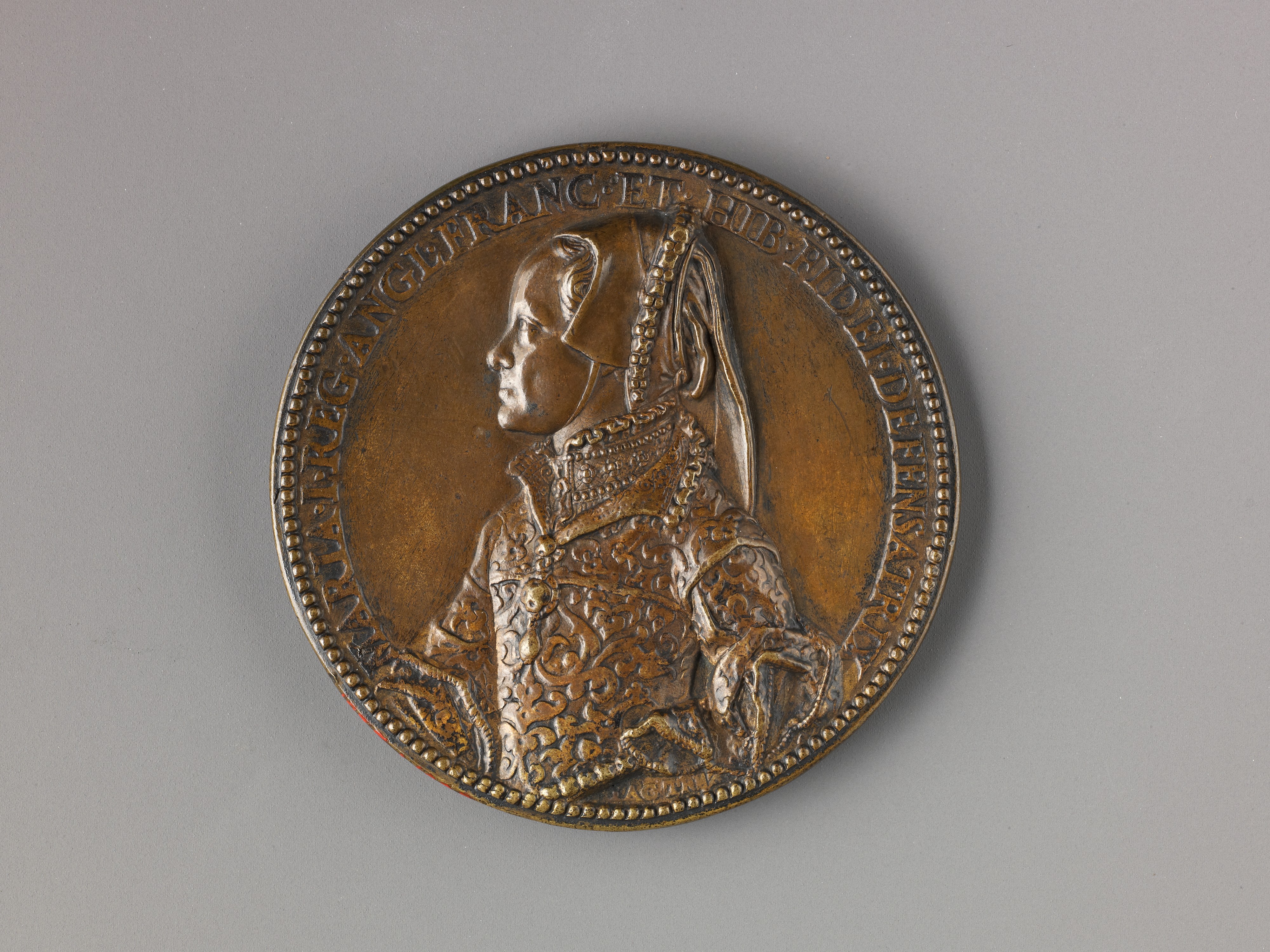
Portrait Medal of Mary Tudor: Aesthetic Archaeology and the 2026 Silhouette
Artifact Analysis: The Bronze Portrait Medal of Mary Tudor
The object under study—a portrait medal of Mary Tudor, Queen of England (obverse), paired with an allegorical representation of her reign (reverse)—represents a singular convergence of Renaissance political iconography and metallurgical mastery. Crafted in a copper alloy that has developed a honey-colored patina over centuries, this medal is not merely a commemorative object but a sophisticated aesthetic artifact whose formal properties resonate with contemporary luxury design. The obverse presents a rigorously structured profile: a high forehead, a defined jawline, and a regal posture framed by elaborate headdress and collar. The reverse, an allegorical tableau, introduces a dynamic counterpoint—flowing drapery, symbolic figures, and a sense of narrative movement. This duality of rigid structure versus fluid allegory forms the conceptual foundation for our 2026 haute couture investigation.
Materiality and Patina: The Bronze Alloy as Design Lexicon
The medal’s material composition—a copper alloy with a honey-colored patina—offers a nuanced palette for textile and silhouette development. The patina itself is not a surface defect but a time-induced finish, a chemical transformation that adds depth, warmth, and a sense of historical gravitas. For the 2026 collection, this translates into a deliberate exploration of oxidized metallic finishes on fabrics. Consider a silk gazar treated with a copper-infused foil that mimics the alloy’s initial brightness, then subtly distressed to reveal a honeyed undertone. The patina’s color gradient—from deep bronze to warm amber—informs a monochromatic layering strategy: a bodice in burnished copper lamé, a skirt in honey-toned matte faille, and a train in translucent bronze organza. The materiality of the medal thus becomes a chromatic and textural blueprint for constructing garments that appear both ancient and avant-garde.
Silhouette Construction: The Rigid Profile and the Allegorical Flow
The obverse’s rigid profile—the sharp delineation of Mary Tudor’s jawline, the geometric precision of her collar—directly informs the construction of structured, architectural silhouettes. For 2026, we propose a “medallic” shoulder: a sharply defined, almost sculpted shoulder line achieved through internal boning and a high, stand-away collar reminiscent of Renaissance portraiture. This is not a soft, draped shoulder but a hard architectural element, a nod to the medal’s metallic rigidity. The bodice, similarly, is a study in containment—a corseted shell that references the medal’s circular boundary, with seams that trace the contours of a profile view. The waist is cinched, but the line is not softened; it is a clear, deliberate incision in the garment’s structure.
Conversely, the reverse’s allegorical flow—the swirling drapery of the allegorical figures, the implied motion of the narrative—introduces a counterpoint of fluidity. This is expressed in the 2026 silhouette through asymmetrical, trailing elements: a single sleeve that extends into a cape-like panel, a skirt that is structured at the hip but cascades into a liquid train. The contrast is intentional and dramatic. The garment begins as a rigid, medallic form at the shoulder and bodice, then dissolves into allegorical movement at the hem. This duality mirrors the medal’s own formal tension: the fixed, eternal profile of the queen versus the dynamic, interpretative scene of her reign.
Surface Embellishment: Engraved Lines and Patina Effects
The medal’s surface is defined by engraved lines—the delicate incisions that form the queen’s hair, the folds of her garments, the symbolic details on the reverse. For haute couture, this translates into intricate embroidery and beading that functions as a form of textile engraving. We propose a technique of metallic thread couching on a bronze-toned base fabric, creating linear patterns that mimic the medal’s engraved details. The honey-colored patina effect is replicated through layered appliqué: a base of copper-colored silk, overlaid with a sheer, amber-toned tulle, and then embroidered with bronze beads and sequins. The result is a surface that appears to have aged and transformed, with the underlying fabric peeking through like the bronze beneath the patina. This technique is applied selectively—concentrated on the bodice and shoulders (the obverse zone) and fading into the skirt (the reverse zone), reinforcing the silhouette’s narrative arc.
Color Palette: Bronze, Amber, and Oxidized Greens
The color palette for the 2026 collection is directly extracted from the medal’s materiality. The primary hue is a deep, metallic bronze, achieved through a combination of copper-infused silk and bronze-toned metallic threads. This is complemented by warm amber, the color of the honey-colored patina, used in sheer overlays and lining fabrics. A tertiary note of oxidized green—a subtle, almost imperceptible verdigris—is introduced through jacquard weaves and printed patterns, referencing the copper alloy’s natural aging process. This is not a literal reproduction of the medal’s colors but a sophisticated translation into a textile palette that feels both historical and entirely contemporary. The overall effect is one of controlled decay and preserved luxury, a garment that appears to have been unearthed from a Renaissance treasury yet possesses the precision of 2026 craftsmanship.
Proportion and Scale: The Medallic Frame
The medal’s circular format introduces a consideration of proportion and scale. The obverse’s profile is contained within a defined boundary, while the reverse’s allegory expands beyond it. In silhouette terms, this suggests a focal point of containment—a tightly structured bodice—that then expands into a wider, more voluminous skirt. The 2026 silhouette is thus characterized by a dramatic A-line or a bell-shaped skirt, with the volume concentrated below the hip. The hemline is not a clean edge but a scalloped or irregular border, referencing the medal’s edge and the organic quality of the patina. The overall proportion is elongated and regal, with a high waist and a long, sweeping line that echoes the queen’s formal posture.
Conclusion: An Artifact for the Future
The portrait medal of Mary Tudor, with its dual faces of rigid portraiture and flowing allegory, its bronze materiality and honey-colored patina, offers a complete design system for the 2026 haute couture silhouette. It is not a source of literal historical costume but a conceptual and material lexicon that informs structure, surface, color, and proportion. The resulting garments are archaeological in their depth and futuristic in their precision, embodying the tension between the fixed and the fluid, the ancient and the new. For Natalie Fashion Atelier, this artifact is not a relic but a living design document, a testament to the enduring power of aesthetic archaeology to shape the luxury silhouettes of tomorrow.