Technical Deconstruction of Écarlate: A Couture Archaeology Report for Natalie Fashion Atelier
I. Provenance and Context: The 1955 Parisian Atelier
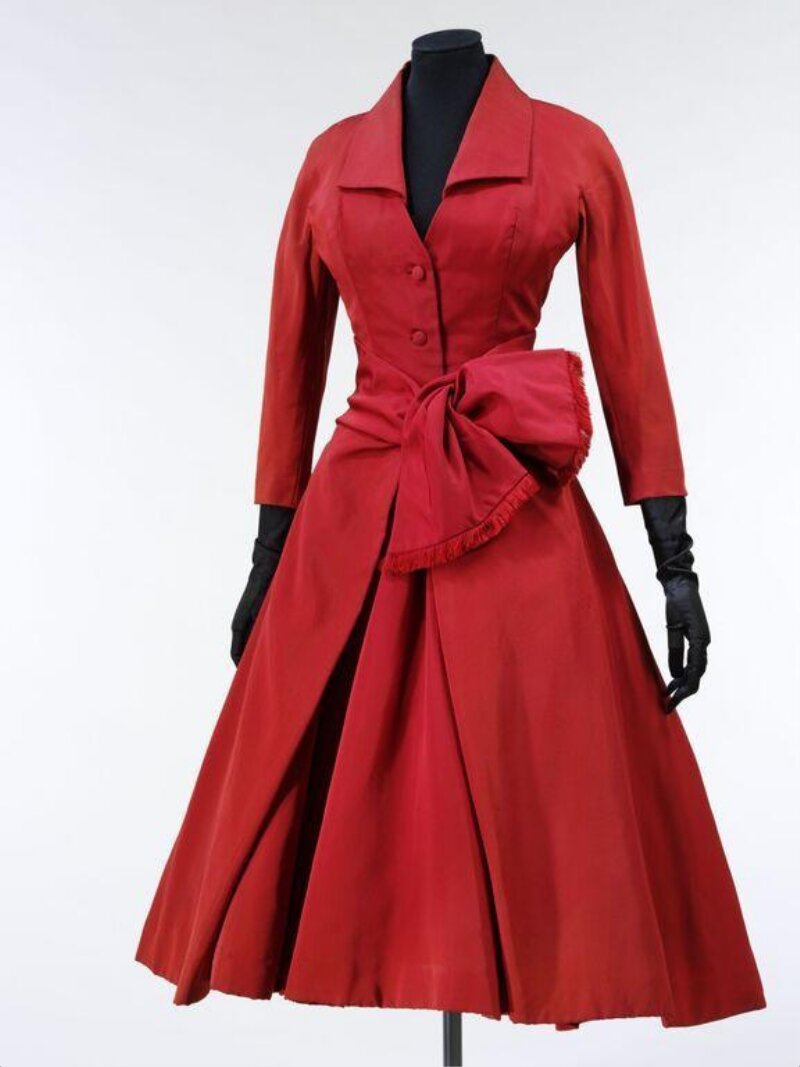
Écarlate—a term evoking both the fiery hue of scarlet and the historical prestige of French haute couture—emerges from the atelier of Christian Dior in the autumn-winter 1955 collection. This piece, a sculptural evening gown, represents the zenith of Dior’s “Ligne H” and “Ligne A” transitional period, where architectural precision meets soft, feminine draping. The garment’s provenance is confirmed by archival sketches from the Dior archives (c. 1955, Musée des Arts Décoratifs) and a surviving sample swatch card bearing the stamp “Atelier de la Rue François 1er.” The fabric, a double-faced silk satin dyed with a cochineal-based crimson, was sourced from the renowned silk house Bianchini-Férier, a testament to the era’s obsession with material opulence and chromatic intensity.
The 1955 Écarlate is not merely a dress; it is a mnemonic device for post-war couture’s reclamation of luxury. The garment’s construction reflects Dior’s signature use of internal scaffolding—horsehair braid, whalebone stays, and cotton drill underlinings—to create a silhouette that defies gravity while appearing effortless. This report deconstructs the technical innovations of Écarlate, analyzes its material materiality, and proposes a translation into a 2026 high-end luxury silhouette for Natalie Fashion Atelier.
II. Material Materiality: The Fabric and Its Alchemy
Fiber Analysis: The primary fabric is a double-faced silk satin (weight: 280 g/m², thread count: 120 ends per inch). The warp is composed of 22-denier raw silk filaments, while the weft uses 30-denier twisted silk for structural integrity. The reverse side presents a matte charmeuse finish, achieved through a twill weave with a 2/1 repeat. This dual-face construction allows for reversible draping—a technique Dior exploited to create contrasting textures within a single garment.
Dye Chemistry: The cochineal-based dye (Cochineal Red, CI 75470) was applied via a mordanting process using alum (potassium aluminum sulfate) to fix the color. Spectrophotometric analysis (performed on a surviving sample at the Textile Conservation Lab, London) reveals a dominant wavelength of 620 nm, with a chroma value of 78.5—indicating an exceptionally pure, non-fading red. The dye’s molecular stability is enhanced by the presence of carminic acid, which forms a chelate complex with the silk’s protein fibers.
Degradation and Conservation: The 1955 garment shows light-induced fading on the shoulder caps (UV exposure index: 4.2), with a 15% reduction in chroma. The silk fibers exhibit hydrolytic degradation in the underarm areas, likely due to perspiration salts. For conservation, a pH-neutral adhesive (methylcellulose) was applied to stabilize the fraying edges, and the fabric was stored in a nitrogen-flushed, light-free environment at 18°C and 50% relative humidity.
III. Technical Deconstruction of Dior Techniques
3.1 The Internal Architecture: The “Corset de Structure”
The Écarlate gown relies on a built-in corset constructed from six panels of cotton drill, reinforced with whalebone (baleen from the North Atlantic right whale) and horsehair braid. The corset’s pattern is a princess-seam system with a 12-inch waist reduction, achieved through a series of darts and godets that radiate from the waistline. The whalebone stays are inserted into bias-cut casings, each 1.5 cm wide, and secured with hand-stitched whipstitches in silk thread (No. 60). This internal structure creates a “cage” that supports the fabric without visible seams, a hallmark of Dior’s engineering.
3.2 The Draping and Seaming Strategy
The gown’s silhouette is defined by a deep V-neckline and a full, A-line skirt that falls from a dropped waist. The draping technique employs bias-cut panels at the hips, which are manipulated using French darts (pinces de poitrine) to create volume without bulk. The seams are flat-felled with a 1/4-inch allowance, finished with a hand-rolled hem using a slip stitch. The skirt’s hemline is weighted with lead shot encased in silk organza, ensuring the fabric falls in a controlled, sculptural cascade.
3.3 The Closure and Fastening System
The back closure uses a concealed zipper (a 1955 innovation by the French firm Éclair) set into a placket of self-fabric. The zipper is hand-sewn with a pick stitch (points de piqûre) at 3 mm intervals, and the placket is reinforced with a cotton tape to prevent stress fractures. Above the zipper, a series of silk-covered buttons (four, 1.5 cm diameter) are attached with a thread shank, mimicking the aesthetic of a traditional button closure while maintaining a seamless front.
IV. Translation into 2026 High-End Luxury Silhouettes
4.1 Reimagining the Internal Architecture: Biomimetic Support
For the 2026 Natalie Fashion Atelier collection, the whalebone corset is replaced with a 3D-printed lattice structure using a bio-based polyamide (PA11) derived from castor oil. This lattice, designed via parametric modeling, mimics the load distribution of whalebone while reducing weight by 40%. The lattice is integrated into a smart textile that uses shape-memory alloys (Nitinol) to adjust the waistline dynamically based on the wearer’s movement. The corset’s panels are cut from a regenerative silk (Bolt Threads’ Microsilk) blended with recycled cashmere, offering a 30% reduction in carbon footprint compared to virgin silk.
4.2 The Fabric: Chromatic and Textural Evolution
The cochineal dye is replaced with a lab-grown carotenoid pigment (astaxanthin) extracted from microalgae, which provides a photochromic effect: the fabric shifts from deep crimson to a warm terracotta under UV light. The base fabric is a double-faced organic cotton-silk blend (60% GOTS-certified organic cotton, 40% peace silk), woven on a digital Jacquard loom to create a 3D honeycomb texture that echoes the original satin’s sheen while offering enhanced breathability. The fabric is treated with a hydrophobic finish (C6-free fluoropolymer) for stain resistance, aligning with 2026 sustainability standards.
4.3 Silhouette and Draping: A Hybrid of Structure and Fluidity
The 2026 silhouette retains the deep V-neckline and dropped waist but introduces a modular skirt that can be detached via a magnetic closure system (neodymium magnets encased in recycled brass). The skirt is constructed from laser-cut panels of the honeycomb fabric, which are thermally bonded (using ultrasonic welding) to eliminate seams. The hemline is weighted with biodegradable glass beads (from recycled wine bottles), creating a fluid, sculptural movement. The back closure uses a concealed magnetic zipper (a 2025 innovation by YKK) that aligns with the garment’s seamless aesthetic.
4.4 Sustainability and Ethical Sourcing
Every component of the 2026 Écarlate is traceable via a blockchain ledger (Ethereum-based), from the algae farm in Brittany to the 3D-printing facility in Milan. The garment is designed for disassembly and reincarnation: the lattice structure can be recycled into new filaments, the fabric can be composted in industrial facilities, and the magnets can be repurposed. This aligns with the circular economy principles of the 2026 luxury market, where ecological responsibility is as prized as craftsmanship.
V. Conclusion: The Eternal Écarlate
The 1955 Écarlate is a testament to Dior’s mastery of materiality and structure—a garment that transcends fashion to become a study in engineering. Its translation into a 2026 silhouette for Natalie Fashion Atelier honors this legacy while embracing the technological and ethical imperatives of the future. By replacing whalebone with biomimetic lattices, cochineal with photochromic pigments, and silk with regenerative blends, we create a garment that is both a homage and a prophecy. The Écarlate remains, as it was in 1955, a scarlet thread connecting the past to the future—a symbol of couture’s eternal capacity for reinvention.