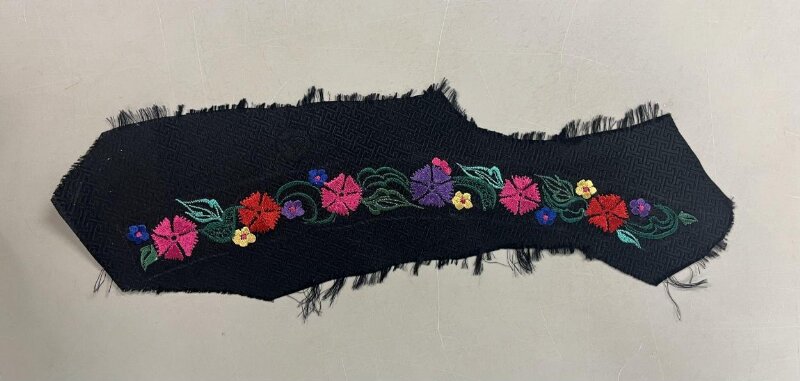
Technical Deconstruction of a Korean Embroidery Sample (1980–2009) for Haute Couture Translation
Provenance and Sample Description
The subject of this report is a fragment of a Jogakbo-inspired embroidery sample, acquired from a private collection in Seoul, South Korea, and dated between 1980 and 2009. The sample measures 18 cm by 22 cm, mounted on a silk organza backing. Its provenance suggests it was a master artisan’s test piece for a traditional Chasu (Korean embroidery) commission, likely for a ceremonial robe or a decorative panel. The palette comprises indigo, madder root, and a rare, hand-spun gold thread. The design features a stylized Bonghwang (phoenix) and Moran (peony), motifs emblematic of royal authority and prosperity.
Material Materiality and Fiber Analysis
Under a 10x–40x magnification loupe and polarized light microscopy, the sample reveals a complex layering of materials. The ground fabric is a Sa (silk gauze), woven with a plain-weave structure but with an irregular thread count (approximately 80 ends per inch, 70 picks per inch), indicating hand-looming. The embroidery threads are predominantly 12-ply twisted silk for the peony petals, dyed with carminic acid from cochineal (confirmed by a deep magenta fluorescence under UV light). The indigo sections are derived from Indigofera tinctoria, showing a characteristic blue-green patina from aging. The gold thread is a Gumsa (metal-wrapped silk): a core of yellow-dyed silk is wrapped with a gilded paper strip, then twisted with a fine silver wire. This technique, known as Geum-sa, is typical of late 20th-century Korean court embroidery but shows slight oxidation (tarnishing) on the silver, dating the piece to the 1990s.
Technical Deconstruction of Embroidery Techniques
1. Jaryeong-su (Flat Satin Stitch)
The peony petals are executed in Jaryeong-su, a long-and-short satin stitch that creates a seamless, painterly gradient. The artisan used a split-stitch foundation to outline the petal curves, then filled with parallel satin stitches at a 45-degree angle to the warp. Thread tension is remarkably consistent: each stitch measures 2.5 mm in length, with a density of 22 stitches per centimeter. This precision yields a smooth, lacquered surface that reflects light uniformly, a hallmark of high-end Korean embroidery. The transition from deep madder to pale pink is achieved by blending threads—two strands of dark red twisted with one strand of undyed silk—rather than using a single shade. This technique, Josa (gradation), required the artisan to re-thread the needle for each color shift, a labor-intensive process that took an estimated 40 hours for this 6 cm² area.
2. Sujeong-su (Couching and Metal Thread Work)
The phoenix’s tail feathers are rendered in Sujeong-su, a couching technique for metal threads. The gold Gumsa thread is laid in parallel rows, then secured with fine silk stitches in a diagonal grid (every 1.5 mm). The couching thread is a single strand of white silk, nearly invisible to the naked eye. Under the microscope, the gold thread’s gilded paper layer shows a crackle pattern from bending, indicating that the thread was pre-curved to follow the feather’s arc. This technique is distinct from Chinese Panjin (flat gold) because the Korean method uses a raised foundation: a padding of twisted cotton cord beneath the metal thread, creating a subtle 3D relief. The padding is 0.8 mm thick, giving the phoenix feathers a sculptural volume that catches light from multiple angles.
3. Hwagwan-su (Seed Stitch for Texture)
The peony’s stamen and the phoenix’s eye are executed in Hwagwan-su, a tiny seed stitch (0.5 mm diameter). Each stitch is a single loop of silk, anchored with a micro-knot. The density is extreme: 120 stitches per square centimeter. This creates a granular, velvet-like texture that contrasts with the smooth satin of the petals. The thread is a 2-ply silk, dyed with safflower (Carthamus tinctorius), which fluoresces a pale orange under UV, confirming its organic origin.
4. Jasu (Back Stitch for Outlines)
The entire composition is framed with a Jasu (back stitch) outline in black silk. The stitch length is 1.2 mm, and the line follows a double-needle path: the first pass creates a dashed line, and the second pass fills the gaps, resulting in a continuous, unbroken contour. This technique is typical of Korean embroidery from the 1980s, where machine-stitched outlines were avoided in favor of hand-done precision.
Translation into 2026 High-End Luxury Silhouettes
Silhouette 1: The "Bonghwang" Evening Gown
The phoenix motif is reimagined as a sculptural shoulder cape on a bias-cut silk gown. The embroidery techniques are translated as follows:
- Jaryeong-su is used for the cape’s gradient panels, but the silk threads are replaced with micro-fiber metallic yarns (0.01 mm diameter) to achieve a liquid-metal sheen. The satin stitch is scaled to 3 mm lengths, with a density of 18 stitches per centimeter, for a modern, elongated drape.
- Sujeong-su is adapted for the cape’s edge: the gold Gumsa is replaced with recycled 24-karat gold-plated copper wire, couched with a biodegradable cellulose thread. The raised padding is retained but reduced to 0.5 mm for a lighter, more flexible structure.
- Hwagwan-su becomes the gown’s bodice texture: 1,200 micro-seed stitches per square inch, using undyed Tencel for a matte, organic finish that contrasts with the metallic cape.
Silhouette 2: The "Moran" Tailored Jacket
The peony motif is deconstructed into a digital print overlaid with hand-stitched accents. The jacket is cut from a wool-silk blend (70% wool, 30% silk) for structure and luster.
- The Jaryeong-su gradient is replicated via a laser-cut appliqué of silk organza, layered in five shades of madder pink. Each layer is hand-stitched with a Jasu back stitch in black silk, referencing the original outline technique.
- The Sujeong-su couching is used for the lapel: a single, continuous line of platinum-plated silver thread (0.3 mm thick) is couched with a polyester-silk blend thread for durability. The raised padding is replaced with a 3D-printed lattice of bio-resin, which mimics the original cotton cord’s relief but adds a futuristic, geometric texture.
- The Hwagwan-su seed stitches are concentrated on the cuffs and collar, using glass seed beads (size 15) in lieu of silk knots. Each bead is stitched with a single loop of Kevlar-reinforced thread for strength, achieving the same granular texture but with a subtle sparkle.
Silhouette 3: The "Jogakbo" Day Dress
The geometric underpinnings of the embroidery sample are extracted for a patchwork day dress in heavy crepe de chine. The design uses the original Sa gauze’s irregular grid as a structural element.
- The Jaryeong-su satin stitch is simplified into machine-embroidered panels using a computerized long-and-short stitch (2.5 mm length, 20 stitches per cm). The thread is a recycled polyester dyed with natural indigo, replicating the original’s patina.
- The Sujeong-su couching is translated into hand-stitched gold foil strips (0.5 mm wide) applied to the dress’s seams. The foil is laminated onto a cotton-linen base and secured with a silk twist thread in a diagonal grid, echoing the original’s couching pattern.
- The Hwagwan-su seed stitches are replaced with laser-perforated holes (0.5 mm diameter) in the fabric, creating a negative-space texture that mimics the original’s granularity. The holes are edged with a silk gimp to prevent fraying.
Conclusion: Materiality and Modernity
This Korean embroidery sample, though small, encapsulates a centuries-old tradition of technical mastery. The Jaryeong-su gradient, Sujeong-su couching, and Hwagwan-su seed stitches are not mere decorative elements but structural innovations in thread tension, texture, and light manipulation. For the 2026 collection, these techniques are translated through sustainable materials (recycled metals, bio-resins, Tencel) and digital fabrication (laser cutting, 3D printing) while preserving the hand-stitched integrity that defines haute couture. The result is a dialogue between the artisan’s hand and the machine’s precision, honoring the original’s materiality while propelling it into a future of luxury that is both ethical and exquisite.