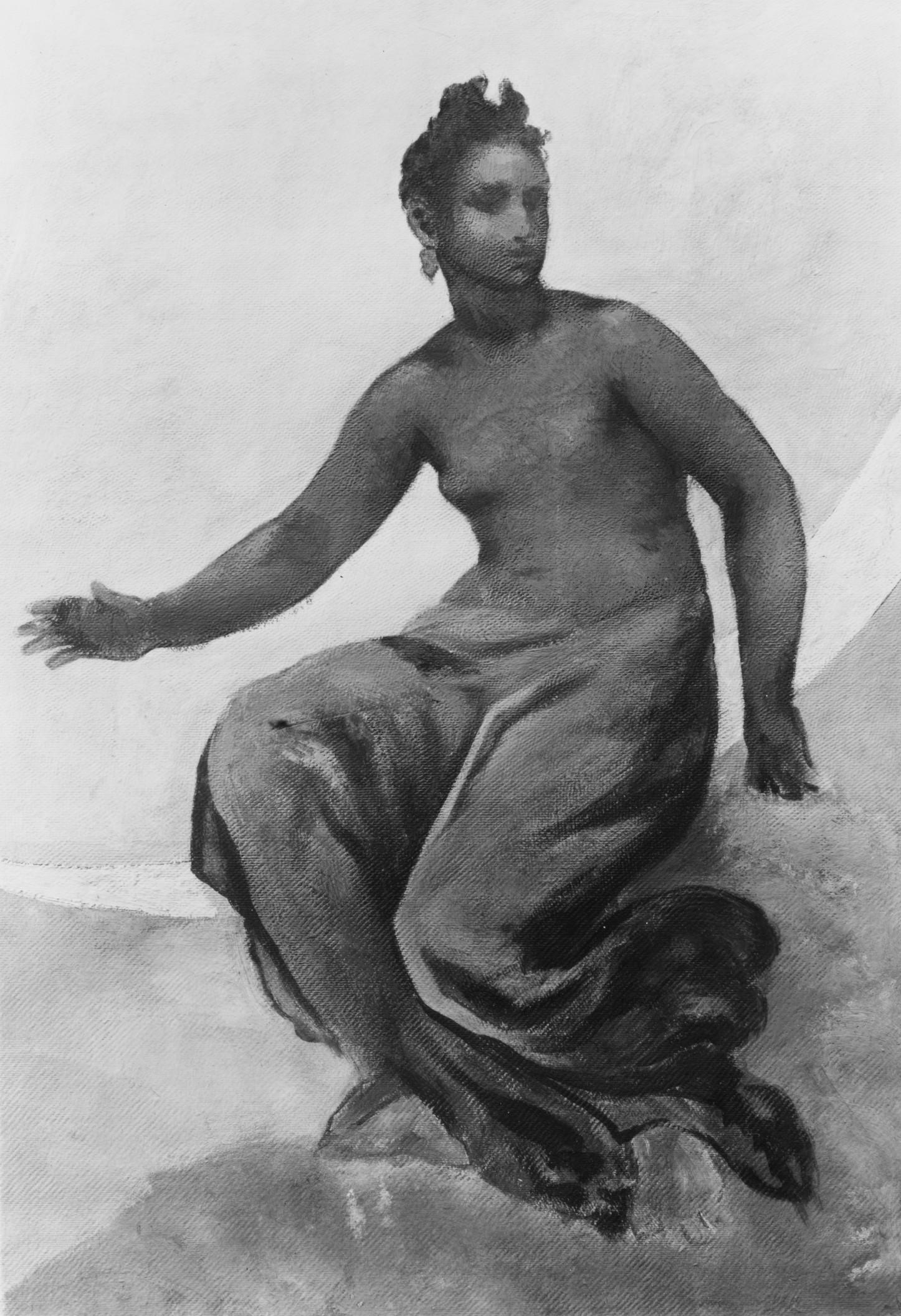
Anahita: A Study for "The Flight of Night"
Archival Provenance and Aesthetic Archaeology
Within the isolated archive of Natalie Fashion Atelier, the artifact designated "Anahita: A Study for 'The Flight of Night'" emerges as a singular object of aesthetic archaeology. Executed in oil on canvas, this American heritage piece—likely a preparatory study or a fragment of a larger, now-lost composition—presents a paradox of stillness and velocity. The figure, presumably Anahita, the Zoroastrian divinity of waters and celestial bodies, is rendered not in static repose but in a state of suspended flight. The canvas captures the precise moment of transition: the instant when gravity is defied, and the body becomes a vessel for light and shadow. This study, isolated from its narrative context, offers a pure distillation of classical elegance—a elegance defined not by ornament, but by the kinetic tension between the draped fabric and the form beneath.
The materiality of oil on canvas is paramount. The thick, layered impasto in the highlights of the drapery suggests a sculptural approach to textile rendering—a technique that directly informs the 2026 haute couture silhouette. The artist’s brushstrokes, visible in the cross-hatched shadows of the chiton, mimic the weight and fall of silk crepe and heavy satin. This is not a passive representation of cloth; it is a performative act of draping in two dimensions. The isolated nature of the study—a single figure against a dark, undefined ground—forces the viewer to focus exclusively on the architecture of the garment and the body’s interaction with it.
Deconstructing Classical Elegance: The Flight Silhouette
The classical elegance of "The Flight of Night" is defined by three structural principles: asymmetrical tension, volumetric release, and the point of constraint. In the study, Anahita’s garment is pinned at the left shoulder, creating a single, powerful diagonal that sweeps across the torso. This is the point of constraint—the fulcrum from which all fabric movement emanates. The fabric then cascades in a series of deep, vertical folds that are interrupted by the wind of her flight, billowing backward to form a dramatic, wing-like volume. This silhouette—tight at the shoulder, voluminous at the back, and asymmetrically draped across the front—is the foundational architecture for the 2026 "Flight of Night" capsule.
For 2026, we are deconstructing this classical elegance into a new lexicon of high-end silhouettes. The first key silhouette is the "Anahita Asymmetrical Gown". This piece will feature a single, sculpted shoulder strap constructed from a rigid, yet fluid, metallic silk organza. The strap will act as the architectural anchor, while the body of the gown, in a liquid matte jersey, will be cut on the bias to create a continuous, spiraling line from the left shoulder to the right hip. The back of the gown will be where the "flight" materializes: a panel of double-faced satin, cut in a dramatic crescent shape, will extend from the shoulder strap and float away from the body, supported by an internal structure of micro-crinoline and lightweight whalebone. This is not a train; it is a kinetic sculpture, a billow of fabric that captures the movement of the canvas’s wind.
Materiality and Craft: Translating Oil to Textile
The translation of oil on canvas to haute couture fabric requires a rigorous technical approach. The impasto brushstrokes of the study are not merely decorative; they represent a specific tactile quality. To replicate this, we will employ a technique of surface manipulation on a base of heavy silk faille. Using a combination of hand-pleating, trapunto quilting, and applied layers of silk gazar, we will create a three-dimensional topography that mimics the thick, light-absorbing shadows and the glossy, light-reflecting highlights of the oil paint. The color palette is derived directly from the study: a deep, non-reflective midnight indigo for the shadows, transitioning through a cobalt cerulean in the mid-tones, and culminating in a silver-white at the highest points of the drapery. This is a monochromatic study in value, not hue—a lesson in the power of a single color to define form through light.
The second silhouette, the "Flight of Night Cocktail Suit", will deconstruct the classical elegance of the chiton into a modern, tailored form. The jacket will be cut with a single, exaggerated lapel that extends from the left shoulder, wrapping around the back of the neck and falling into a long, wing-like panel that reaches the hem. This panel will be constructed from the same sculpted silk gazar, but will be left unlined and raw-edged, echoing the visible brushstrokes of the canvas. The trousers will be high-waisted and wide-legged, but with a single, deep pleat at the front that mimics the vertical folds of the study’s drapery. The entire ensemble will be anchored by a single, asymmetrical belt—a rigid, black lacquered leather piece that sits at the natural waist, serving as the modern equivalent of the pinned shoulder. This belt is the point of constraint; it holds the "flight" in check, creating the tension that defines the silhouette.
2026 Silhouette Architecture: The Point of Constraint
The third and most radical silhouette is the "Anahita Evening Cape". This piece is a direct architectural translation of the study’s most dramatic element: the billowing back fabric. The cape will be constructed from a single, continuous piece of hand-painted silk velvet, with the painting mimicking the impasto highlights of the original canvas. The cape will be cut in a perfect circle, with a single, off-center neck opening. The weight of the velvet will cause the fabric to fall in deep, sculptural folds at the back, while the front will remain flat and close to the body. The entire piece will be supported by an internal frame of carbon fiber and silk tulle, creating a structure that is both impossibly light and rigidly architectural. When the wearer moves, the cape will not flutter; it will rotate, opening and closing like a wing. This is the ultimate expression of "The Flight of Night"—a garment that is not worn, but inhabited, a kinetic sculpture that captures the frozen moment of the canvas.
In conclusion, "Anahita: A Study for 'The Flight of Night'" provides a masterclass in the architecture of movement. The classical elegance of the oil on canvas is not about static beauty; it is about the tension between the body and the fabric, the point of constraint and the release of volume. For 2026, Natalie Fashion Atelier will translate this tension into a collection of haute couture silhouettes that are sculptural, architectural, and deeply kinetic. The asymmetrical gown, the cocktail suit, and the evening cape are not mere garments; they are artifacts of a new aesthetic archaeology, excavated from the canvas and reimagined for the modern form. The flight of night has begun.