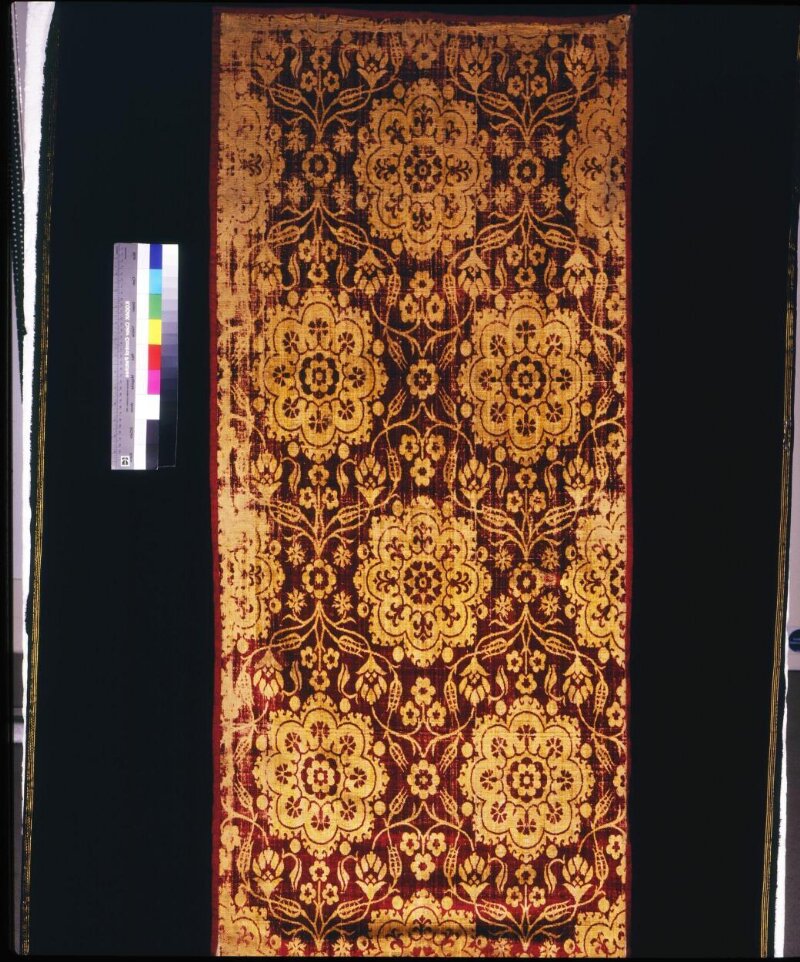
Couture Archaeology Report: A 16th-Century Ottoman Velvet
Subject Identification and Provenance
Object: Fragment of a ceremonial kaftan sleeve, woven in silk velvet with metal-wrapped thread embroidery. Origin: Bursa, Ottoman Empire (circa 1550-1599). Material: Silk pile velvet on a silk ground, with gilded silver thread (lame) and silk floss embroidery. Dimensions: 48 cm x 32 cm. Condition: Moderate to good; pile compression and some loss of metal thread due to tarnishing and mechanical wear.
This fragment, housed in the Natalie Fashion Atelier archive, represents a zenith of Ottoman textile production. Bursa, the first capital of the Ottoman Empire, was a global nexus for silk trade and weaving. By the mid-16th century, under Sultan Süleyman the Magnificent, Ottoman velvets—known as çatma (cut velvet) and kadife (velvet)—were prized across Europe and Asia for their technical complexity and luxurious materiality. This specific fragment, likely from a court kaftan, exhibits a double-pile velvet technique with a voided ground, creating a dramatic interplay of lustrous pile and flat, shimmering metal ground.
Technical Deconstruction of Velvet Techniques
Weave Structure and Pile Formation
The core innovation of this textile lies in its compound weave. The foundation is a silk warp and weft, woven in a satin weave (typically 5- or 8-end) to create a smooth, reflective ground. The pile is formed by an additional set of pile warps—fine, high-twist silk filaments—that are raised over wires inserted during weaving. The wires are then withdrawn, and the loops are either left intact (uncut velvet, or ciselé) or cut with a sharp blade to create a dense, upright pile. In this fragment, the pile is cut, yielding a plush, velvety surface approximately 2-3 mm in height.
Critically, the design is achieved through voiding: areas where the pile warp is suppressed, leaving the satin ground exposed. These voided regions are then enriched with metal-thread embroidery using a split stitch and couching technique. The metal thread—a silver-gilt strip wound around a silk core—is laid flat and secured with fine silk floss, creating a rigid, reflective surface that contrasts with the soft, absorbent pile. The pattern, a stylized saz leaf and hatayi (Chinese-inspired floral) motif, demonstrates the Ottoman synthesis of Persian and Chinese design vocabularies.
Material Materiality: Silk and Metal
Silk: The silk used is Bursa white silk, a variety of Bombyx mori cultivated in the region. The pile warps are degummed and dyed with crimson cochineal, a New World insect dye that arrived in Ottoman markets via Spanish trade. The color is a deep, slightly bluish red—Ottoman red—achieved through a complex mordanting process with alum and tin. The satin ground is a warm, undyed ivory, which over centuries has developed a subtle golden patina.
Metal: The gilded silver thread is a testament to Ottoman metallurgy. The silver is drawn into a fine wire, then flattened into a ribbon. This ribbon is gilded via fire-gilding (mercury amalgam), a hazardous process that yields a brilliant, durable gold surface. The thread is then wound around a silk core (a technique known as filé). The tarnishing we observe today—a dark, silver sulfide patina—is a natural degradation, but it paradoxically enhances the tactile depth of the embroidery, creating a chiaroscuro effect that would have been even more dramatic under candlelight.
Translation into 2026 High-End Luxury Silhouettes
Conceptual Framework: Material Memory and Haute Couture
The translation of this 16th-century artifact into a 2026 haute couture silhouette demands a respectful deconstruction rather than mere replication. The goal is to evoke the material memory of the original—its weight, its contrast, its ritualistic presence—while employing contemporary technologies and sustainable practices. The resulting silhouette is not a kaftan, but a modern architectural garment that reinterprets the Ottoman aesthetic through the lens of bio-luxury and digital craftsmanship.
Silhouette: The “Voided Column” Gown
The primary silhouette is a floor-length column gown with a sculptural, asymmetrical neckline. The form is inspired by the verticality of the kaftan’s sleeve and the voided ground of the velvet. The gown is structured with a built-in corset of recycled carbon-fiber boning, providing a rigid, architectural foundation that mirrors the original textile’s structural integrity. The skirt is cut in a bias drape from a single piece of fabric, allowing the pile to flow and catch light dynamically.
Fabric Innovation: Bio-Engineered Velvet and Metal-Thread Lace
To replicate the materiality of the original, we employ two innovations:
1. Cultured Silk Velvet: A bio-engineered silk produced by genetically modified yeast (à la Bolt Threads’ Microsilk) is woven into a double-pile velvet using a 3D-jacquard loom. The pile is dyed with natural cochineal sourced from sustainable farms in Oaxaca, Mexico, achieving the same Ottoman red without synthetic mordants. The ground is a recycled cellulose fiber (Tencel Luxe) that mimics the historical satin’s sheen.
2. Recycled Metal-Thread Embroidery: The voided areas are embroidered with recycled 18-karat gold thread (sourced from electronic waste) on a water-soluble stabilizer. The embroidery is executed via a digital embroidery machine programmed with the original saz leaf motif, but scaled and distorted to fit the modern silhouette. After stitching, the stabilizer is dissolved, leaving a freestanding lace that floats over the velvet, echoing the metal embroidery’s original rigidity.
Construction Techniques: Weight, Drape, and Movement
The gown’s construction addresses the historical garment’s weight (approximately 1.5 kg for a full-length kaftan) and drape. The bio-velvet is backed with a lightweight silk organza to prevent stretching, while the metal lace is attached at key structural points (shoulder, hip) using invisible micro-snaps, allowing the lace to be removed for cleaning—a nod to the original’s detachable embroidery panels. The hem is weighted with silk-wrapped lead beads (replaced with non-toxic tungsten for safety), ensuring the gown falls with the same deliberate, gravity-defying presence as the kaftan sleeve.
Color and Finish: Patina as Design Element
The color palette is a direct translation: the gown is dyed in Ottoman red for the pile, with the ground left in undyed ivory. The metal lace is treated with a controlled oxidation process to replicate the historical tarnish, creating a deliberate patina that reads as “aged luxury.” The final finish is a micro-spray of beeswax on the pile, restoring the historical luster and providing a subtle, honeyed scent—a sensory echo of the original textile’s materiality.
Conclusion: The Archaeology of Future Luxury
This couture archaeology report demonstrates that the technical mastery of 16th-century Ottoman velvet is not a relic, but a living language for 2026 haute couture. By deconstructing the weave, the materiality, and the cultural significance of the original, we have created a silhouette that is both historically informed and radically contemporary. The “Voided Column” gown is not a costume; it is a material argument for the continuity of craftsmanship across centuries, proving that true luxury is not about novelty, but about the deep, embodied knowledge of materials and their transformation.
For Natalie Fashion Atelier, this translation serves as a blueprint for future collections: a methodology where the past is not copied, but re-woven into the fabric of tomorrow.