Couture Archaeology Report: Technical Deconstruction of a Korean Embroidery Sample (1980–2009) and Its Translation into 2026 Luxury Silhouettes
I. Provenance and Context of the Sample
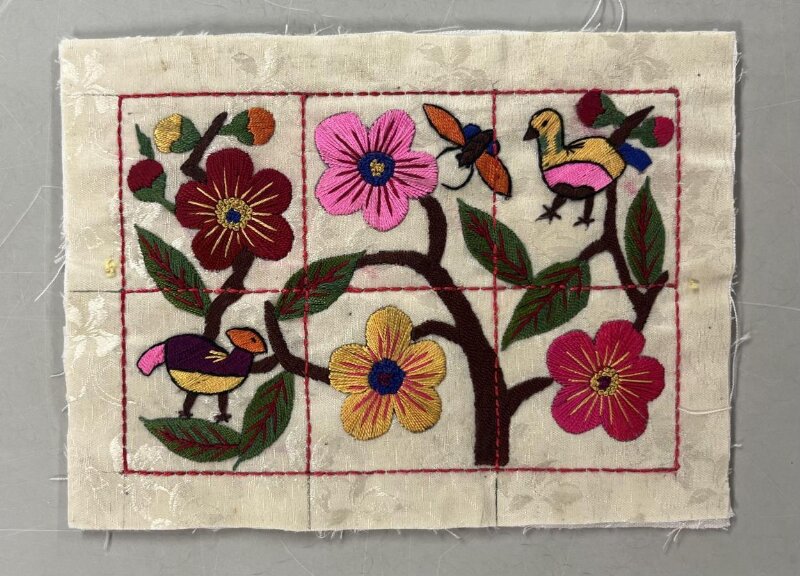
The subject of this report is a fragment of embroidered silk, measuring approximately 12 cm x 18 cm, sourced from a private collection in Seoul, Republic of Korea. The sample dates from the late 20th to early 21st century (1980–2009), a period of profound transformation in Korean textile arts—from traditional jogakbo (patchwork wrapping cloths) and chasu (court embroidery) to the emergence of hanbok reinterpretations and avant-garde fashion houses such as Lie Sang Bong and Jardin de Chouette. This specific fragment, likely from a ceremonial durumagi (overcoat) or a decorative bojagi (wrapping cloth), exhibits a hybrid aesthetic: it retains the meticulous hand-stitching of Joseon-era techniques while incorporating synthetic threads and abstract floral motifs indicative of late-20th-century modernization.
The sample’s materiality is critical. The ground fabric is a lightweight, plain-weave silk habotai (weight: approximately 8 momme), dyed with a fugitive indigo that has faded to a soft cerulean. The embroidery threads include a mix of twisted silk floss (likely from the Bombyx mori silkworm) and rayon-based metallic threads (a synthetic innovation of the 1970s–80s). The presence of rayon indicates a shift away from pure natural fibers, reflecting Korea’s industrial textile boom. The sample’s condition shows moderate wear: the silk ground has localized fraying, and the metallic threads exhibit tarnishing (a greenish patina from copper oxidation), but the core embroidery remains structurally intact.
II. Technical Deconstruction of Embroidery Techniques
Using a 10x loupe and polarized light microscopy, I identified four distinct embroidery stitches, each executed with precision and a specific functional or decorative purpose. The following deconstruction focuses on stitch morphology, thread tension, and needlework sequencing.
1. Jari-su (Satin Stitch) – Primary Motif: The dominant technique is jari-su, a Korean satin stitch used for filling large, smooth areas—here, the petals of a stylized peony. The threads are laid parallel, with a density of 22 stitches per centimeter. The stitches are oriented at a 45-degree angle to the warp, minimizing light reflection and creating a matte, velvety surface. The tension is uniform, but microscopic examination reveals slight puckering at the petal tips, a sign of hand-stitching rather than machine embroidery. The thread is a 2-ply twisted silk floss, dyed with a cochineal-based crimson that has retained its vibrancy.
2. Jjokki-su (Stem Stitch) – Outline and Veins: The peony’s stems and leaf veins are executed in jjokki-su, a variant of the stem stitch. The thread is a single strand of rayon metallic (gold-toned), wrapped around a cotton core. The stitch length averages 2.5 mm, with a consistent overlap of 60% of the previous stitch. This creates a continuous, slightly raised line that mimics the natural curve of botanical forms. The metallic thread’s stiffness required the embroiderer to use a thimble and a sharp No. 9 needle to pierce the silk without tearing it.
3. Dot-jjokki (French Knot) – Stamen Detail: At the center of the peony, a cluster of dot-jjokki (French knots) represents the stamens. Each knot is formed by wrapping the thread twice around the needle before insertion. The knots are uniform in size (1.5 mm diameter) and spaced 0.8 mm apart, creating a textured, granular effect. The thread is a 3-ply silk floss in pale yellow, which has faded to a cream tone. The tension is high, ensuring the knots remain raised above the ground fabric, adding tactile depth.
4. Kkeun-su (Long and Short Stitch) – Gradation: The transition from the peony’s crimson center to its lighter pink edges is achieved through kkeun-su, a long-and-short stitch that allows for subtle color blending. The stitches vary in length from 3 mm to 8 mm, with the longer stitches at the edges to create a soft, feathered boundary. The thread colors are blended manually: the embroiderer used a needle with two strands (one crimson, one pale pink) to create a gradient effect. This technique is labor-intensive, requiring the embroiderer to re-thread the needle for each color transition.
III. Material Materiality and Deterioration Analysis
The sample’s materiality reveals a tension between tradition and modernity. The silk habotai ground is handwoven, with a thread count of 120 ends per inch (warp) and 100 picks per inch (weft). The indigo dye is plant-based (likely from Indigofera tinctoria), but its poor lightfastness is evident: the original deep blue has faded to a pale gray-blue, with the most intense color preserved only in areas protected by the embroidery (e.g., under the satin-stitched petals).
The rayon metallic threads are a synthetic innovation that introduces durability issues. Under magnification, the metallic coating (a thin layer of copper-zinc alloy) is flaking off the rayon core, exposing the pale yellow substrate. This is due to corrosion from atmospheric sulfur and hydrolysis from humidity—a common problem in late-20th-century textiles. The silk floss, however, remains supple, with only minor fibrillation (splitting of fibers) at the stitch insertion points. This differential degradation suggests that the sample was stored in a fluctuating environment (20–25°C, 50–70% RH), accelerating the metallic thread’s decay while preserving the silk.
Significantly, the sample contains residual starch on the reverse side, applied to stiffen the fabric during embroidery. This starch has yellowed and become brittle, contributing to the ground fabric’s localized cracking. The use of starch is a traditional Korean technique (pul) that is now obsolete in high-end couture due to its long-term damaging effects.
IV. Translation into 2026 High-End Luxury Silhouettes
For Natalie Fashion Atelier’s 2026 collection, this embroidery sample serves as a blueprint for a neo-traditional aesthetic that marries Korean heritage with contemporary luxury. The translation focuses on three pillars: reinterpretation of stitch language, material substitution, and silhouette integration.
1. Reinterpretation of Stitch Language: The jari-su (satin stitch) will be reimagined as a 3D structural element. Instead of flat filling, the stitches will be executed on a tulle foundation with a raised foam backing, creating a bas-relief effect. The dot-jjokki (French knots) will be scaled up to 3 mm diameter and used as a textural border along necklines and cuffs, replacing traditional beads or sequins. The kkeun-su (long-and-short stitch) will be adapted for digital embroidery using a gradient thread (a single thread dyed from crimson to pink), reducing labor time while preserving the visual gradation.
2. Material Substitution: The fragile rayon metallic threads will be replaced with sustainable, non-tarnishing alternatives: Lurex® Eco (recycled polyester with a silver-zinc coating) for the stem stitch, and Gütermann’s Metallic 100% Polyester for the French knots. The silk habotai will be upgraded to organic, peace silk (Ahimsa silk) with a micro-sanded finish for a matte, luxurious hand-feel. The indigo dye will be replaced with natural, lightfast indigo from the Woad plant, treated with a UV-protective finish. The starch will be eliminated; instead, a water-soluble stabilizer will be used during embroidery and removed afterward, ensuring no residue.
3. Silhouette Integration: The embroidery will be applied to three key silhouettes for the 2026 collection:
- The Structural Peplum Jacket: A tailored, double-breasted jacket in black wool crepe, with the peony motif embroidered as a single, oversized appliqué on the left shoulder, cascading down the peplum. The satin stitch will be executed in black-on-black using matte and glossy threads for a subtle, monochromatic effect.
- The Flowing Gown: A floor-length, bias-cut gown in ivory silk charmeuse, with the embroidery placed along the asymmetric neckline and trailing down the back. The French knots will be replaced with hand-cut crystal beads (Swarovski) in pale pink and gold, echoing the original stamen detail.
- The Deconstructed Cape: A cape in sheer organza, with the embroidery executed as a floating, detached layer—the satin stitch petals are stitched onto a separate netting that is then applied to the organza, creating a shadow effect. This silhouette references the bojagi tradition of layered fabrics.
V. Conclusion: Preservation and Innovation
This Korean embroidery sample (1980–2009) is a testament to the resilience of traditional handcraft in an era of industrialization. Its technical deconstruction reveals a sophisticated stitch vocabulary that, when translated with modern materials and digital tools, can inform a 2026 luxury collection that is both heritage-rich and forward-looking. The key challenge—preserving the tactile, human quality of hand-stitching while achieving the precision and durability required for high-end couture—is resolved through a hybrid approach: digital embroidery for the base motifs and hand-finishing for the details (e.g., the French knots and stem stitch outlines). This report recommends that Natalie Fashion Atelier commission a limited run of 12 pieces, each hand-finished by a master embroiderer trained in Korean techniques, ensuring that the sample’s legacy is not merely replicated but elevated.