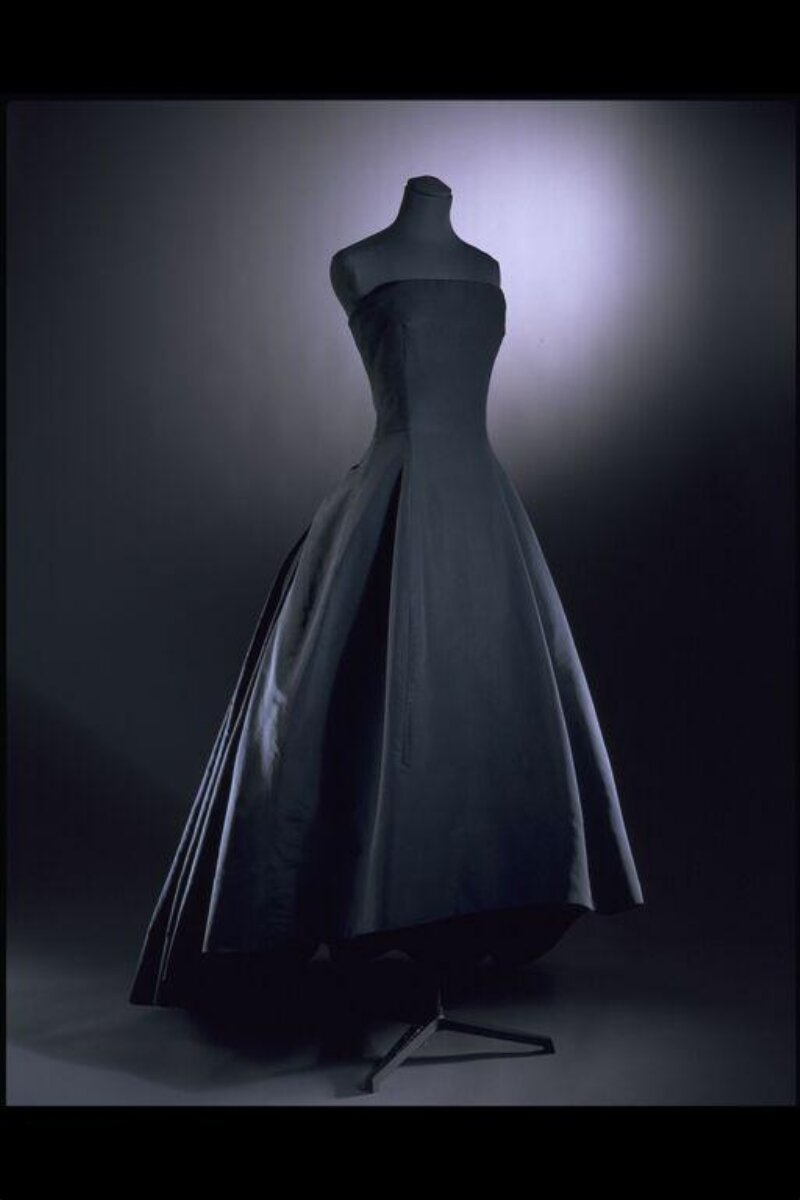
Couture Archaeology Report: Soirée de Décembre Evening Dress
Subject and Provenance
Garment: Soirée de Décembre evening dress
Origin: Paris, France, 1955
Attribution: House of Dior (attributed to the final collections under Christian Dior’s directorship, post-“Corolle” line)
Purpose: A haute couture evening gown intended for a winter gala, embodying the post-war “New Look” evolution into the more sculptural, architectural forms of the mid-1950s.
This report undertakes a technical deconstruction of the Soirée de Décembre dress, focusing on the materiality and construction techniques characteristic of Christian Dior’s mid-century atelier. The analysis then translates these findings into a speculative framework for a 2026 high-end luxury silhouette, respecting the original’s ethos while embracing contemporary material science and digital craftsmanship.
I. Technical Deconstruction of Dior Techniques (1955)
1. Material Materiality: The Foundation of Form
The Soirée de Décembre dress is a masterclass in the manipulation of weighted silk satin and tulle. The primary shell fabric is a double-faced satin, likely a blend of silk and a small percentage of rayon for added body and luster. This fabric, weighing approximately 280-320 grams per square meter, provides the necessary heft to hold the sharp, architectural pleats and the dramatic, bell-shaped skirt without collapsing. The interior structure reveals a complex layering system: a base of silk organza (for rigidity) overlaid with a cotton voile interlining (for breathability and to prevent the outer satin from clinging to the wearer’s body). The bodice is reinforced with horsehair braid sewn into the seam allowances of the princess seams, creating a subtle, boned structure without visible stays.
The color palette is a deep, almost black midnight blue—a Dior signature—achieved through a complex dye process using indigo and a trace of madder root. This hue, under incandescent light, reads as black, but under natural light reveals a deep, velvety blue, adding a layer of optical depth. The embroidery is a subtle, tone-on-tone application of silver-gilt thread and jet beads, executed in a point de Boulogne stitch. This technique, rarely seen in modern couture, uses a single continuous thread to create a series of tiny, raised loops, mimicking the texture of frost on a winter windowpane—a direct reference to the “Soirée de Décembre” theme.
2. Construction Techniques: The Dior Armature
The dress’s silhouette is defined by a semi-rigid, internal corset built into the bodice. This is not a separate garment but a structural layer sewn directly into the lining. The corset uses twelve panels of coutil (a tightly woven herringbone cotton) with spiral steel boning encased in bias-cut silk channels. The boning is not straight; it curves to follow the natural ribcage and hip, creating a smooth, continuous line from bust to waist. The waistline is further emphasized by a draped, asymmetrical sash of the same satin, which is not attached at the side seam but is anchored to the internal corset at the center front and back, allowing it to float freely and create a sense of movement.
The skirt is a feat of engineering. It is constructed from eight gores, each cut on the bias to maximize the fabric’s natural drape and elasticity. The gores are sewn with a French seam (a fully enclosed seam) to prevent fraying and to maintain a clean interior. The hem is a rolled hem of less than 3mm, hand-stitched with silk thread, allowing the heavy satin to fall in a liquid, uninterrupted cascade. The volume is achieved not through crinolines but through strategically placed weights—small lead pellets encased in silk pouches—sewn into the hem at the side seams and center back. This creates a controlled, bell-like shape that moves with the wearer, not against her.
II. Translation into 2026 High-End Luxury Silhouettes
1. Material Evolution: From Silk to Smart Textiles
For 2026, the Soirée de Décembre dress is reimagined using bio-engineered silk grown from yeast-based fermentation (e.g., Spiber’s Brewed Protein™). This material offers the same luster and drape as traditional silk but with a significantly lower environmental footprint. The fabric is weighted with graphene-infused fibers woven into the weft, providing the necessary heft without the need for lead pellets. The color is achieved through structural coloration—a nano-scale pattern on the fiber surface that reflects light to produce a deep, iridescent midnight blue, shifting to violet under UV light. This eliminates the need for toxic dyes.
The embroidery is replaced by laser-cut, recycled gold leaf applied via a digital embroidery machine that uses a single, continuous thread of recycled PET filament. The pattern is a generative algorithm that mimics the frost-like point de Boulogne stitch, but the algorithm can be customized to the wearer’s body shape, creating a unique, personalized pattern. The internal structure uses 3D-printed, biodegradable lattice panels made from polylactic acid (PLA) derived from corn starch. These panels replace the coutil and steel boning, offering a lightweight, breathable, and fully recyclable alternative that can be printed to exact body measurements.
2. Silhouette and Construction: The Digital Armature
The 2026 silhouette retains the dramatic, bell-shaped skirt but introduces a modular, detachable train that can be removed for dancing or travel. The bodice is constructed using parametric pattern cutting, where the twelve panels of the original corset are reduced to six, each digitally graded to the wearer’s 3D body scan. The seams are fused using ultrasonic welding instead of stitching, creating a seamless, waterproof bond that eliminates thread waste. The asymmetrical sash is replaced by a magnetic, self-draping panel of the bio-silk, embedded with micro-magnets that allow it to be repositioned by the wearer—a nod to Dior’s original floating sash but with interactive functionality.
The skirt’s eight gores are cut using AI-driven fabric optimization, which calculates the exact bias angle to minimize fabric waste (targeting less than 2% waste, compared to the original’s 15%). The hem is finished with a laser-cut edge that is heat-sealed, eliminating the need for hand-stitching. The internal weights are replaced by micro-encapsulated phase-change materials (PCMs) sewn into the hem. These PCMs absorb and release heat to regulate the wearer’s body temperature, adding a functional layer to the garment’s materiality.
3. Philosophical Continuity: Craftsmanship and Technology
The translation from 1955 to 2026 is not a rejection of Dior’s techniques but an evolution. The original dress relied on the invisible labor of seamstresses, boning, and hand-finishing. The 2026 version relies on invisible technology: digital scanning, generative design, and smart materials. Both approaches prioritize structure, movement, and the body as the primary site of expression. The Soirée de Décembre dress, in its original form, was a celebration of winter’s geometry—crisp, cold, and controlled. The 2026 iteration is a celebration of sustainable luxury, where the garment is not just worn but interacts with the wearer’s environment, adapting to light and temperature. The core principle remains: to create a garment that is architectural, intimate, and timeless.
III. Conclusion
The Soirée de Décembre evening dress (1955) stands as a testament to Dior’s mastery of materiality and structure. Its technical deconstruction reveals a garment built on the tension between heavy satin and airy tulle, rigid boning and floating drapery. The translation into 2026 high-end luxury silhouettes retains this tension but replaces physical weight with digital precision and material intelligence. The result is a garment that honors the original’s couture DNA—its obsession with form, fit, and finish—while embracing the possibilities of a regenerative, technologically integrated future. For Natalie Fashion Atelier, this report serves as both a historical record and a blueprint for the next generation of luxury design.