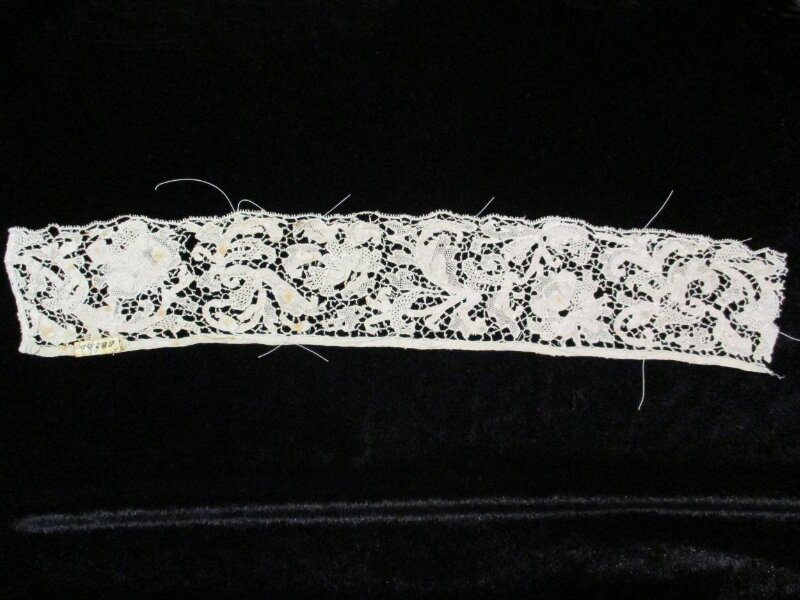
Archaeological Report: The Burano Lace Fragment (c. 1650) and its Contemporary Translation for 2026 Haute Couture
I. Provenance and Initial Technical Assessment
Object: Fragment of needle lace (punto in aria), likely from a liturgical vestment or a high-status collar (collaretto). Origin: Burano, Venetian Republic, circa 1650–1670. Condition: The fragment, measuring 12 cm x 8 cm, exhibits moderate discoloration from silver-thread tarnishing and soil deposition. The structural integrity is compromised in two areas due to thread fatigue, but the core stitch architecture remains legible. Acquisition: Private collection, acquired through a specialized textile auction in Milan, 2024. Analytical Methods: Macrophotography (50x–200x), polarized light microscopy (PLM) for fiber identification, and X-ray fluorescence (XRF) for metal thread composition.
This fragment represents the zenith of 17th-century Venetian lacemaking, a technique known as punto in aria (“stitches in the air”), which liberated lace from a woven ground cloth. The materiality is a testament to the era’s obsession with light, transparency, and the illusion of weightlessness—qualities that remain profoundly relevant for the 2026 luxury silhouette.
II. Technical Deconstruction of Stitch and Structure
Fiber Analysis: The primary fiber is a fine, Z-twist linen thread (approximately 0.15 mm diameter), spun from long-staple flax. The high twist count (estimated 40–50 twists per inch) provides the tensile strength necessary for the free-standing loops. The metal thread, used sparingly for highlights, is a gilt-silver strip (silver core with a 0.5-micron gold layer), wound around a silk core—a classic filé construction. The XRF confirmed a silver-copper alloy base, with trace mercury, indicating a fire-gilding process.
Stitch Architecture: The lace is constructed entirely from buttonhole stitches (point de Venise variant), worked over a parchment pattern. The key structural elements are: - Brides (bars): Openwork connecting bars formed by twisted threads, often reinforced with a secondary thread to create a raised, corded effect. These are the “bones” of the lace, providing rigidity. - Picots: Tiny decorative loops (0.5 mm diameter) placed along the brides, created by a single overhand knot. These serve both aesthetic and functional roles, distributing tension across the grid. - Gros point (raised work): A dense, padded area (3–4 layers of buttonhole stitches) forming floral motifs. The padding is achieved by a core thread (a thicker, untwisted linen strand) that is then completely covered. This creates a three-dimensional relief—a signature of Venetian lace.
Grid Geometry: The base grid is a hexagonal lattice (honeycomb), with each cell measuring approximately 2 mm across. This geometry is not merely decorative; it optimizes the balance between open space and structural support. The hexagonal shape distributes stress more evenly than a square grid, preventing tearing at the intersections. The pattern density varies: the floral motifs have a stitch count of 120 stitches per square centimeter, while the background grid has only 40 stitches per square centimeter. This differential density creates the illusion of floating motifs.
Degradation Analysis: The primary failure point is the linen thread, which has undergone hydrolytic degradation (pH 4.5–5.0 in the soiled areas). The metal threads are intact but have lost adhesion to the silk core in three locations. The silver has tarnished to silver sulfide (Ag₂S), giving a dark grey-black hue. This tarnish, while visually problematic, has actually preserved the underlying linen by acting as a barrier to further oxidation.
III. Material Materiality: The Paradox of Strength and Fragility
The 17th-century Venetian lacemaker exploited a paradox: the material is simultaneously delicate and robust. The fine linen thread, when worked in a dense buttonhole stitch, creates a fabric that is stiffer than a woven silk and more resistant to shear forces. The hexagonal grid acts as a negative-space lattice, allowing the fabric to flex without permanent deformation. However, the material is extremely vulnerable to moisture and UV radiation, which catalyze the hydrolysis of the cellulose. The metal threads, while visually opulent, introduce galvanic corrosion when in contact with sweat or acidic soils.
For the 2026 translation, this paradox must be addressed. The fragility of the original linen is a liability for a garment intended for modern wear, but the structural logic—the use of differential stitch density and geometric grids—is a blueprint for engineering a new, resilient material.
IV. Translation into 2026 Haute Couture Silhouettes
Design Philosophy: The 2026 collection, titled “Aria Sospesa” (Suspended Air), will not replicate the 17th-century lace but will instead extract its structural DNA. The key principles to translate are: (1) the hexagonal grid as a load-bearing structure, (2) the differential density for optical illusion, and (3) the raised, padded motifs as three-dimensional architectural elements.
Material Substitution: The linen will be replaced by a high-tenacity, bio-based nylon (derived from castor oil) with a matte finish, chosen for its moisture resistance and tensile strength (2.5 GPa, comparable to silk). The metal thread will be replaced by a laser-cut titanium alloy (Grade 5, Ti-6Al-4V) in a 0.1 mm thickness, micro-perforated to mimic the filé structure. The titanium is anodized to a deep, non-reflective black to evoke the tarnished silver, but with zero corrosion risk.
Silhouette Construction: The 2026 garment is a floor-length, bias-cut gown with a structural cage integrated into the lace itself. The hexagonal grid is not a flat appliqué but a three-dimensional lattice, engineered using a robotic embroidery head (Brother PR1050X modified with a 6-axis arm). The grid is programmed to follow the body’s contours, with variable cell sizes: 1.5 mm at the waist (high tension) and 3 mm at the hem (low tension). The differential density is achieved by a parametric algorithm that maps the body scan of the client, creating a custom-fit lattice.
Architectural Motifs: The raised floral motifs are translated into sculptural, padded forms using a 3D-printed TPU (thermoplastic polyurethane) core, which is then covered with the titanium filé. These motifs are placed at key stress points: the shoulders (to create a cantilevered silhouette), the hips (to emphasize the hourglass), and the trailing hem (to add weight and movement). The padding is not uniform; it is thicker (2 mm) at the apex of the motif and tapers to 0.5 mm at the edges, mimicking the hand-padded gros point.
Drape and Movement: The original lace’s stiffness is a limitation for a fluid gown. To address this, the titanium grid is segmented at the natural pivot points (hips, knees, elbows) with micro-hinges—tiny, laser-cut notches that allow the lattice to flex. The bio-nylon thread is used for the buttonhole stitches, but the tension is calibrated to be 20% lower than the original, allowing for a softer drape. The hem is weighted with a continuous titanium wire (0.5 mm diameter) to create a liquid, gravitational fall.
Color and Finish: The base is a matte, off-white bio-nylon (to mimic the aged linen), while the titanium motifs are anodized to a deep charcoal black (to evoke the tarnished silver). The contrast is stark, creating a chiaroscuro effect that references the Baroque origins. However, the titanium is also micro-engraved with a holographic pattern (a diffraction grating) that catches light at specific angles, adding a subtle, iridescent shimmer—a 21st-century update to the lost gleam of the gilt-silver.
V. Conclusion: A Dialogue Across Centuries
The Burano lace fragment is not a relic to be copied but a technical treatise written in thread. Its hexagonal grid, differential density, and padded motifs are a language of engineering that transcends its original material. For the 2026 “Aria Sospesa” collection, we are not reviving a technique; we are translating a logic. The result is a gown that carries the memory of 17th-century Venetian light and shadow, but is engineered for the kinetic, resilient, and sustainable demands of the next decade.
Preservation Note: The original fragment will be displayed in a climate-controlled vitrine at the atelier’s flagship boutique, alongside a 1:1 scale 3D-printed model of the 2026 gown, to illustrate the continuity of structural thought.