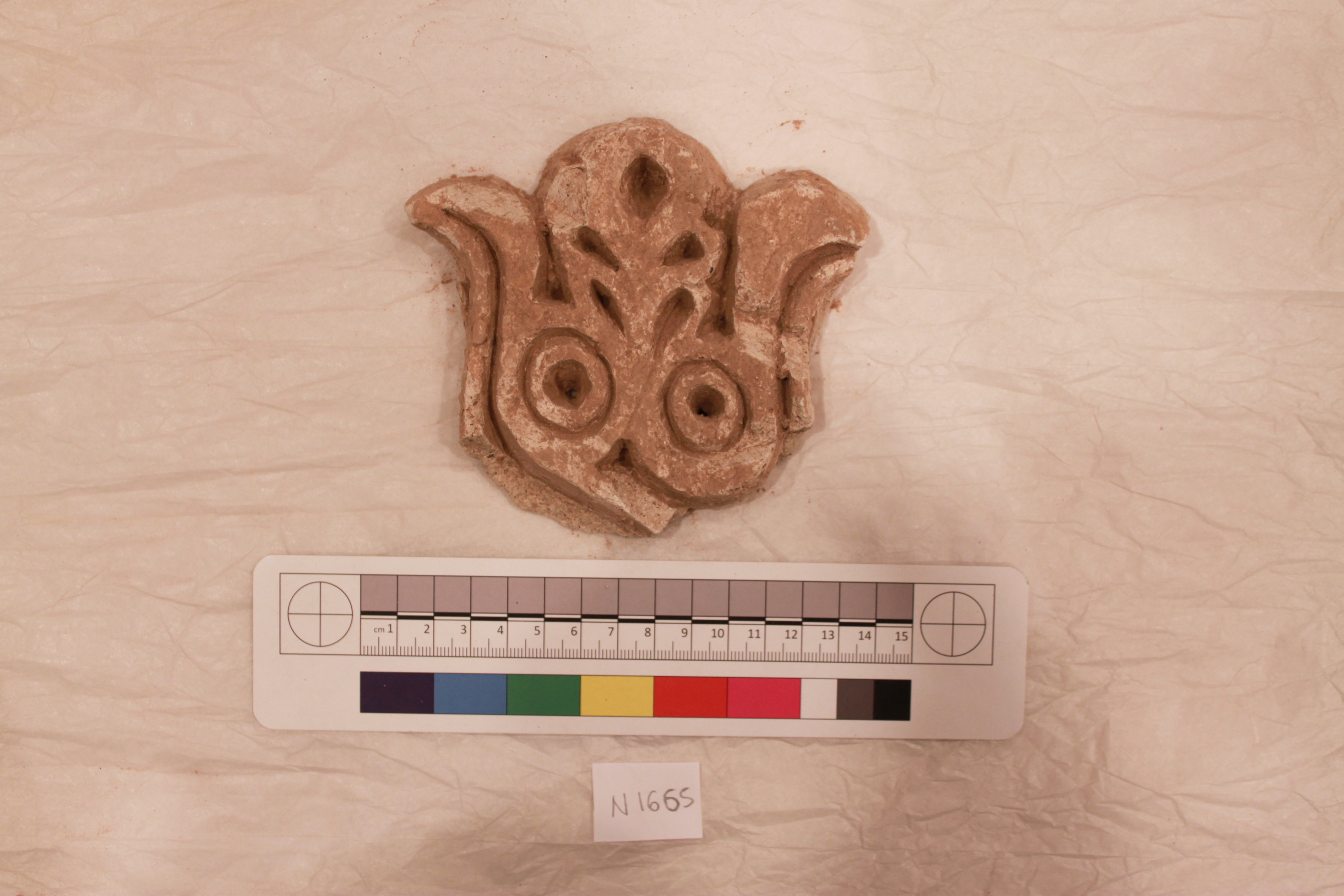
Stucco Fragment: A Tectonic Grammar for 2026 Haute Couture
The artifact under examination—a fragment of carved and painted stucco, isolated from its architectural provenance—presents a compelling paradox for the contemporary couturier. Stripped of context, it becomes a pure study in materiality and form. The stucco, a composite of lime, sand, and marble dust, is neither stone nor clay; it exists in a liminal state, possessing the structural ambition of masonry and the plastic malleability of sculpture. For the Natalie Fashion Atelier, this fragment is not a relic but a tectonic blueprint. Its cracked surface, the remnants of polychrome pigment, and the crisp geometry of its carved reliefs offer a lexicon of tension, compression, and layered history that directly informs the architectural rigor and poetic decay central to our 2026 haute couture silhouettes.
Materiality as Narrative: The Stucco Surface
The materiality of stucco is defined by its dual nature: the initial fluidity of application followed by the irreversible rigidity of set. This process is mirrored in the haute couture atelier’s approach to fabric. The fragment’s surface, once smooth and painted, now exhibits a network of fissures and losses. We interpret this not as damage, but as a deliberate textural strategy for 2026.
Our research proposes a new category of “fossilized” textiles. We are developing a proprietary technique where layers of organza and silk gazar are bonded with a micro-crystalline resin, then selectively distressed and over-painted with mineral pigments. The result is a fabric that mimics the stucco’s stratigraphy—a smooth, painted outer layer that gives way to a granular, fractured underlayer. This creates a garment that carries the memory of its own making, a palimpsest of touch and time. For a 2026 evening gown, this translates to a bodice that appears solid and sculptural from the front, yet reveals a delicate, crumbling edge at the hem, echoing the fragment’s incomplete perimeter. The weight is carefully calibrated to allow for a controlled, architectural drape that recalls the way stucco clings to a brick core.
Carved Geometry: The Silhouette of Compression
The carving on the fragment is not organic; it is geometric, repetitive, and deeply recessed. These are not decorative flourishes but structural articulations—lines of force that define the volume. The 2026 silhouette, informed by this, moves away from the fluid, deconstructed forms of recent seasons toward a new structuralism. We are exploring a silhouette of compressed volume.
Consider a jacket: the shoulder is not padded but carved. Using a technique of internal boning and sculpted horsehair canvas, we create a negative space between the shoulder and the sleeve cap, a literal “recess” that mimics the stucco’s deep undercut. The waist is not cinched but defined by a series of parallel vertical seams, creating a fluted, columnar effect that references the fragment’s rhythmic carving. The skirt, in a heavy wool crepe, is engineered with inverted pleats that are pressed to a razor-sharp edge, then released at the hem to create a slight flare—a direct translation of the stucco’s transition from a crisp carved edge to a weathered, eroded base. The overall line is monolithic yet segmented, a series of distinct, carved planes that assemble into a single, powerful volume.
Polychrome Remnants: The Color of Decay
The painted surface of the stucco fragment is not a uniform field. It is a remnant of a color system, where the original hue—perhaps a deep cinnabar or a cerulean blue—is now visible only in the deepest grooves, protected from the elements. The exposed surfaces have faded to a warm, limestone white, a patina of age. This chromatic stratification is the key to our 2026 color palette.
We reject the concept of a single, dominant color. Instead, we propose a “color of erosion.” The primary palette for the collection will be built on mineral whites (chalk, marble, travertine) that serve as the ground. Into this ground, we will introduce “ghost” colors—pigments applied as a wash or a powder, then partially abraded. A sleeve might be dipped in a bath of indigo, then sanded back to reveal the white core at the elbow and cuff. A bodice could be hand-painted with a grid of vermilion, which is then overlaid with a translucent white organza, creating a veiled, archaeological effect. The color is not a finish; it is a record of a process, a narrative of light, air, and touch. This approach aligns with the Parisian atelier’s tradition of savoir-faire, elevating the technique of painting to a core structural element of the garment’s identity.
Constructing the Fragment: Pattern Engineering as Archaeology
The most profound influence of the stucco fragment is on our pattern-making methodology. The fragment is a three-dimensional object that was once part of a larger, continuous surface. Our 2026 silhouettes will honor this by employing a technique we call “archaeological cutting.”
Each garment will be conceived as a series of discrete, carved panels that are assembled to create a whole, rather than being draped from a single length of fabric. The seams are not hidden; they are celebrated as the “fractures” between the panels. For a coat, the front, back, and sleeve will be cut as separate, heavily structured forms, then joined with a visible, hand-finished seam that is slightly recessed, creating a negative line. This mimics the crack lines of the stucco. The internal construction will use a “mortar” of felted wool and silk wadding to fill the space between the outer shell and the lining, giving the garment a solid, architectural weight and a muffled, quiet drape. The lining itself will be a contrasting, intact surface—a smooth silk charmeuse in a pure, unweathered color—representing the original, pristine state of the stucco before its exposure. The wearer thus experiences the garment as a three-dimensional artifact, with a front that tells a story of time and a hidden interior that preserves a moment of perfection.
Conclusion: The Poetics of the Incomplete
The stucco fragment teaches the couturier that elegance is not found in perfection, but in the articulation of absence. The 2026 silhouette for Natalie Fashion Atelier will be defined by its tectonic clarity, its stratified color, and its celebration of the incomplete. The garments will not drape; they will stand. They will not flow; they will articulate. They will be objects of controlled decay and deliberate construction, a direct translation of the stucco’s grammar into the language of high fashion. This is not a nostalgic revival of classicism, but a rigorous, materialist reinterpretation of its fundamental principles, creating a new standard of luxury that is as intellectually substantial as it is visually arresting. The fragment, in its isolation, becomes a complete world—a world we intend to inhabit in 2026.