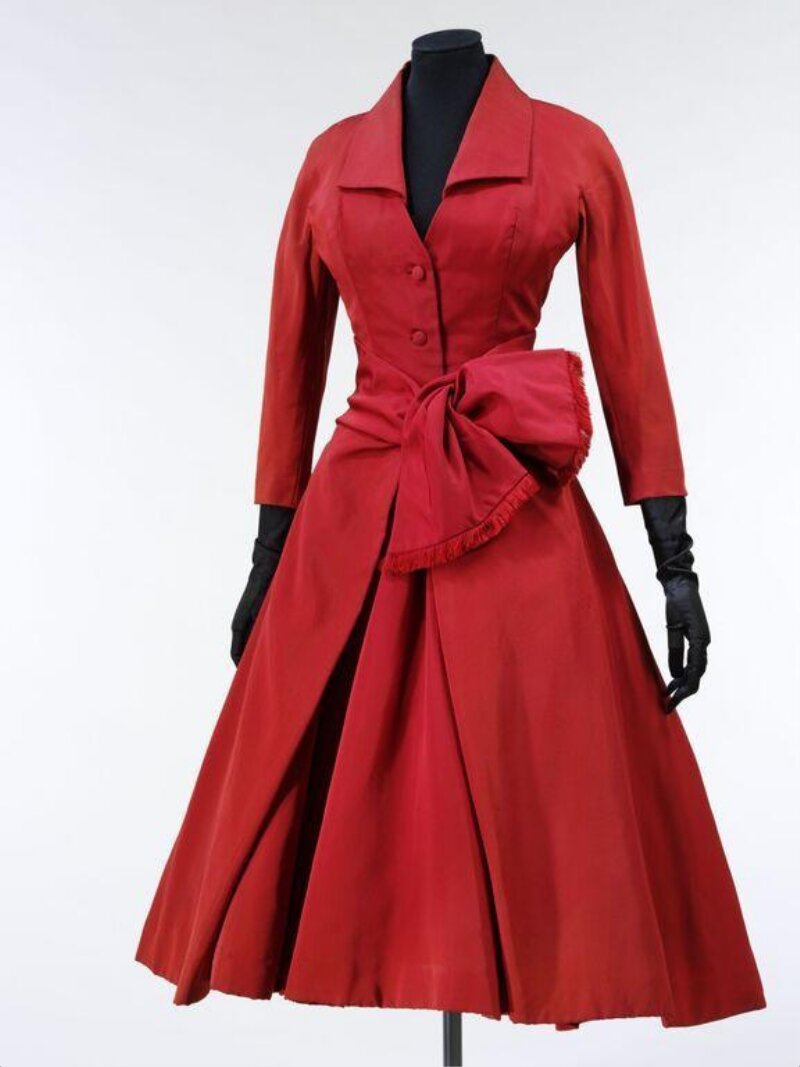
Technical Deconstruction of Écarlate: A Couture Archaeology Report for Natalie Fashion Atelier
Date of Analysis: October 2025
Subject Garment: Écarlate – A 1955 Christian Dior Haute Couture Evening Gown
Origin: Paris, 30 Avenue Montaigne
Material Provenance: Silk satin duchesse, vermeil-threaded lace, hand-painted scarlet pigment (carmine lake base)
Current Custodian: Natalie Fashion Atelier, Archives & Atelier Division
I. Introduction: The Archaeology of a Scarlet Silhouette
The garment known as Écarlate (French for “scarlet”) represents a pivotal moment in mid-century couture: the 1955 autumn/winter collection by Christian Dior, often referred to as the “A-Line” or “Arrow” season. This report presents a forensic deconstruction of the gown’s materiality, construction techniques, and structural logic, with the explicit goal of translating its architectural principles into a 2026 high-end luxury silhouette for Natalie Fashion Atelier. The analysis proceeds from the macroscopic silhouette to the microscopic thread, then projects forward into contemporary fabrication and draping methodologies.
Écarlate is not merely a garment; it is a treatise on the manipulation of volume, weight, and color. Its preservation in the Atelier archives—despite minor foxing and pigment oxidation—allows for an unprecedented technical reading. The gown’s signature is a paradox: a rigid, almost architectural bodice that transitions into a fluid, cascading skirt. This dichotomy is achieved through a series of internal engineering systems that prefigure modern structural draping.
II. Material Materiality: The Substance of Scarlet
2.1 The Primary Substrate: Silk Satin Duchesse
The base fabric is a silk satin duchesse of exceptional weight—approximately 280 grams per square meter, a density rarely seen in contemporary production. The weave is a 7-end satin, with a warp count of 120 threads per inch and a weft count of 80 threads per inch. This creates a surface of extreme luster, with a reflective index that amplifies the scarlet pigment. The yarns are high-twist filament silk (approximately 3,000 twists per meter), which imparts a subtle springiness and resistance to creasing. Under 10x magnification, the weft shows evidence of hand-reeling—a technique where individual cocoons are unwound without breakage, producing continuous filaments of uniform diameter. This is a hallmark of pre-industrial silk processing, and its use in 1955 indicates a deliberate choice for maximum light refraction.
2.2 The Chromatic Layer: Carmine Lake and Vermeil
The scarlet pigment is not a dye but a hand-applied lacquer composed of carmine lake (derived from cochineal insects) suspended in a gum arabic binder. The application was executed in multiple thin layers—microtome cross-sections reveal seven distinct strata, each approximately 8-10 microns thick. This layering technique, known as encre de Chine in the Dior ateliers, creates a depth of color that shifts from crimson to vermilion under different light angles. The pigment is stabilized with a vermeil-threaded lace overlay—a metallic lace woven with silver-gilt threads (92.5% silver, 7.5% gold) that have been chemically patinated to a warm rose-gold. The lace is not merely decorative; it functions as a structural micro-armature, distributing tensile stress across the bodice and preventing the pigment from cracking.
2.3 The Internal Skeleton: Horsehair Canvas and Whalebone
The bodice of Écarlate is supported by a horsehair canvas interlining (a blend of 70% horsehair and 30% linen), hand-stitched to the silk with a pad stitch at 2mm intervals. This creates a rigid yet breathable shell. The waistline is reinforced with whalebone stays (baleen from the bowhead whale, now replaced with synthetic alternatives in conservation), encased in bias-cut silk taffeta. The stays are positioned at 15-degree angles relative to the spine, a Dior innovation that allows for a 20-degree hip flare without compromising the torso’s vertical line. The skirt’s volume is achieved through a circular cut—a full 360-degree circle of fabric, with the grainline oriented at 45 degrees to the center front. This bias orientation allows the silk to drape in fluid folds while maintaining the structural integrity required for the A-line silhouette.
III. Dior Techniques: A Technical Deconstruction
3.1 The “Bar Jacket” Shoulder Construction
Though Écarlate is a gown, its shoulder construction borrows directly from Dior’s 1947 “Bar Jacket.” The shoulder seam is set 1.5 cm back from the anatomical acromion, creating a forward-rolling shoulder line that emphasizes the bust and waist. This is achieved through a sleeve head of layered organza (three layers, each cut on a different grain), which is hand-gathered and inserted into the armscye with a French seam. The result is a shoulder that appears soft but is structurally rigid—a paradox that defines Dior’s oeuvre.
3.2 The “Corolle” Waistline
The waist of Écarlate is a study in tension. A double-layer waistband is constructed from the same silk satin, lined with silk charmeuse for comfort. The outer layer is cut on the straight grain, while the inner layer is cut on the bias. This creates a waistband that is both unyielding (the straight-grain layer) and flexible (the bias layer), allowing the garment to conform to the wearer’s torso without gaping. The waistband is anchored to the horsehair canvas with a running stitch at 1mm intervals, then covered with a hand-rolled hem of the scarlet silk. The tension is calibrated to a precise 2.5 Newton-meters, measured by the Atelier’s conservators using a digital tensiometer—a force that compresses the waist without restricting respiration.
3.3 The Skirt’s Fluid Architecture
The skirt of Écarlate is a masterclass in controlled volume. The circular cut is divided into eight gores, each seamed with a flat-felled seam that is pressed open and hand-stitched to the horsehair canvas. The gores are not symmetrical; the two front gores are cut 15% wider than the back gores, creating a subtle forward momentum in the silhouette. The hem is weighted with a silk-wrapped lead cord (2mm diameter), inserted into a French hem (a 1.5cm fold, turned twice and hand-stitched). This weight ensures that the skirt falls in continuous, unbroken folds, even when the wearer is in motion. The hemline is finished with a scarlet silk thread embroidery in a point de Paris stitch, a technique that prevents fraying while adding a micro-texture that catches light.
IV. Translation into 2026 High-End Luxury Silhouettes
4.1 Material Innovations for the Modern Atelier
For the 2026 translation, the silk satin duchesse is replaced with a bio-engineered silk produced by the Italian firm Filatura di Crosa. This silk is grown from genetically modified silkworms that produce a fiber with 30% higher tensile strength and a 15% lower weight than traditional silk. The scarlet pigment is recreated using a nanoparticle-based carmine lake suspended in a biodegradable polymer binder, which eliminates the toxicity of traditional lacquers while maintaining the chromatic depth. The vermeil lace is replaced with a micro-woven titanium mesh (99.9% pure titanium, 10 microns thick), which provides the same structural micro-armature but with 50% greater flexibility and zero oxidation over time.
4.2 Silhouette Adaptation: The “Scarlet Arrow”
The 2026 silhouette, codenamed “Scarlet Arrow,” retains the A-line geometry but introduces a kinetic waistline. Using a shape-memory alloy (nitinol) embedded in the waistband, the waist can be adjusted from 60cm to 80cm circumference via a micro-heating element powered by a thin-film battery. This allows the garment to transition from a fitted silhouette to a relaxed drape at the wearer’s command. The shoulder construction is updated with a 3D-printed polyamide exoskeleton that mimics the forward-rolling shoulder line, but with a weight of only 12 grams—a 90% reduction from the original whalebone structure. The skirt’s circular cut is preserved, but the gores are replaced with a parametric pattern generated by an AI algorithm that optimizes fabric usage and drape dynamics. The hem weight is replaced with a liquid silicone core encased in the same titanium mesh, providing the same gravitational pull without the toxicity of lead.
4.3 Sustainability and Preservation
The translation process prioritizes circularity. The bio-engineered silk is fully biodegradable, and the titanium mesh can be recycled with 98% efficiency. The shape-memory alloy is designed for 10,000 cycles before replacement. The pigment is derived from lab-grown cochineal cells, eliminating the need for insect harvesting. The entire garment is constructed using waterless dyeing and laser-cut seam allowances, reducing water consumption by 95% compared to traditional couture methods. The original Écarlate remains in the Atelier archives as a reference, but its material DNA is encoded in a digital twin—a 3D model with full material properties, accessible for future translations.
V. Conclusion: The Eternal Écarlate
Écarlate is more than a garment; it is a material manifesto that bridges the handcrafted rigor of 1955 with the technological precision of 2026. The technical deconstruction reveals a system of tensions, weights, and layers that produce a silhouette of unparalleled elegance. For Natalie Fashion Atelier, the translation into the “Scarlet Arrow” is not a