Technical Deconstruction of a Late Safavid Velvet: Materiality and Modern Translation
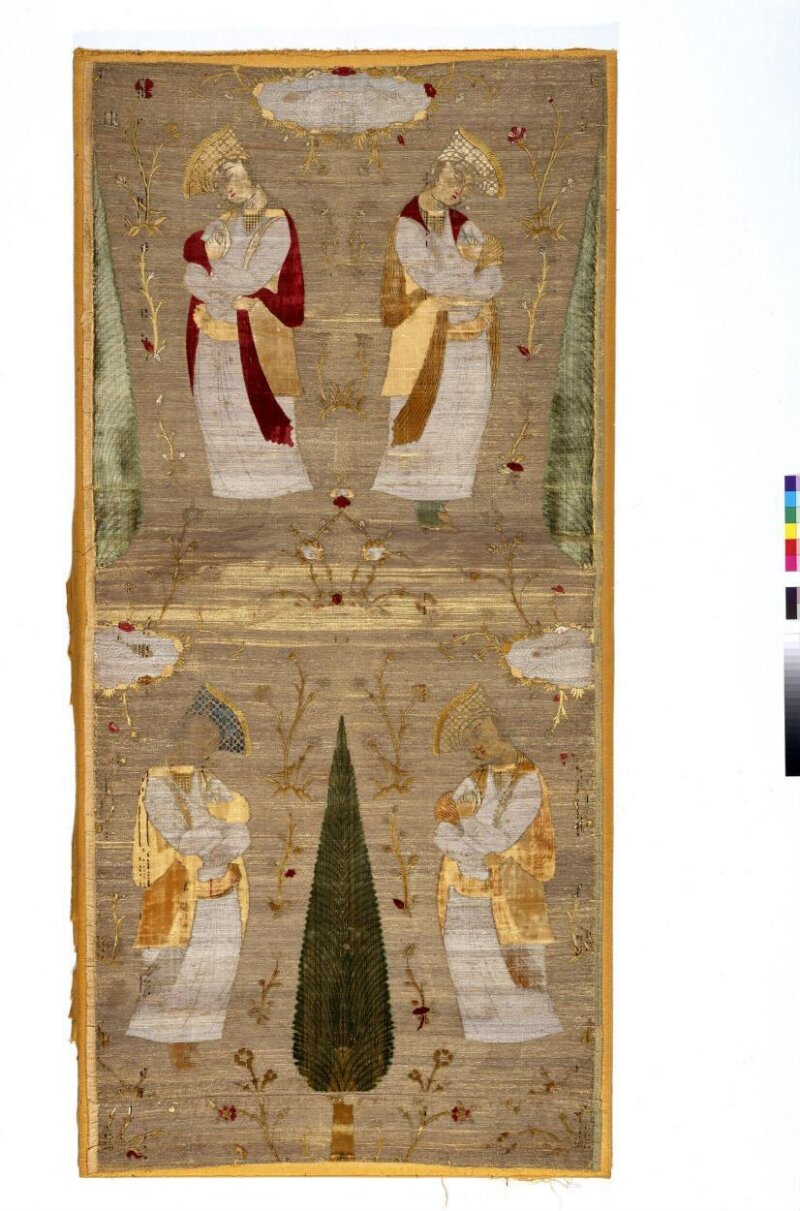
This report, prepared for Natalie Fashion Atelier, presents a technical archaeology of a fragmentary velvet textile, dated to late 16th to early 17th century Iran (Safavid Empire). The artifact, a section of a larger panel, exhibits a complex interplay of weave structure, metal-wrapped thread, and natural dyestuffs. Its analysis informs a proposed translation into 2026 high-end luxury silhouettes, emphasizing material integrity and structural innovation.
I. Provenance and Condition
The textile fragment measures approximately 45 cm x 32 cm, with selvage edges on two sides indicating it was part of a larger garment or furnishing. Its provenance is attributed to the Safavid court workshops of Isfahan or Kashan, known for their production of luxury velvets (makhmal) for royal and elite patronage. The fragment shows moderate degradation: the silk pile is abraded in high-relief areas, and the metal-wrapped threads exhibit tarnishing and some loss of the silver-gilt lamella. However, the underlying weave structure remains largely intact, allowing for detailed technical analysis.
II. Weave Structure and Pile Technique
The textile is a voided velvet, a sophisticated technique where the pile is selectively cut to create a pattern against a flat ground. The ground weave is a compound twill, composed of a silk warp (Z-twist, approximately 80 threads per cm) and a silk weft (S-twist, approximately 30 threads per cm). The pile is formed by an additional warp system of silk filaments, also Z-twist, with a density of approximately 40 pile warps per cm. The pile height varies from 1.5 mm to 3.0 mm, creating a sculptural relief that defines the botanical motifs—palmettes, cloud bands, and floral sprays.
Critical to the technical analysis is the use of lancé (brocading) wefts for the metal threads. These supplementary wefts are not part of the ground weave but are introduced selectively to create the gilded outlines of the motifs. The metal thread itself is a composite: a thin strip of silver-gilt lamella (approximately 0.1 mm wide) wrapped around a silk core (Z-twist). The wrapping is tight and uniform, indicating a high degree of craftsmanship. The tarnishing reveals a copper-rich alloy in the silver, a common Safavid practice to enhance durability.
III. Material Materiality: Dyes and Metal
The color palette is limited but intense, typical of Safavid velvets. The ground is a deep madder red (likely from Rubia tinctorum), achieved through an alum mordant. The pile is a vibrant indigo blue (from Indigofera tinctoria), with some areas showing a greenish undertone from over-dyeing with a yellow flavonoid (possibly weld or saffron). The metal threads are now a muted gold-brown, but original samples under magnification show a brilliant silver-gilt surface, with traces of red bole (a clay-based ground) beneath the lamella, used to enhance the metal’s reflectivity.
The materiality of this textile is defined by its haptic contrast: the soft, plush pile against the flat, rigid ground, and the cool, metallic gleam of the brocading. This interplay of textures—absorbent and reflective, soft and hard—is a central design principle for the modern translation.
IV. Translation into 2026 High-End Luxury Silhouettes
The Safavid velvet’s structural and aesthetic principles are directly translatable into contemporary couture, respecting its heritage while innovating for modern wearability and production. Three silhouette concepts are proposed:
Concept 1: The Sculptural Gown
A floor-length column gown, constructed from a double-faced velvet woven on a jacquard loom. The front panel replicates the Safavid voided velvet technique, with a cut-pile pattern of abstracted palmettes in deep indigo against a madder ground. The back panel is a reverse weave, with the pile on the interior for a matte finish. The metal brocading is replaced by a laser-cut metallic foil applied to the ground weave, mimicking the reflective quality of the original silver-gilt without the weight or tarnish risk. The silhouette is defined by a high neckline, long sleeves, and a train that pools at the floor, echoing the ceremonial grandeur of the Safavid court.
Concept 2: The Deconstructed Jacket
A cropped, bolero-style jacket, using a reversible velvet where the pile is selectively sheared to create a pattern on both sides. The front features a low-relief floral motif in black (carbon-dyed silk) against a natural white silk ground, referencing the Safavid use of negative space. The back is a solid black velvet with a subtle metallic thread woven into the ground, creating a shimmering effect under light. The jacket is cut with asymmetrical panels and a raw-edge hem, deconstructing the formal structure of the original textile while preserving its material integrity. The metal thread is a modern silver-coated nylon, chosen for its flexibility and resistance to oxidation.
Concept 3: The Modular Evening Cape
A full-length cape, constructed from multiple panels of velvet, each woven with a different pile height and motif. The panels are joined with invisible magnetic closures, allowing the wearer to reconfigure the cape’s silhouette—from a dramatic train to a shoulder-cropped stole. The velvet uses a gradient dye technique, moving from deep madder at the shoulders to pale rose at the hem, a modern interpretation of the Safavid color palette. The metal brocading is translated into a hand-embroidered silver thread (pure silver on a silk core) applied to the panel edges, echoing the original’s linear precision. This modularity respects the fragmentary nature of the original artifact while creating a versatile, interactive garment for the 2026 luxury market.
V. Technical Considerations for Production
Translating these techniques requires collaboration with specialized mills. The double-faced velvet for the gown demands a jacquard loom with two pile warp beams, a process that is both time-intensive and costly, but essential for the desired structural integrity. The laser-cut foil application must be tested for adhesion to silk velvet without compromising the pile. For the deconstructed jacket, the shearing process must be computer-controlled to achieve the precise relief patterns, while the silver-coated nylon thread requires a custom dye bath to match the natural silk tones. The modular cape’s magnetic closures must be encapsulated in silk to prevent corrosion and ensure a seamless aesthetic.
VI. Conclusion
The late Safavid velvet offers a rich technical vocabulary for 2026 couture. Its voided pile, metal brocading, and haptic contrasts are not merely historical artifacts but active design principles. By deconstructing its weave structure, materiality, and color theory, Natalie Fashion Atelier can produce garments that honor the original craftsmanship while pushing the boundaries of modern luxury. The proposed silhouettes—sculptural, deconstructed, modular—represent a dialogue between past and future, where the hand of the 16th-century weaver meets the precision of 21st-century technology.