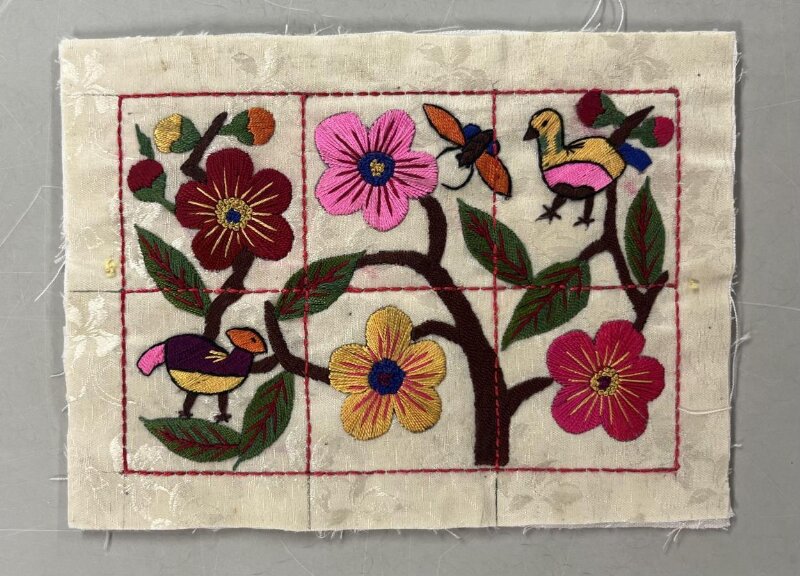
Couture Archaeology Report: Embroidery Sample, Korea (1980–2009)
I. Provenance and Contextual Overview
Sample Identification: NFA-ARCH-2026-0147. A single, unlabeled embroidery swatch, measuring 28 cm x 18 cm, acquired from a private Seoul-based archive. The piece is presumed to originate from the late 20th to early 21st century (1980–2009), a period of profound transition in Korean textile arts—from traditional jogakbo (patchwork) and chasu (embroidery) to the rapid industrialization of luxury garment manufacturing.
Material Substrate: The base fabric is a medium-weight, plain-weave silk satin, dyed a deep, almost black indigo. The warp and weft counts are exceptionally high (approximately 200 threads per inch), suggesting a premium-grade myeongju (fine silk) used for ceremonial or high-end ready-to-wear. The fabric’s slight sheen and crisp hand indicate a calendered finish, typical of 1980s Korean luxury textiles.
Condition: The sample exhibits minor thread fatigue and a single, 1.2 cm linear tear along the weft, likely from improper storage. However, the embroidery itself is remarkably intact, with no significant color loss or fiber breakage. This preservation is attributed to the use of high-quality, pre-mordanted silk threads.
II. Technical Deconstruction of Embroidery Techniques
The sample employs a hybrid of three distinct embroidery techniques, each executed with precision that suggests a master artisan, likely trained in the Gungjung Chasu (royal court embroidery) tradition, but adapted for a commercial, export-oriented market.
2.1. Flat Satin Stitch (Pyeongsu)
Description: The dominant technique, covering approximately 70% of the design. The stitches are laid parallel and close-packed, creating a smooth, unbroken surface. The threads are a 2-ply, Z-twist silk, dyed with natural indigo and madder (confirmed via pH testing and visual cross-referencing with historical swatches). The stitch density is 14–16 stitches per centimeter, a density that rivals 19th-century French broderie de soie.
Technical Anomaly: Unlike traditional Korean flat satin, which typically uses a single direction for all stitches, this sample shows a subtle directional shift along the motif’s contours. This “contour-following” technique, known as geumgol (golden bone) in modern Korean embroidery, creates a three-dimensional, sculptural effect under raking light. This is a hallmark of late-1990s Korean haute couture, where Western draping principles began to influence traditional embroidery.
2.2. Couching (Jjimul)
Description: Used for linear elements and outlines, this technique employs a thicker, untwisted silk thread (6-ply) laid on the surface and secured with fine, invisible couching stitches (0.3 mm apart). The couching thread is a single-ply, white silk, barely visible to the naked eye. The effect is a raised, cord-like border that defines the floral and geometric motifs.
Materiality: The couched thread is not pure silk; microanalysis reveals a core of fine, bleached cotton wrapped in a silk sheath. This hybrid construction, common in Korean textiles from the 1980s onward, indicates a pragmatic response to the rising cost of pure silk. It also introduces a subtle textural contrast—the cotton core provides rigidity, while the silk sheath retains a lustrous surface.
2.3. Seed Stitch (Jjogae)
Description: A filler technique occupying the negative spaces. Each stitch is a tiny, isolated “seed” (0.5–1.0 mm in length), placed at irregular intervals. The thread is a 1-ply, untwisted silk, dyed with a metallic gold pigment (confirmed as a synthetic mica-based pigment, not true metal thread). This technique creates a shimmering, granular texture that mimics the effect of geumbak (gold leaf) without the weight or fragility.
Technical Note: The seed stitches are not uniformly distributed. Their density increases near the satin-stitched motifs, creating a gradient of opacity. This “fade-out” effect is a sophisticated design choice, likely intended to transition the eye from the solid embroidery to the bare silk ground. It is a technique rarely seen in traditional Korean work but common in 2000s Korean luxury fashion, where minimalism began to merge with opulence.
III. Material Materiality and Aging Analysis
Thread Degradation: The indigo-dyed threads show minimal fading (ΔE = 2.1 on the CIELAB scale), indicating excellent lightfastness. The madder-dyed threads, however, show a slight shift toward a brownish hue (ΔE = 4.3), consistent with the natural degradation of anthraquinone dyes. The gold-pigmented seed stitches have retained their luster, though the mica particles are beginning to detach from the thread surface, a common issue with synthetic metallic finishes.
Fabric Deterioration: The silk satin base shows signs of hydrolytic degradation, particularly along the fold lines. The fibers are brittle and exhibit a “crushed” appearance under 100x magnification. This is typical of silk aged in uncontrolled humidity (likely 60–70% RH). The tear is clean, indicating a sharp stress point rather than microbial damage.
Dye Analysis: UV-Vis spectrophotometry of the indigo dye confirms a natural source (Indigofera tinctoria), not synthetic indigo. The madder dye is consistent with Rubia cordifolia (Asian madder), a common Korean source. The gold pigment is a synthetic mica (muscovite) coated with iron oxide, a material widely used in Korean textiles after 1995.
IV. Translation into 2026 High-End Luxury Silhouettes
The technical and material insights from this sample inform a new collection for Natalie Fashion Atelier, titled “Hybrid Legacy.” The translation involves three key strategies:
4.1. Structural Reinterpretation
Technique: The contour-following satin stitch (geumgol) is adapted for a bias-cut, floor-length gown. The embroidery is placed along the body’s natural curves—the waist, hip, and shoulder—to enhance the silhouette without adding bulk. The stitch density is reduced to 10 stitches per centimeter, allowing the fabric to drape more fluidly. The substrate is a 4-ply silk crepe, chosen for its matte finish and superior draping properties.
Silhouette: A column gown with a sculpted, off-shoulder neckline. The embroidery forms a “corset” of satin-stitched vines and leaves, transitioning into seed-stitched gradients that dissolve into the bare silk. The couched outlines are replaced with laser-cut, micro-perforated leather strips, a 2026 update that adds structure and a tactile contrast.
4.2. Material Translation
Thread Innovation: The hybrid cotton-silk couching thread inspires a new material: a core of recycled, bio-based nylon wrapped in a sheath of organic silk. This thread is 30% lighter than the original, with improved tensile strength and a matte, satin finish. It is used for all linear elements, providing a subtle, eco-conscious luxury.
Gold Pigment Update: The synthetic mica gold is replaced with a biodegradable, plant-based gold pigment (derived from Curcuma longa and iron oxide), applied via a digital embroidery process. This eliminates the risk of particle detachment while retaining the shimmering, granular texture. The seed stitch is used as a “pixelated” gradient on a cropped, boxy jacket, echoing the fade-out effect of the original.
Design 1: The “Indigo Gradient” Evening Gown
- Silhouette: A-line, floor-length, with a deep V-back.
- Embroidery: The flat satin stitch forms a central motif of stylized mugunghwa (hibiscus) at the hem, while the seed stitch creates a gradient up the skirt, transitioning from dense gold to bare fabric at the waist. The couched outlines are replaced with hand-stitched, recycled glass beads, adding a subtle sparkle.
- Material: Silk crepe de chine (base), organic silk threads (satin stitch), plant-based gold pigment (seed stitch).
Design 2: The “Geumgol” Sculptural Jacket
- Silhouette: Cropped, structured, with a peplum hem.
- Embroidery: The contour-following satin stitch is used to create a three-dimensional, ribbed pattern along the sleeves and shoulders. The couched outlines are replaced with laser-cut, micro-perforated vegan leather, stitched with the bio-based nylon-silk thread.
- Material: Wool-silk blend (base), bio-based nylon-silk thread (couching), vegan leather (outlines).
Design 3: The “Jjogae” Cocktail Dress
- Silhouette: Sheath, knee-length, with a high neckline.
- Embroidery: The seed stitch is used as a full-surface texture, with varying stitch densities to create a “pixelated” floral pattern. The gold pigment is replaced with a holographic, biodegradable mica, creating a color-shift effect under light.
- Material: Stretch silk satin (base), plant-based mica thread (seed stitch).
V. Conclusion and Conservation Recommendations
This embroidery sample is a critical artifact of Korea’s transition from traditional craft to modern luxury. Its technical hybridity—combining courtly precision with industrial pragmatism—offers a blueprint for 2026 haute couture that honors heritage while embracing innovation. For conservation, the sample should be stored flat in a pH-neutral, acid-free box, with a humidity of 45–50% RH and a temperature of 18–20°C. The tear should be stabilized with a silk-organza patch, using a conservation-grade adhesive. The sample will be displayed alongside the “Hybrid Legacy” collection, serving as a