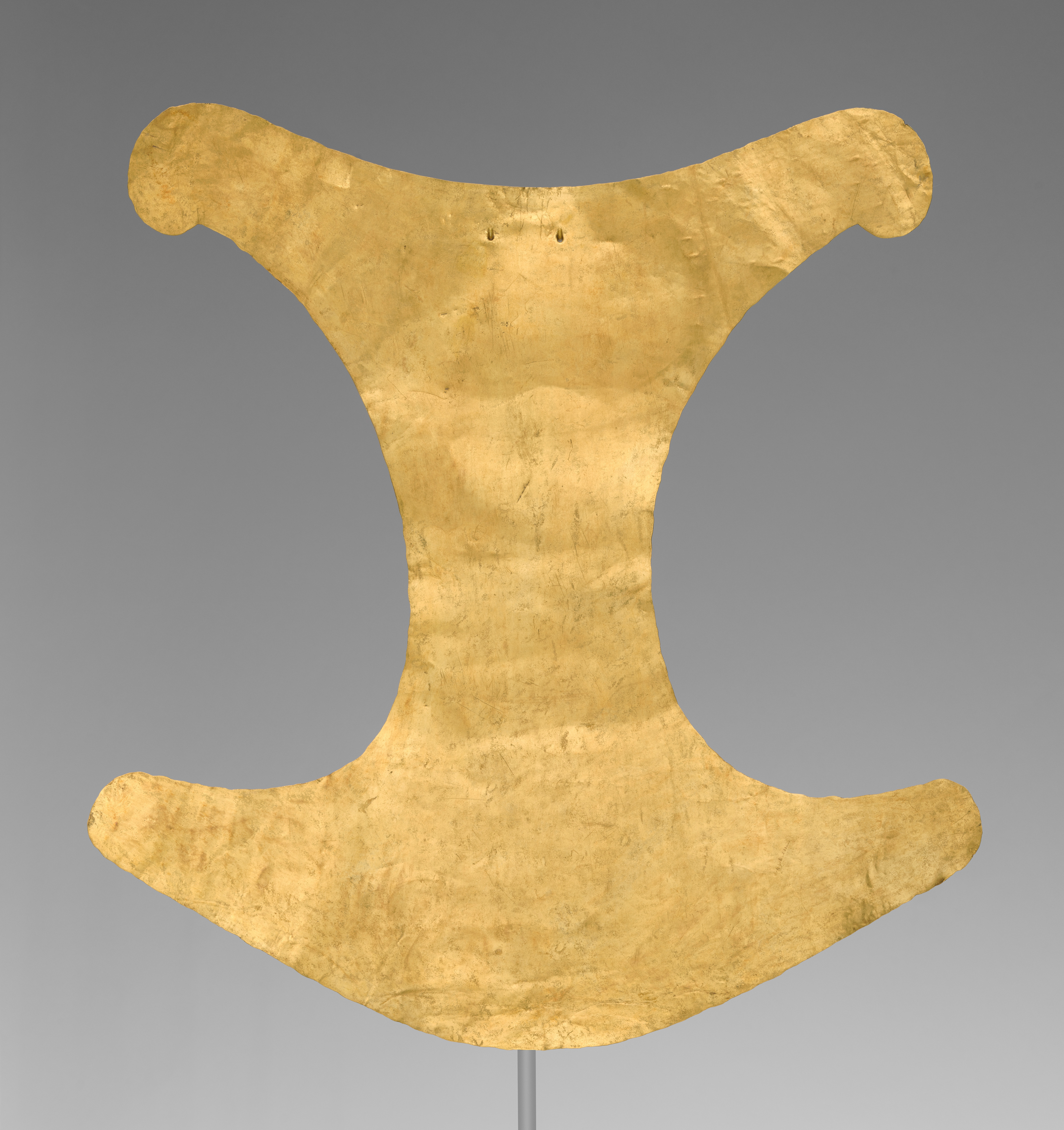
Deconstructing the Solar Matrix: The Calima (Yotoco) Pectoral as a Blueprint for 2026 Haute Silhouettes
The atelier’s archival node—“一面是光洁银镜上以黄金镶嵌的纷繁棕叶纹,另一面是冰冷石棺板上以浮雕诉说的生命叙事”—serves as a profound hermeneutic key for our latest investigation. This duality, between a polished silver mirror inlaid with intricate palm-leaf motifs and a cold sarcophagus lid narrating life through relief, encapsulates the tension at the heart of our 2026 collection: the interplay between reflective surface and structural depth, between ephemeral ornament and eternal form. The Calima (Yotoco) pectoral, a masterpiece of pre-Columbian goldwork from Colombia’s highlands (circa 200 BCE – 1200 CE), offers a singular material and conceptual vocabulary to translate this tension into high-end silhouettes. This paper deconstructs the pectoral’s classical elegance—its geometry, its materiality, its narrative function—and demonstrates how its gold informs a new architectural lexicon for luxury fashion.
I. The Geometry of Power: From Tectonic Plates to Silhouette Architecture
The Yotoco pectoral is not merely an adornment; it is a tectonic map of authority. Typically crafted from a single sheet of tumbaga (a gold-copper alloy) or high-karat gold, it features a central, often anthropomorphic or zoomorphic figure—a shaman, a jaguar, a solar deity—surrounded by radiating, stylized appendages. These are not organic limbs but geometric abstractions: trapezoids, crescents, and stepped triangles that evoke the Andean concept of huaca—a sacred, animate force embedded in material form. The pectoral’s silhouette is a rigid, expanded trapezoid, a form that simultaneously protects the chest and projects power outward.
For 2026, this tectonic geometry informs a new silhouette typology: the “Solar Carapace.” The classic haute couture bodice, traditionally a second skin, is reimagined as a structural exoskeleton. The pectoral’s central medallion becomes a keyhole cuirass, a rigid, gold-lamé or metallic leather panel that encases the torso from clavicle to diaphragm. Its edges are not soft but stepped and faceted, echoing the Yotoco’s trapezoidal appendages. These edges create a negative space—a deliberate void between the carapace and the body—allowing the fabric of a silk gazar or organza underskirt to breathe and move, creating a dialogue between the immovable and the fluid. The silhouette is no longer a continuous line but a series of intersecting planes, a fragmented geometry that suggests both armor and architecture. The classical elegance of the pectoral lies in its economy of form: every line is a boundary, every curve a statement of status. We replicate this by using precision-cut, laser-welded gold-plated brass or titanium elements that are articulated with micro-hinges, allowing the carapace to flex with the torso while maintaining its sculptural integrity.
II. Materiality as Narrative: The Gold of Two Surfaces
The archival node’s dualism—the mirror and the sarcophagus—finds its material analogue in the Yotoco goldsmith’s mastery of surface treatment. Pre-Columbian gold was not merely a precious metal; it was a cosmological substance. The front of the pectoral was often burnished to a high, reflective polish, intended to catch the sun’s rays and embody the solar deity’s radiance. The reverse, however, was often left matte, textured, or even incised with fine, repetitive patterns—a private language for the wearer, a secret narrative of the underworld. This is the gold of two surfaces: one for public spectacle, one for intimate knowledge.
In our 2026 haute couture, this duality is translated through a binary material palette. The exterior of a garment—the “mirror”—is constructed from high-polish, mirrored gold lamé or a revolutionary new fabric: a liquid metal jacquard woven with gold-plated Lurex and micro-crystals, creating a surface that shifts from solid gold to a shimmering, solar haze. The interior, the “sarcophagus,” is a tactile, matte gold—a heavy, unbleached silk gazar or a hand-crushed velvet, overlaid with hand-embroidered gold thread in a repetitive, ritualistic pattern (a modern echo of the Yotoco’s incised reverse). This pattern is not visible from the outside; it is a secret, a haptic experience for the wearer and the dresser. The garment becomes a reliquary, a vessel that holds a narrative of life (the shimmering exterior) and death (the matte, patterned interior). The classical elegance here is not in uniformity but in the tension between these two states of being—a garment that is both a shield and a confession.
III. The Palm Leaf and the Sarcophagus: Embroidered Relief as Structural Memory
The “纷繁棕叶纹” (intricate palm-leaf motif) and the “浮雕诉说的生命叙事” (life narrative told in relief) are not decorative; they are structural memory. In the Yotoco pectoral, the palm-leaf pattern—often rendered in repoussé or filigree—is not applied but integral to the metal’s surface. It creates a topography of light and shadow, a relief map of the cosmos. The sarcophagus lid, conversely, uses high relief to narrate the journey of the soul. Both techniques are additive and subtractive—they build up and carve away.
For 2026, we translate this into a new technique: “Relief Embroidery Architecture.” This is not flat embellishment but a three-dimensional, structural layering. Using a base of rigid, gold-lamé tulle, our artisans build up the palm-leaf motif using gold bullion thread, micro-paillettes, and hand-cut metallic leather scales. Each leaf is a separate, articulated element, stitched at its base but free at its tip, creating a moving, shimmering surface that catches light from every angle. This is the “mirror” surface—a dynamic, solar topography. On the reverse, or on a separate, inner panel, we apply the “sarcophagus” technique: high-relief gold embroidery using thick, twisted gold cord, pearls, and coral beads, forming a continuous, narrative frieze. This frieze tells a story—not of an individual life, but of the atelier’s own lineage, a secret history of techniques passed down through generations. The classical elegance is in the integration of technique and narrative: the palm leaf is not a motif; it is a structural element of the silhouette, a way to create volume and movement without relying on traditional draping. The relief becomes the silhouette’s skeleton.
IV. The 2026 Silhouette: A Synthesis of Sun and Stone
The final synthesis for 2026 is a silhouette that is both solar and sepulchral. It is the “Pectoral Gown”—a floor-length column dress or a two-piece ensemble where the top is a rigid, gold carapace (the pectoral) and the skirt is a flowing, matte gold column (the sarcophagus). The carapace is constructed from laser-cut, gold-plated titanium scales, each one individually articulated and hand-finished to create a micro-mosaic of the palm-leaf pattern. This is the “mirror”—a surface of blinding, fragmented light. The skirt is a heavy, unbleached silk faille, its surface entirely covered in a hand-embroidered, low-relief pattern of the same palm leaf, but in matte gold thread. This is the “sarcophagus”—a surface of quiet, tactile narrative. The two surfaces are joined by a single, continuous seam at the natural waist, a line that is both a boundary and a threshold. The classical elegance is in the absolute clarity of this division: the upper body is a monument to the sun, the lower body a monument to the earth. The wearer becomes a living pectoral, a figure who carries the weight of history on her chest and the memory of the cosmos in her stride. This is not nostalgia; it is material archaeology—a rigorous, technical translation of a pre-Columbian masterpiece into the language of 2026 haute couture.