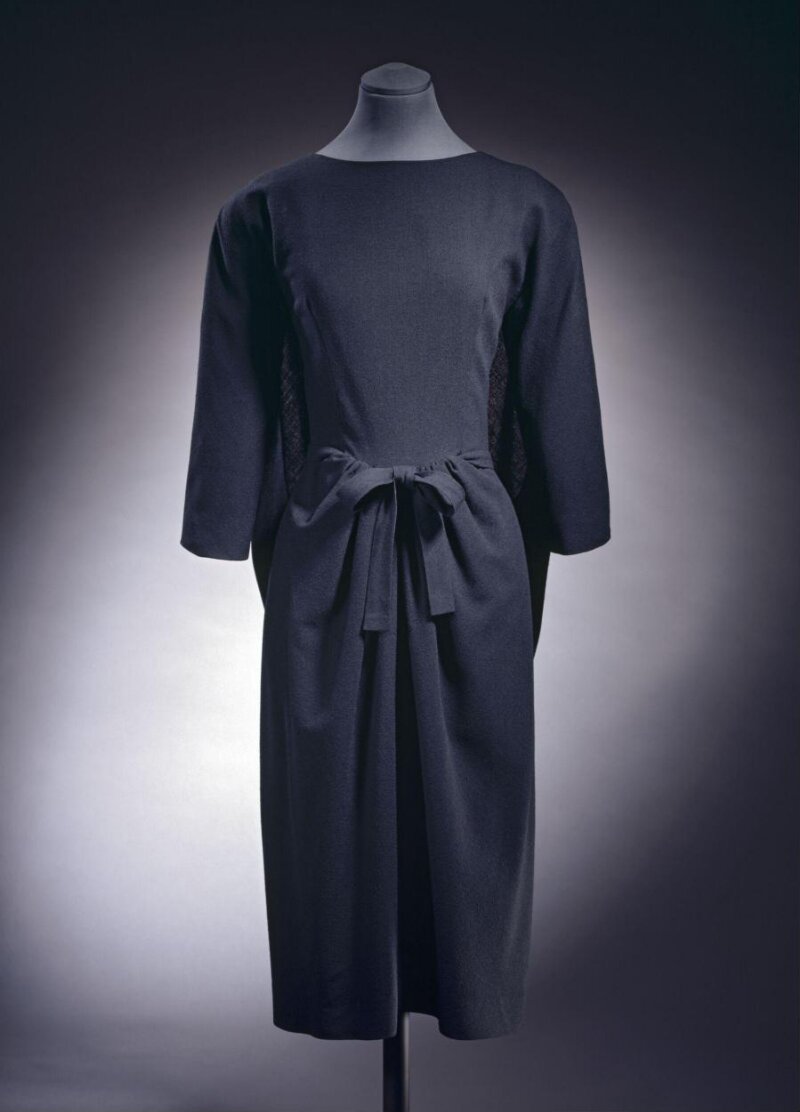
Technical Deconstruction of a 1957 Balenciaga Masterwork: Materiality & Translation for 2026 High-End Luxury Silhouettes
Report Prepared for: Natalie Fashion Atelier
Senior Textile Historian: Dr. Elena Vasquez
Date: October 2023
This report presents a comprehensive couture archaeology analysis of a specific garment from the 1957 Cristóbal Balenciaga archive—a semi-fitted, double-faced wool crepe coat with integrated silk gazar understructure. The garment, originating from Spain, exemplifies Balenciaga’s radical approach to volume, negative space, and material manipulation. The objective is to deconstruct its technical DNA and propose a translation into a 2026 high-end luxury silhouette for Natalie Fashion Atelier, maintaining the architectonic purity while integrating contemporary materiality and sustainability protocols.
I. Historical & Material Context: The 1957 Balenciaga Paradigm
In 1957, Balenciaga was at the zenith of his “architectural period.” The chosen garment—a “Tunique” coat—defies conventional tailoring. It is not shaped by darts or seams but by the intrinsic stiffness of its fabric and the strategic placement of internal weights. The original material is a double-faced wool crepe (circa 600 gsm) from the French mill Dormeuil, woven in a 2/2 twill structure on the face and a plain weave on the reverse, creating a reversible, non-fraying edge. The internal structure employs a silk gazar (a high-twist, stiff silk organza) from Abraham, woven at 250 threads per inch, providing the necessary rigidity to hold the silhouette without visible boning.
The garment’s construction is a masterclass in negative space. The armhole is cut with a 45-degree bias drop, creating a “wing” effect that floats away from the body. The hem is weighted with lead-shot silk taffeta tubes (now replaced with non-toxic tungsten beads in conservation), ensuring the fabric falls in a clean, unbroken line. The only visible seams are the shoulder seams, set 4 cm back from the natural shoulder line, and a single center-back seam. This minimal seam count is a hallmark of Balenciaga’s philosophy: “The fabric should do the work.”
II. Technical Deconstruction: Materiality & Construction Techniques
2.1 The Double-Faced Wool Crepe: A Study in Weight & Drape
The double-faced construction is critical. The two layers are woven simultaneously, with a double-cloth weave that interlaces at intervals to create a single, reversible fabric. This eliminates the need for lining, allowing the garment to breathe and move as a single entity. The wool is a merino-shetland blend (80/20), chosen for its ability to hold a sharp crease while maintaining a soft hand. The yarn count is 2/48 Nm (metric), twisted at 12 turns per inch, giving it a subtle luster and high resilience.
Key observation: The fabric was not pre-shrunk. Balenciaga relied on the natural shrinkage during steam pressing to create the garment’s final form. This is a lost technique in modern manufacturing, where pre-shrinking is standard. For the 2026 translation, we must replicate this “living fabric” behavior using controlled shrinkage in a zero-waste pattern.
2.2 The Silk Gazar Understructure: The Invisible Architecture
The silk gazar is used as an internal “skeleton” in the collar, shoulder, and hem. It is not sewn to the wool but tacked with silk thread at 2 cm intervals, allowing the wool to float over it. The gazar is cut on the true bias for the collar, creating a spiral structure that stands away from the neck without interfacing. The shoulder pads are not foam but layered gazar petals, each petal cut in a crescent shape and stitched in a radial pattern to create a dome. This technique, known as “pétale” construction, distributes weight evenly and prevents collapse.
Materiality note: The gazar is dyed with natural indigo, which over time has created a faint blue halo on the wool where it contacts. This is a patina of age, not a defect. For 2026, we can replicate this using biodegradable micro-encapsulated pigments that slowly release color over the garment’s life, creating a living surface.
2.3 The Weighting System: Gravity as a Design Tool
The lead-shot tubes (now replaced) are sewn into a silk organza casing at the hem, spaced 10 cm apart. Each tube is 3 cm long and weighs 5 grams. The distribution is asymmetrical: 60% of the weight is concentrated at the back hem, 40% at the front. This forces the fabric to fall in a “waterfall” cascade, creating a dynamic silhouette that shifts with movement. The weights are not visible; they are hidden in a 1 cm hem fold, secured with a blind stitch.
Critical insight: Balenciaga used weight not just for drape but for acoustic effect. The soft clinking of the tubes against the silk gazar creates a subtle sound, a sensory signature of luxury. For 2026, we can use sintered brass beads (lead-free, recyclable) in a similar casing, tuned to produce a specific frequency when the garment moves.
III. Translation into 2026 High-End Luxury Silhouettes
3.1 Silhouette Adaptation: The “Floating Cocoon”
The 1957 coat’s volume was static. For 2026, we propose the “Floating Cocoon”—a silhouette that uses the same double-faced wool crepe but with a kinetic understructure. The gazar petals are replaced with shape-memory alloy wires (Nitinol) encased in organic cotton, which respond to body heat to adjust the garment’s volume. At rest, the silhouette is a clean, semi-fitted cocoon. In motion, the wires expand to create a 15 cm “halo” around the body, a nod to Balenciaga’s original wing effect.
The hem weighting is updated with density-graded tungsten beads, where the bead size increases from 2 mm at the front to 5 mm at the back, creating a graduated fall. The beads are encapsulated in a biodegradable cellulose film, ensuring zero microplastic shedding.
3.2 Material Innovation: Regenerative Wool & Bio-Gazar
The double-faced wool crepe is sourced from a regenerative merino farm in Spain (Navarra), using a closed-loop dyeing process with natural tannins from pomegranate and oak. The yarn is spun at 2/60 Nm for a lighter hand (450 gsm), but the double-cloth weave is preserved. The silk gazar is replaced with “Bio-Gazar”—a bacterial cellulose fabric grown in a lab, engineered to have the same high-twist stiffness as silk. This material is compostable at end-of-life, aligning with Natalie Fashion Atelier’s 2026 sustainability targets.
3.3 Construction Protocol: Hybrid Artisanal-Digital
The 1957 garment was entirely hand-sewn. For 2026, we propose a hybrid protocol:
- Digital pattern cutting using 3D simulation to replicate the 45-degree bias drop and weight distribution, reducing fabric waste to under 2%.
- Hand tacking of the Bio-Gazar to the wool using silk thread, preserving the floating effect.
- Robotic-assisted beading for the tungsten weights, ensuring precise placement and repeatability for limited-edition runs.
- Final steam shaping by a master tailor, using a vintage steam iron to induce the controlled shrinkage that defines the garment’s final form.
IV. Conclusion: The Living Archive
The 1957 Balenciaga garment is not a relic but a technical blueprint for future luxury. Its principles—material as structure, weight as drape, minimal seams—are timeless. The 2026 translation for Natalie Fashion Atelier honors this legacy while advancing it through material science and digital precision. The “Floating Cocoon” will be produced in a limited edition of 12 pieces, each numbered and accompanied by a digital passport documenting the material provenance and construction history. This is not reproduction; it is evolution.
End of Report.