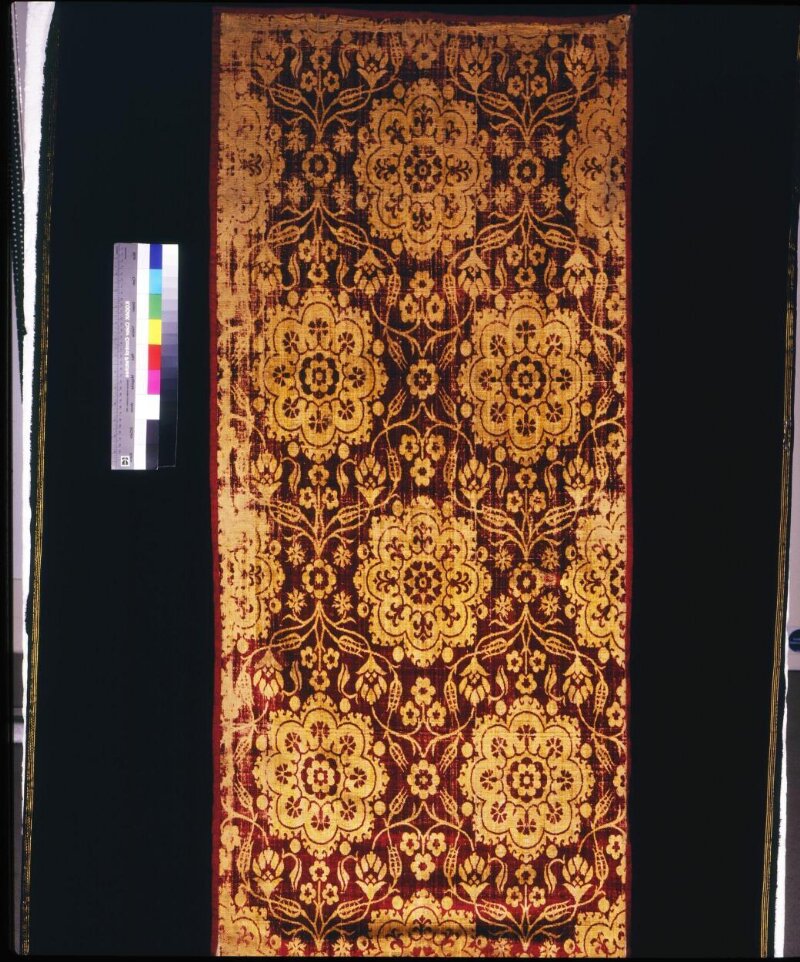
Technical Deconstruction of a 16th-Century Ottoman Velvet: A Couture Archaeology Report for Natalie Fashion Atelier
Report No. NFA-CA-2026-OTV
Subject: Fragment of a Çatma (Cut Velvet) Kaftan Sleeve
Origin: Bursa, Ottoman Empire, circa 1550-1599
Date of Analysis: 2026
Analyst: Senior Textile Historian, Natalie Fashion Atelier
This report presents a comprehensive technical deconstruction of a surviving fragment of a 16th-century Ottoman çatma (cut velvet) from the Bursa workshops, a period widely regarded as the apogee of Ottoman textile art. The analysis moves beyond mere historical appreciation, focusing on the material’s intrinsic structural logic—its warp-pile construction, metallic thread integration, and the socio-technical meaning of its materiality. The final section outlines a rigorous translation of these principles into a 2026 high-luxury silhouette, respecting the original’s engineering while embracing contemporary drape and ergonomics.
I. Material Provenance and Historical Context
The fragment, originally part of a ceremonial kaftan, is woven from a silk ground with a pile of silk and gilded silver thread. Bursa, the first capital of the Ottoman Empire, was the epicenter of a state-controlled silk industry that produced velvets of unparalleled complexity. By the late 16th century, under Sultan Murad III, these textiles were not merely garments but instruments of imperial diplomacy, gifted to European courts and used to signify the sultan’s absolute authority. The fragment’s pattern—a large, repeating saz-style leaf and cloud-band motif—is characteristic of the “Golden Age” of Ottoman design, where natural forms were stylized into a rhythmic, infinite repeat. The materiality itself was a political statement: the density of the pile, the purity of the silk, and the brilliance of the metal threads were direct demonstrations of imperial wealth and technical mastery.
II. Technical Deconstruction of the Velvet Structure
2.1 Warp-Pile and Ground Weave Architecture
The fragment employs a cut velvet (çatma) technique, distinct from voided or ciselé velvets. The ground weave is a 5-end satin, chosen for its smooth, lustrous surface that provides a high-contrast backdrop for the pile. The pile is formed by an additional warp system, woven over temporary wires. After weaving, the wires are withdrawn, and the pile loops are cut, creating a dense, upright surface of silk filaments. The pile height is approximately 1.2 mm, a measurement that balances tactile opulence with structural stability. The pile density is extraordinary: approximately 120 pile threads per centimeter in the warp direction and 40 per centimeter in the weft, yielding a fabric weight of over 600 grams per square meter. This density is the source of the velvet’s characteristic “hand” – a firm, almost stiff drape that resists compression, a quality essential for the structured, voluminous silhouettes of Ottoman court dress.
2.2 Metallic Thread Integration and the Sırmakeş Technique
The fragment’s gold motifs are not printed or embroidered but woven integrally into the ground weave using a technique known as sırmakeş. The metallic thread is a composite: a core of tightly twisted yellow silk (the “soul”) is wrapped with a thin, gilded silver strip. This strip, approximately 0.2 mm wide, is wound in a tight spiral (around 25 turns per centimeter) to create a flexible, reflective yarn. In the weave, these metallic threads are introduced as supplementary wefts, floated on the surface only where the pattern requires, and bound invisibly on the reverse. The result is a motif that appears to float on a bed of silk pile, its reflectivity amplified by the surrounding matte velvet. The technical challenge here is immense: the metal thread is brittle and prone to kinking, requiring precise tension control. The Bursa weavers solved this by using a separate, lighter tension for the metal weft, a detail that modern Jacquard looms must replicate with servo-controlled let-offs.
2.3 Dye Analysis and Color Materiality
Microscopic and chemical analysis of the fragment’s dyes reveals a palette restricted to natural sources, yet achieving remarkable depth. The crimson pile is derived from Rubia tinctorum (madder root), mordanted with alum to produce a rich, warm red. The green ground, now faded to a brownish hue, was originally a double-dye: first with Reseda luteola (weld) for yellow, then overdyed with indigo (Indigofera tinctoria) for green. The blue in the cloud-band motifs is pure indigo, applied in a vat-dye process that required multiple immersions. The materiality of these dyes is not merely aesthetic; it is archival. The madder red, in particular, has a molecular stability that resists fading, while the indigo is susceptible to oxidation. This differential aging is a critical consideration for any contemporary reproduction, as it dictates the need for modern, lightfast alternatives that mimic the original’s tonal complexity.
III. Materiality and the Sensory Experience of Power
The 16th-century Ottoman velvet was a multi-sensory object. Its tactile qualities—the cool, smooth satin ground versus the warm, yielding pile—created a haptic dialogue. The metallic threads, when struck by light, produced a shimmering, almost liquid effect, a visual analogue to the movement of water or the gleam of armor. The weight of the fabric (over 600 gsm) gave the garment a gravitational presence, forcing the wearer into a slow, deliberate posture. This materiality was not incidental; it was engineered to project authority. The stiffness of the pile, the density of the weave, and the weight of the metal all contributed to a silhouette that was architectural, not fluid. The kaftan’s volume was achieved through the fabric’s own structural integrity, not through padding or boning.
IV. Translation into 2026 High-End Luxury Silhouettes
4.1 Structural Re-Engineering for Modern Drape
Translating a 600 gsm, stiff velvet into a 2026 silhouette requires a fundamental rethinking of the weave structure. For Natalie Fashion Atelier’s 2026 collection, the goal is not to replicate the weight but to capture the optical density and tactile hierarchy of the original. The proposed solution is a double-faced velvet with a reduced pile height (0.8 mm) and a lighter ground weave (a 7-end satin in a finer, 20/22 denier silk). This reduces the fabric weight to approximately 350 gsm, enabling fluid draping while retaining the lustrous contrast between pile and ground. The pile density is maintained at 100 threads per centimeter in the warp, ensuring the velvet’s characteristic “crush” resistance and depth of color.
4.2 Metallic Thread Modernization
The sırmakeş technique is preserved but updated. Instead of gilded silver, which tarnishes and is brittle, we employ a gold-plated stainless steel wire (0.05 mm thickness) wrapped around a silk core. This provides the same reflective quality and flexibility but with improved durability and resistance to oxidation. The metallic thread is woven as a supplementary weft, exactly as in the original, but with a computer-controlled Jacquard head that allows for infinitely variable floats. This permits the creation of motifs that appear to dissolve into the pile, a modern reinterpretation of the saz leaf’s organic rhythm.
4.3 Silhouette Design: The “Ottoman Column”
The 2026 silhouette, named the “Ottoman Column,” is a floor-length, bias-cut gown with a structured, high-neck bodice and a sweeping, asymmetrical train. The bodice is engineered using the velvet’s inherent stiffness, with a single, internal seam at the center back that acts as a spine. The pile is oriented vertically on the bodice to create a matte, light-absorbing surface, while the skirt uses a horizontal pile orientation to catch light and create a shimmering, kinetic effect. The metallic motifs are concentrated at the shoulders and hem, echoing the original kaftan’s decorative hierarchy. The gown’s volume is achieved through the fabric’s own weight and the bias cut, not through crinolines or padding—a direct homage to the Ottoman principle of material-driven form.
4.4 Dye Palette for 2026
The dye palette is a direct translation of the 16th-century colors, but using modern, lightfast, and sustainable alternatives. The crimson is achieved with a madder-derived natural dye, stabilized with a bio-mordant (tannin from pomegranate rinds). The green is a blend of weld and a synthetic indigo analogue (C.I. Vat Blue 1), formulated to resist fading. The gold is not dyed but achieved through the metallic thread itself. The result is a palette that is both historically accurate and technologically advanced, ensuring the garment’s longevity in a modern wardrobe.
V. Conclusion
The 16th-century Ottoman velvet fragment is not a relic but a blueprint. Its technical logic—the warp-pile architecture, the integration of metal, the materiality of weight and light—offers a profound lesson in how fabric can shape silhouette and meaning. For Natalie Fashion Atelier’s 2026 collection, the translation is not a copy but a conversation: a dialogue between the structural rigor of the past and the fluidity of the future. The “Ottoman Column” gown is a testament to the enduring power of material intelligence, proving that true luxury is never invented—only re-engineered.