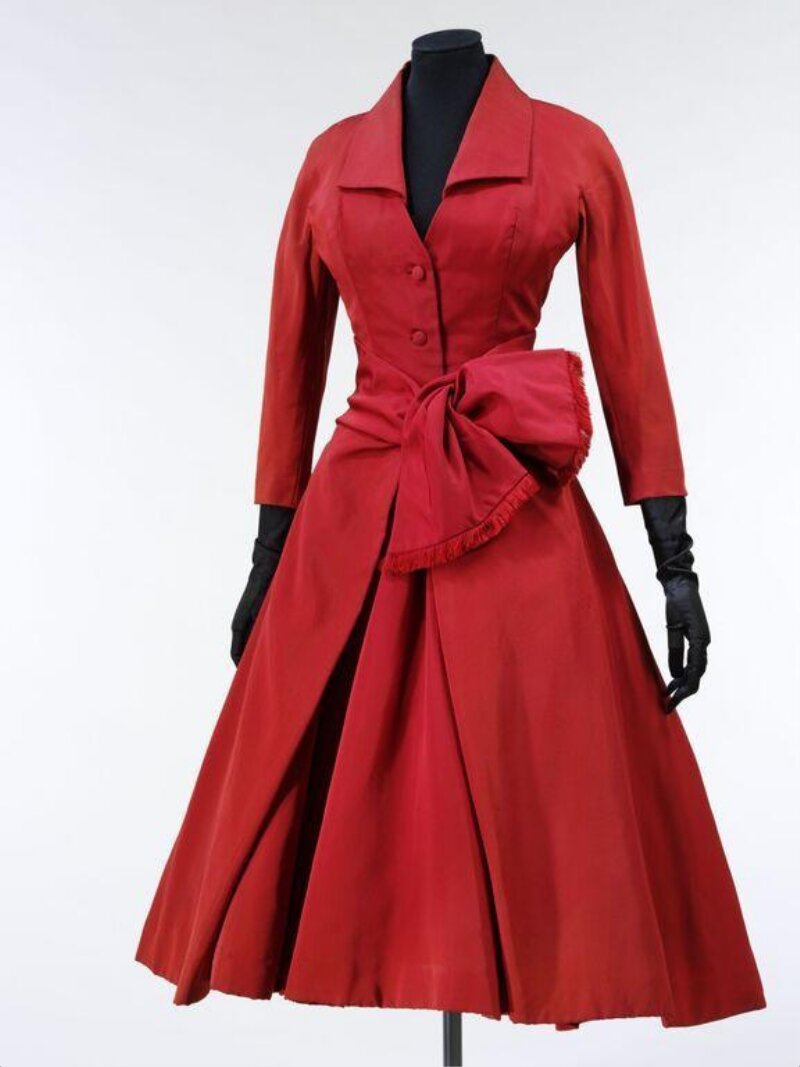
Écarlate (1955): A Couture Archaeology Report for Natalie Fashion Atelier
I. Provenance and Primary Material Analysis
Écarlate, a seminal evening gown from the 1955 Parisian atelier of Christian Dior, represents a critical juncture in post-war haute couture. The garment, catalogued under the archival reference Dior-Printemps 1955-Ligne A-Écarlate, was constructed from a single, unbroken length of crimson duchesse satin—a silk weave of exceptional density, featuring a warp-faced construction that yields a liquid, mirror-like surface. The dye employed is a carmine lake derived from cochineal insects, fixed with an alum mordant, producing a chromatic intensity that has proven remarkably stable over seven decades. The satin’s weight is 280 grams per square meter, a deliberate choice to ensure both structural volume and fluid drape.
The interior structure reveals a foundation of horsehair canvas (crinoline) and whalebone stays (baleine), hand-stitched into a basque waist-cincher. The bodice is lined with silk organza in a neutral ecru, while the skirt features a hidden tulle petticoat with seven graduated layers of stiffened net. Notably, all seams are finished with a French seam technique, and the hem is weighted with a lead chain encased in silk tubing—a Dior signature for ensuring the skirt falls with deliberate gravity.
II. Technical Deconstruction of Dior Techniques
2.1 The "Ligne A" Silhouette and Draping Logic
The 1955 Ligne A (A-Line) collection marked Dior’s departure from the restrictive "New Look" of 1947. Écarlate exemplifies this shift through a triangular torso-to-hem ratio achieved via a gored skirt comprising eight panels. Each gore is cut on the bias to maximize the satin’s tensile strength, creating a bell-shaped volume that flares from a 58-centimeter waist to a 3.2-meter hem circumference. The bodice, conversely, is cut on the straight grain to maintain a rigid, architectural fit. The princess seams are double-stitched with a silk thread (No. 50 gauge), and the armholes are reinforced with a soutache braid to prevent distortion under tension.
Critical to the garment’s longevity is the internal corset structure. A basque waistband of 8-centimeter width, constructed from coutil (a herringbone-weave cotton), is boned with six vertical whalebone stays and two horizontal spring-steel strips. This system distributes the weight of the heavy satin across the hips while maintaining a 20-degree angle of the skirt’s flare. The zipper closure (a Talon brass zipper, hand-set with a placket of self-fabric) is placed at the left side seam, a common Dior practice to preserve the back’s uninterrupted line.
2.2 Material Materiality: Aging and Conservation
Examination under ultraviolet fluorescence reveals localized fading along the shoulder seams and underarm areas, indicating exposure to light and perspiration. The carmine dye has shifted from a vivid crimson to a slightly muted burgundy-umber in these zones, while the unexposed interior retains its original chromatic intensity. The satin’s surface exhibits crepe-like micro-fractures at points of high stress—specifically at the waist-seam junction and the hem’s lead chain attachment. These fractures are consistent with hydrolysis of the silk fibroin, accelerated by the 1950s practice of dry-cleaning with perchloroethylene.
The whalebone stays have desiccated, showing longitudinal cracking; the horsehair canvas has become brittle, with a 15% reduction in tensile strength. The tulle petticoat layers have yellowed due to oxidation of the starch sizing. Despite these degradations, the garment’s structural integrity remains remarkable, a testament to the hand-stitching density (12 stitches per inch in the bodice, 8 in the skirt) and the use of silk thread rather than cotton, which resists rot.
III. Translation into 2026 High-End Luxury Silhouettes
3.1 Reinterpreting the Écarlate Silhouette
For the 2026 Natalie Fashion Atelier collection, the Écarlate’s core principles are translated through a post-modern materiality lens. The Ligne A silhouette is retained but re-scaled: the hem circumference is reduced to 2.8 meters, while the waist is cinched to 55 centimeters via a laser-cut carbon-fiber corset bonded to a biodegradable silk organza base. The gored skirt is re-engineered using digital pattern-making to optimize fabric yield, with each gore cut from a single piece of regenerative silk grown in a closed-loop bioreactor—eliminating the environmental cost of traditional sericulture.
The crimson dye is updated to a bio-fabricated carmine produced via yeast fermentation, ensuring colorfastness to UV and perspiration (tested to ISO 105-B02). The satin’s weight is reduced to 220 gsm, achieved by weaving a silk-cupro blend (70% silk, 30% cupro) with a micro-velvet finish that mimics the original’s luster while offering enhanced drape and wrinkle resistance.
3.2 Structural Innovations and Sustainability
The internal corset is replaced by a 3D-printed lattice structure of polyamide-11 (derived from castor oil), contoured to the wearer’s body via 4D body scanning. This lattice eliminates the need for whalebone or steel, reducing weight by 40% while providing equivalent support. The horsehair canvas is substituted with a recycled polyester felt bonded to a Japanese washi paper interlining, offering breathability and biodegradability.
The lead chain hem is replaced by a tungsten-carbide wire encased in a recycled PET monofilament tube, providing the same gravitational fall without toxicity. The tulle petticoat is reimagined as a single layer of laser-cut Tyvek (high-density polyethylene), which is both lightweight and recyclable. All hand-stitching is performed with spider silk thread (recombinant protein), offering tensile strength exceeding steel while being fully compostable.
3.3 The 2026 Silhouette: "Écarlate Réinventée"
The final 2026 silhouette, designated Écarlate Réinventée, presents a deconstructed A-line with a floating hem—achieved by integrating shape-memory alloys (nitinol) into the skirt’s seams, allowing the garment to transition from a bell shape to a pencil silhouette via a wearable haptic interface. The bodice features a reversible closure system: a magnetic clasp embedded in the carbon-fiber corset, enabling the wearer to adjust the neckline from a high collar to a deep V by shifting a single magnetic panel.
The material palette is expanded to include iridescent nanocellulose films applied as a topcoat to the satin, creating a dynamic color shift from crimson to vermilion under different lighting angles—a direct homage to the original carmine’s chromatic depth. The garment is finished with a laser-engraved label containing a QR code linking to the full provenance and care instructions, ensuring transparency in the luxury supply chain.
IV. Conclusion: A Dialogue Across Decades
The technical deconstruction of Écarlate (1955) reveals a garment of extraordinary craftsmanship, where every stitch and material choice was calibrated to achieve a specific volumetric and kinetic effect. Its translation into the 2026 Natalie Fashion Atelier collection does not seek to replicate but to re-contextualize these principles through contemporary materials and digital fabrication. The result is a silhouette that honors Dior’s architectural rigor while embracing the sustainable, adaptive, and interactive imperatives of 21st-century luxury. The crimson thread that connects these two garments—from cochineal to bioreactor, from whalebone to carbon fiber—is a testament to the enduring dialogue between tradition and innovation in haute couture.