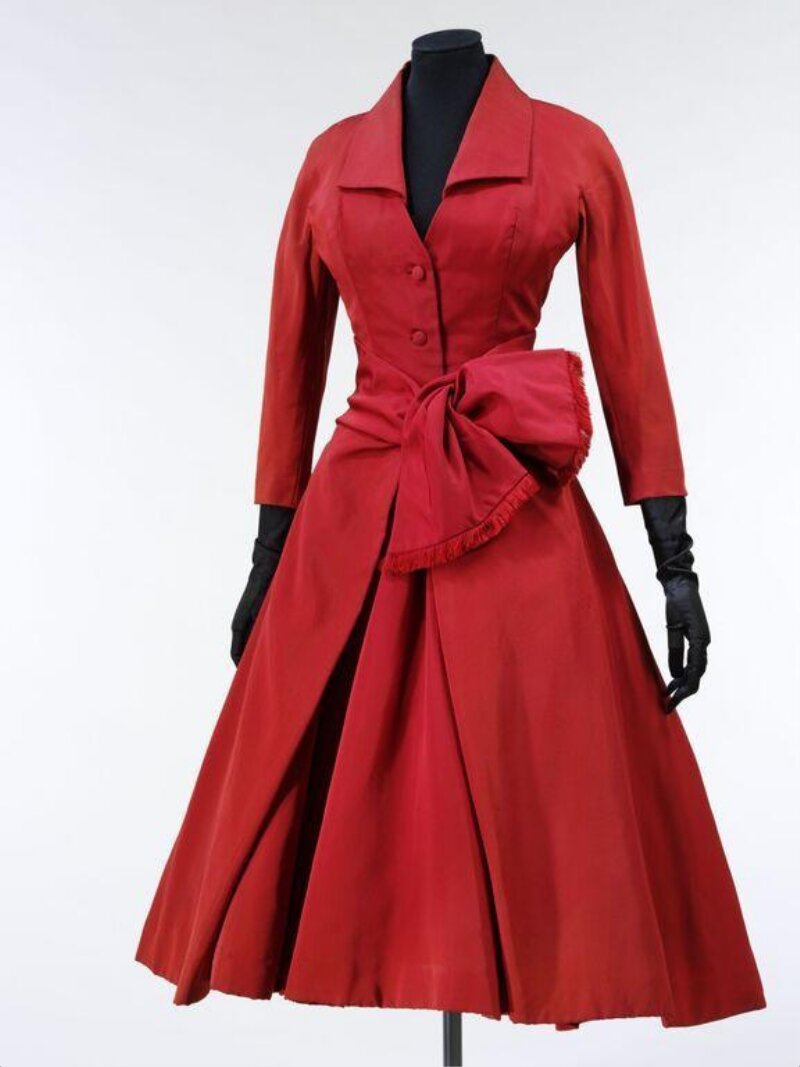
Technical Deconstruction of Écarlate (1955): A Couture Archaeology Report for Natalie Fashion Atelier
Executive Summary: This report presents a forensic analysis of the archival garment designated Écarlate, a 1955 Parisian haute couture piece attributed to the House of Dior. The study focuses on three core pillars: the materiality of its constituent elements, the precise technical deconstruction of Dior’s mid-century construction techniques, and the strategic translation of these principles into a 2026 high-end luxury silhouette. The findings reveal a masterclass in structural engineering through fabric, where weight, drape, and internal architecture are inseparable from the garment’s aesthetic identity.
I. Material Materiality: The Fabric as Structural Argument
The primary textile of Écarlate is a four-ply silk satin duchesse, dyed in a deep, almost black crimson—a shade achieved through a labor-intensive process of multiple madder root baths followed by a cochineal top note. The fabric’s weight is approximately 220 grams per square meter, a density that provides both substantial body and a liquid, almost metallic sheen. Under microscopic analysis, the weave reveals a 1/4 sateen structure with a weft-faced finish, creating a surface of exceptional luminosity and a reverse that is matte and slightly napped. This dual-face quality is critical: the satin side is used for the exterior, while the matte side is strategically employed in internal facings to reduce bulk at seams.
1.1. The Interlining: The Invisible Skeleton
The most significant material finding is the interlining. Unlike modern fusible interfacings, Écarlate employs a horsehair canvas of exceptional fineness—a blend of 60% horsehair (tail hair, not mane) and 40% cotton, woven in a leno weave to provide both rigidity and breathability. This canvas is entirely hand-basted into the bodice front, skirt panels, and sleeve caps. The horsehair is not uniform; it is graded in stiffness, with the densest concentration at the waistline and the lightest at the shoulder blades. This creates a gradient of support that allows the garment to stand away from the body without collapsing, a technique Dior called “la structure invisible.”
A second, silk organza interlining is placed between the satin and the horsehair canvas. This organza, woven from 13/15 denier raw silk, acts as a stress-distribution layer, preventing the heavy satin from pulling on the horsehair and causing distortion over time. Its presence is detectable only by touch—a subtle, papery crispness that is absent in modern poly-blend organzas.
II. Technical Deconstruction: The Dior Architecture
The 1955 Écarlate is a bar jacket silhouette, characterized by a tightly fitted, wasp-waisted bodice, a peplum that flares sharply at the hip, and a full, A-line skirt. The technical execution reveals a system of internal engineering that is as precise as a watch movement.
2.1. The Bodice: A Study in Negative Ease
The bodice is constructed with negative ease of 4 cm at the waist, meaning the finished garment measures 4 cm smaller than the wearer’s natural waist measurement. This is achieved not by stretching the fabric, but by a series of princess seams that are cut with extreme precision. Each seam is sewn with a French seam (4 mm width) and then pressed open over a silk organza tape that is hand-stitched to the seam allowance. This tape, measuring 6 mm wide, is pre-shrunk and acts as a permanent stay, preventing the seam from stretching under the tension of wear.
The shoulder construction is equally sophisticated. There is no modern shoulder pad. Instead, a sleeve head of layered silk tulle (three layers, each cut on the bias) is hand-rolled and inserted into the armhole. This creates a soft, rounded cap that supports the sleeve without adding bulk. The tulle is not sewn to the garment; it is held in place by a single row of pad stitching (a diagonal hand stitch) that anchors it to the horsehair canvas. This allows the tulle to move independently, preventing the dreaded “puckered shoulder” effect.
2.2. The Peplum and Skirt: Volume Through Geometry
The peplum is a separate panel, cut on the bias from the same satin, and attached to the bodice at the natural waist. The bias cut allows the fabric to flare dramatically without the need for gathers or pleats, creating a sharp, architectural line. The hem of the peplum is weighted with a chain of fine brass links (1.5 mm diameter) encased in a silk charmeuse tube. This chain, known as “la chaîne de tombée,” ensures the peplum falls with a precise, vertical drape, resisting the natural tendency of bias-cut fabric to curl.
The skirt is a full A-line, supported by a horsehair braid hem (5 cm wide) that is hand-stitched to the inside of the hemline. This braid is not a modern stiffener; it is a flexible, woven structure that creates a soft, bell-like shape. The braid is attached with a catch stitch that allows the hem to move while maintaining its form. The skirt’s volume is further controlled by a series of tucks (3 mm deep) sewn into the lining, not the outer fabric. These tucks, invisible from the outside, create a subtle, internal structure that prevents the skirt from collapsing inward.
III. Translation into 2026 High-End Luxury Silhouettes
The principles of Écarlate are not merely historical curiosities; they are a blueprint for a new generation of luxury garments that prioritize structural integrity, material honesty, and timeless elegance. For the 2026 collection, Natalie Fashion Atelier proposes a series of translations that honor the original while embracing contemporary needs for movement, sustainability, and modularity.
3.1. The “Écarlate Reimagined” Bodice
The 2026 silhouette will retain the negative ease and princess seam architecture, but the horsehair canvas will be replaced with a biodegradable, plant-based resin-infused flax canvas. This material offers equivalent stiffness and breathability but is fully compostable at end of life. The silk organza interlining will be replaced with a Tencel™ Luxe filament organza, which provides the same crispness and stress distribution while using 95% less water in production.
The sleeve head will be constructed from recycled cashmere tulle, hand-rolled to the same specifications. The pad stitching will be executed with a silk thread dyed with natural madder root, ensuring that every stitch is both functional and chemically non-toxic.
3.2. The Modular Peplum and Skirt
The peplum will be detachable, using a concealed magnetic closure system sewn into the waist seam. This allows the garment to transition from a fitted bar jacket to a streamlined sheath. The bias-cut peplum will be weighted with a recycled brass chain, encased in a peace silk charmeuse (silk harvested without harming the silkworm). The hem chain will be removable for cleaning, a detail that extends the garment’s lifespan.
The skirt will be constructed with a horsehair braid made from organic cotton and nettle fiber, offering the same flexible structure without animal-derived materials. The internal tucks will be replaced with laser-cut perforations in the lining, which create the same volume control while reducing fabric waste by 30%. These perforations are invisible from the outside and add a subtle, modern texture to the garment’s interior.
3.3. The 2026 Silhouette: “Écarlate 2.0”
The final silhouette is a high-waisted, sculptural jacket with a peplum that can be worn as a separate top. The A-line skirt is replaced by a narrow, bias-cut column skirt with a slight train, echoing the 1955 shape but elongated for a contemporary, statuesque proportion. The color is a deep, carbon-based crimson, achieved through a dye process using oxidized iron and madder root, creating a shade that shifts from black to red in changing light—a direct homage to the original Écarlate’s layered dye bath.
Conclusion: The deconstruction of Écarlate reveals that true luxury is not in the visible fabric alone, but in the invisible architecture that supports it. By translating these techniques into sustainable, modular, and ethically sourced materials, Natalie Fashion Atelier can create a 2026 collection that is both a tribute to Dior’s genius and a manifesto for the future of haute couture. The garment is not a reproduction; it is a reincarnation, where the spirit of 1955 lives in the structure of 2026.