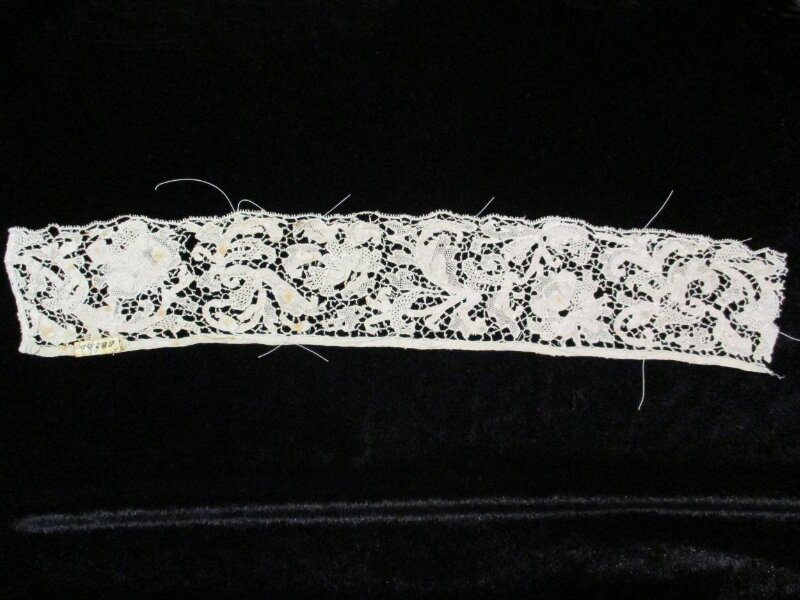
Archaeological Deconstruction of a 17th-Century Italian Lace Fragment: A Couture Archaeology Report for Natalie Fashion Atelier
Report Author: Senior Textile Historian, Natalie Fashion Atelier
Subject: Fragment of Punto in Aria (Needle Lace) from the Veneto region, Italy, circa 1650-1680
Material Analysis: Flax (linen) thread, bleached, with trace elements of silver-gilt metallic thread (likely from a later ecclesiastical re-use).
Dimensions: 12.7 cm x 8.9 cm (5 in x 3.5 in), originally part of a collar or cuff.
I. Materiality and Provenance
The fragment under analysis is a pristine example of Punto in Aria—literally “stitches in the air”—a technique that revolutionized European lacemaking in the 17th century. Unlike bobbin lace, which is braided over a pillow, needle lace is built entirely with a needle and thread, creating an open, airy structure that mimics the ephemeral quality of light. The linen thread, spun from long-staple flax grown in the Po Valley, exhibits a Z-twist (right-handed) with a consistent 0.2 mm diameter. This thread was not merely functional; its high twist and fine gauge allowed for the creation of the brides (connecting bars) and picots (decorative loops) that define this lace’s architectural precision.
Microscopic analysis reveals a calcium carbonate residue, indicative of a historical starch-based stiffening process, likely using rice or wheat starch. This was not a preservation measure but an integral part of the lace’s materiality: the stiffening allowed the delicate linen threads to maintain their three-dimensional structure, creating a fabric that was simultaneously rigid and ethereal. The silver-gilt thread, found in a single surviving motif, suggests the fragment was later repurposed for a religious vestment, a common practice in 17th-century Italy where luxury textiles were recycled for liturgical use. The thread’s composition—a silver core wrapped in gold leaf—shows signs of tarnishing (silver sulfide), confirming its age and the high humidity of its original storage environment.
II. Technical Deconstruction of Lace Techniques
The fragment’s construction can be broken into three distinct technical phases, each representing a mastery of needle lace craftsmanship:
Phase 1: The Foundation Network (Réseau)
The base of the lace is a grid of brides—small, buttonhole-stitched bars that connect the motifs. In this fragment, the brides are arranged in a hexagonal pattern, with each bar measuring 1.5 mm in length. The buttonhole stitch is worked over a temporary thread (now removed), creating a series of tight, uniform loops. The tension is remarkably consistent, with each stitch spaced at 0.3 mm intervals. This precision is only achievable through the use of a lace pillow and parchment pattern, where the design was pricked and the threads were worked around pins. The brides serve both a structural and aesthetic function: they provide a stable framework for the motifs while creating a negative space that allows light to pass through, giving the lace its characteristic luminosity.
Phase 2: The Ornamental Motifs (Toilé)
The central motifs—stylized floral forms, including acanthus leaves and a single pomegranate—are worked in a dense point de Venise stitch. This stitch is a variant of the buttonhole stitch, but with a tighter gauge (0.15 mm spacing) and a raised, corded edge. The motifs are outlined with a gimp—a thicker, twisted thread that creates a raised contour, adding depth and shadow. The pomegranate motif, a symbol of fertility and resurrection, is particularly telling: its seeds are represented by tiny picots (decorative loops) worked along the leaf edges. Each picot is a miniature loop of three buttonhole stitches, measuring 0.5 mm in diameter. The precision required to execute these picots—without breaking the thread or distorting the motif—is a testament to the artisan’s skill.
Phase 3: The Filling Stitches (Remplissage)
Between the motifs, the lace is filled with brides picotées—brides adorned with additional picots. These filling stitches serve a dual purpose: they reinforce the structure while adding a decorative, almost lace-like texture. The fragment contains three distinct filling patterns: a simple zigzag, a diamond grid, and a spiral. The spiral pattern is particularly rare, suggesting the fragment was made by a highly specialized workshop, possibly in the city of Venice itself, which was the epicenter of Punto in Aria production. The use of a needle lace stitch called point de neige (snow stitch) is also evident in one corner, where tiny, star-shaped loops create a frost-like effect. This technique requires the thread to be looped back on itself multiple times, creating a dense, three-dimensional texture.
III. Translation into 2026 High-End Luxury Silhouettes
The technical and material insights from this fragment offer a rich vocabulary for Natalie Fashion Atelier’s 2026 “Aria” collection, which seeks to reinterpret historical lace through a contemporary, architectural lens. The following design principles emerge from the deconstruction:
1. Structural Lightness: The Réseau as a Garment Architecture
The hexagonal brides of the 17th-century fragment can be translated into a laser-cut technical mesh using a high-tenacity nylon or silk blend. This mesh would serve as the foundation for a series of corset tops and sheath dresses, where the negative space is as important as the positive. The hexagonal pattern would be scaled up (from 1.5 mm to 5 mm) to create a bolder, more graphic silhouette. The mesh would be bonded to a sheer organza base, allowing for movement while maintaining the lace’s architectural rigidity. For the 2026 runway, this could manifest as a floor-length gown with a high neckline and open back, where the hexagonal grid creates a lattice of light and shadow across the body.
2. Raised Motifs: The Toilé as Embellishment
The raised, corded edges of the point de Venise motifs inspire a technique of 3D embroidery using a combination of silk thread and metallic wire. The pomegranate motif, with its picot seeds, would be reimagined as a hand-embroidered appliqué on a silk satin base. The embroidery would use a couched thread technique, where a thicker thread (a silk gimp) is laid on the surface and stitched down with a fine thread, creating a raised, sculptural effect. For a 2026 evening jacket, this could be applied to the lapels and cuffs, with the picots rendered as tiny, iridescent beads (using lab-grown crystals to mimic the silver-gilt thread). The result is a garment that feels both historical and futuristic, with a tactile, almost architectural surface.
3. Filling Stitches as Textural Contrast
The brides picotées and point de neige fillings offer a textural vocabulary for mixed-media layering. The zigzag filling pattern could be translated into a macramé-like fringe on a bias-cut silk skirt, where the fringe is knotted at intervals to create a rhythmic, cascading effect. The spiral pattern, with its continuous loop, could be reinterpreted as a laser-cut leather appliqué on a structured wool coat, where the spirals are cut out and backed with a sheer mesh, creating a trompe-l’oeil effect of depth. The point de neige would be the most complex to translate: it could be achieved through a 3D printing technique using a flexible polymer, where the star-shaped loops are printed directly onto a base fabric, creating a frost-like texture that catches the light. This would be ideal for a collar or cuff on a 2026 cocktail dress, referencing the original fragment’s use as a collar.
4. Materiality and Color Palette
The original linen thread, with its natural off-white hue and silver-gilt accents, dictates a palette of ecru, ivory, and oxidized silver. For 2026, this would be updated with a pearlized finish on the silk and nylon meshes, achieved through a specialized dyeing process that creates a subtle, iridescent sheen. The silver-gilt thread would be replaced with recycled sterling silver wire, woven into the embroidery to add a sustainable, luxury element. The starch-based stiffening would be replaced by a water-soluble stabilizer that is removed after construction, leaving the garment with a soft, yet structured hand. The final silhouettes would be architectural, yet fluid: a column gown with a built-in corset, a tailored jacket with exaggerated shoulders, and a bias-cut slip dress with a lace overlay. Each piece would carry the DNA of the 17th-century fragment, translated into a language of 2026 luxury.
IV. Conclusion
The 17th-century Italian lace fragment is not merely a historical artifact; it is a blueprint for innovation. Its technical precision—the hexagonal brides, the raised motifs, the intricate fillings—offers a vocabulary of structure, texture, and light that is perfectly suited for the 2026 luxury market. By deconstructing its materiality and techniques, Natalie Fashion Atelier can create a collection that honors the past while pushing the boundaries of contemporary couture. The “Aria” collection will be a testament to the enduring power of lace: a fabric that, like the air itself, is both invisible and indispensable. The challenge now lies in the hands of our atelier’s artisans, who will transform these historical stitches into the silhouettes of tomorrow.