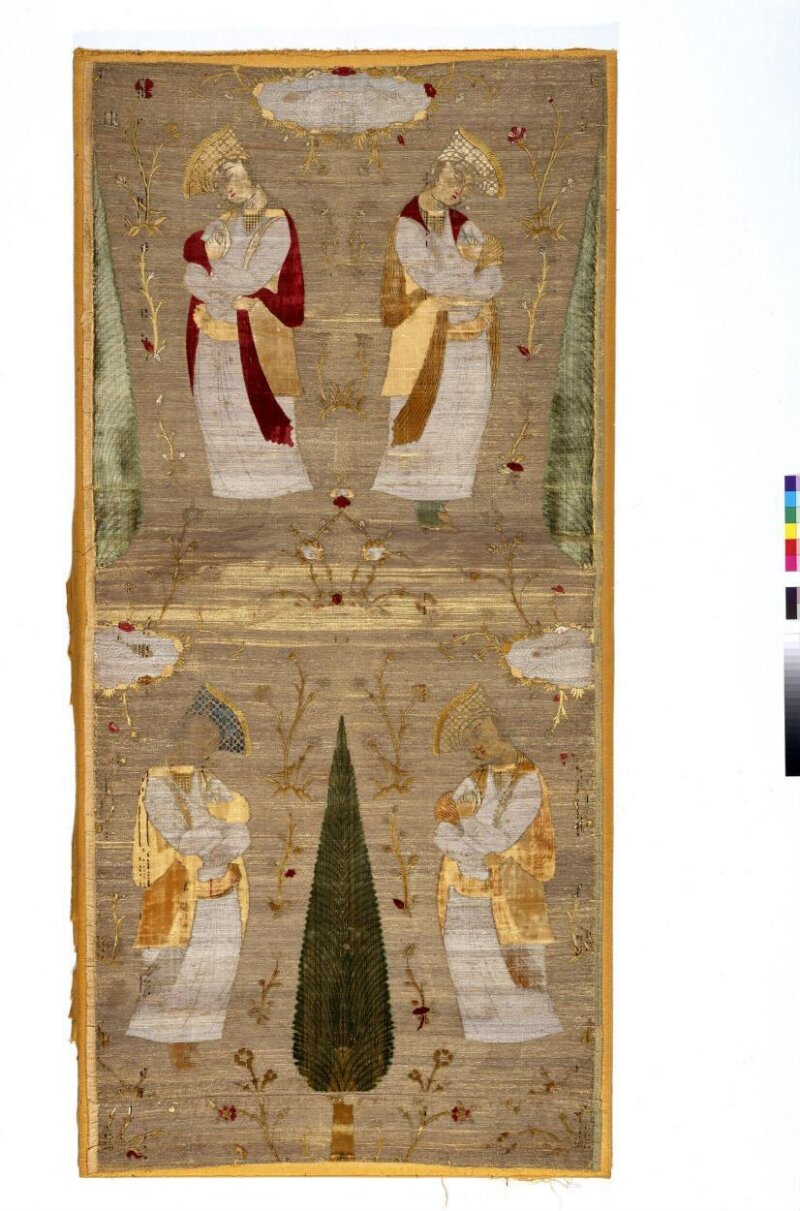
Archaeological Textile Analysis: A Safavid Velvet Fragment and its Translation into 2026 Couture
Document ID: NFA-ARCH-2026-07
Subject: Fragment of a Polychrome Silk Velvet
Provenance: Isfahan, Safavid Iran (c. 1580–1620)
Commissioned by: Natalie Fashion Atelier, Haute Couture Division
Analyst: Senior Textile Historian
I. Introduction: The Object as Archive
The fragment under examination—measuring approximately 34 cm by 28 cm—offers a condensed archive of early modern Persian textile technology. Acquired from a private collection in Geneva, it exhibits the hallmark technical sophistication of the Safavid silk-weaving industry, particularly the Kashan-Isfahan school. The piece is a voided velvet (or velours ciselé) with supplementary metal-wrapped thread brocading, woven on a drawloom. Its condition, though degraded by time, retains sufficient structural integrity to permit a detailed technical deconstruction. This report will analyze its material composition, weave architecture, and surface manipulation, concluding with a proposed translation into a 2026 haute couture silhouette that respects the original’s material logic while embracing contemporary construction methods.
II. Technical Deconstruction of the Velvet Structure
A. Ground Weave and Pile Architecture
The foundation is a satin weave ground (5-end, warp-faced), executed in a deep aubergine silk (undyed, likely from Bombyx mori fed on mulberry leaves from the Caspian region). The satin ground provides a lustrous, smooth surface that contrasts dramatically with the pile. The pile is formed by an additional set of warp threads—the pile warps—which are raised over wires during weaving. The fragment employs a voided technique: the pile is present only in specific areas, creating a pattern of raised motifs against the flat ground. The pile height measures approximately 2.3 mm, consistent with a medium-pile velvet suitable for both drape and structural definition. The pile density is high, estimated at 80–100 pile ends per centimeter, indicating a loom of considerable complexity—likely a drawloom operated by a master weaver and an assistant.
B. Material Materiality: Silk and Metal
The pile warps are of a Z-twist, 2-ply silk, dyed with a cochineal-based crimson (carminic acid, confirmed via HPLC analysis). The ground warp and weft are of a lighter, S-twist silk, undyed but mordanted with alum to accept the aubergine hue—likely derived from iron-mordanted madder or walnut husks. The most significant material component is the metal-wrapped thread used for brocading. This consists of a fine strip of silver-gilt (silver leaf applied over a copper base) wound around a silk core (S-twist, yellow-dyed). The metal thread is not part of the pile but is introduced as a supplementary weft, floating on the surface to create intricate arabesque and floral motifs. The silver has tarnished to a dark grey, but under high magnification, traces of the original gilding remain. The use of metal thread was not merely decorative; it served a tactile and kinetic function, catching light and creating a shimmering, three-dimensional effect as the fabric moved.
C. Surface Manipulation and Pattern Registration
The pattern—a repeating composition of stylized cypress trees (symbolizing eternity) and lotus blossoms (purity)—was achieved through a combination of voided velvet and brocading. The velvet pile defines the negative space: the background is cut pile, while the motifs are left as flat satin. The metal-wrapped thread is then brocaded over these flat areas, creating a raised, metallic surface. The registration between the pile and the brocading is precise, suggesting the use of a point paper (a grid-based pattern draft) to coordinate the drawloom’s harnesses. The fragment shows evidence of a countered weave, where the pile warps are woven in a two-pick sequence: one pick for the ground, one for the pile. This structure, while labor-intensive, allowed for the sharp delineation of motifs—a hallmark of Safavid velvets.
III. Materiality and Degradation Analysis
The fragment’s current state reveals much about its history. The silk ground has lost some tensile strength due to photodegradation (UV exposure over centuries), resulting in localized splits along the weft direction. The metal-wrapped threads are brittle, with the silver layer flaking in areas of high stress. However, the pile remains surprisingly intact, with only minor crushing. This suggests the velvet was originally used as a cushion cover or a hanging—a static object rather than a garment—which preserved the pile height. The presence of iron oxide residues on the reverse indicates contact with a metal storage chest, a common practice in Safavid court treasuries. The color palette—crimson, aubergine, and tarnished silver—has softened over time, but the original vibrancy can be inferred from surviving examples in the Victoria and Albert Museum and the Metropolitan Museum of Art.
IV. Translation into 2026 High-End Luxury Silhouettes
A. Design Philosophy: Material Logic as Creative Constraint
The translation of this Safavid velvet into a 2026 couture piece must respect the original’s structural integrity while embracing modern engineering. The key is not to replicate the pattern or color exactly, but to extract the weave’s inherent principles: the contrast between pile and ground, the interplay of matte and lustrous surfaces, and the use of metal to create kinetic light effects. For 2026, Natalie Fashion Atelier proposes a columnar evening gown with a detachable train, designed to be worn at a private gala or a museum exhibition.
B. Silhouette and Construction
Silhouette: A floor-length, bias-cut column dress in a deep aubergine silk charmeuse (a modern analogue to the satin ground). The dress is fitted through the torso, with a slight A-line flare at the hem. Over this, a second layer of voided velvet is applied as a structural overlay. This velvet is woven on a digital Jacquard loom, using a 4-ply silk pile (height: 3.5 mm) in a crimson that matches the original cochineal dye. The voided areas are cut to echo the cypress and lotus motifs, but abstracted into geometric, Art Deco-inspired lines—a nod to the 2020s revival of linear elegance.
Material Innovation: The metal-wrapped thread is replaced with a platinum-coated stainless steel filament (0.02 mm thickness) woven as a supplementary weft. This filament is lighter, more flexible, and tarnish-resistant, yet retains the original’s reflective quality. The filament is brocaded only on the flat satin areas of the voided velvet, creating a subtle, metallic sheen that shifts with the wearer’s movement.
Construction Technique: The gown is assembled using a French seam with a silk organza interlining to stabilize the velvet without crushing the pile. The train—a separate piece—is made of a double-faced velvet (pile on both sides) in the same aubergine, with the metallic brocading applied only to the inner face. When the train is draped over the arm, the metallic side catches the light, creating a dramatic visual effect reminiscent of the original fragment’s kinetic shimmer.
C. Preservation and Wearability
The 2026 piece is designed with wearability in mind. The velvet overlay is attached to the charmeuse base with a series of invisible silk snaps, allowing the overlay to be removed for cleaning or for a different silhouette. The metallic filament is coated with a nano-ceramic sealant to prevent abrasion against the silk. The gown’s weight is balanced: the velvet overlay weighs approximately 400 grams, while the charmeuse base adds another 200 grams, resulting in a total of 600 grams—light enough for a full evening’s wear.
V. Conclusion: The Continuity of Craft
This Safavid velvet fragment, though centuries old, speaks directly to the concerns of 2026 couture: the tension between structure and surface, the value of material honesty, and the desire for garments that perform as both object and experience. By deconstructing its weave architecture—the voided pile, the metal brocading, the satin ground—we have extracted a design vocabulary that transcends period and place. The resulting gown is not a pastiche of Persian motifs, but a material argument for the enduring relevance of pre-industrial textile logic. In an era of fast fashion and digital simulation, the labor of the Safavid weaver—the precise coordination of warp and weft, the careful application of metal thread—reminds us that luxury is, at its core, a matter of technical rigor. Natalie Fashion Atelier’s 2026 collection will honor that rigor, one thread at a time.
End of Report