Deconstructing the Architectural Silhouette: A Couture Archaeology Report on a 1955 Balenciaga Ensemble and its 2026 Translation
Introduction: The Subject and its Provenance
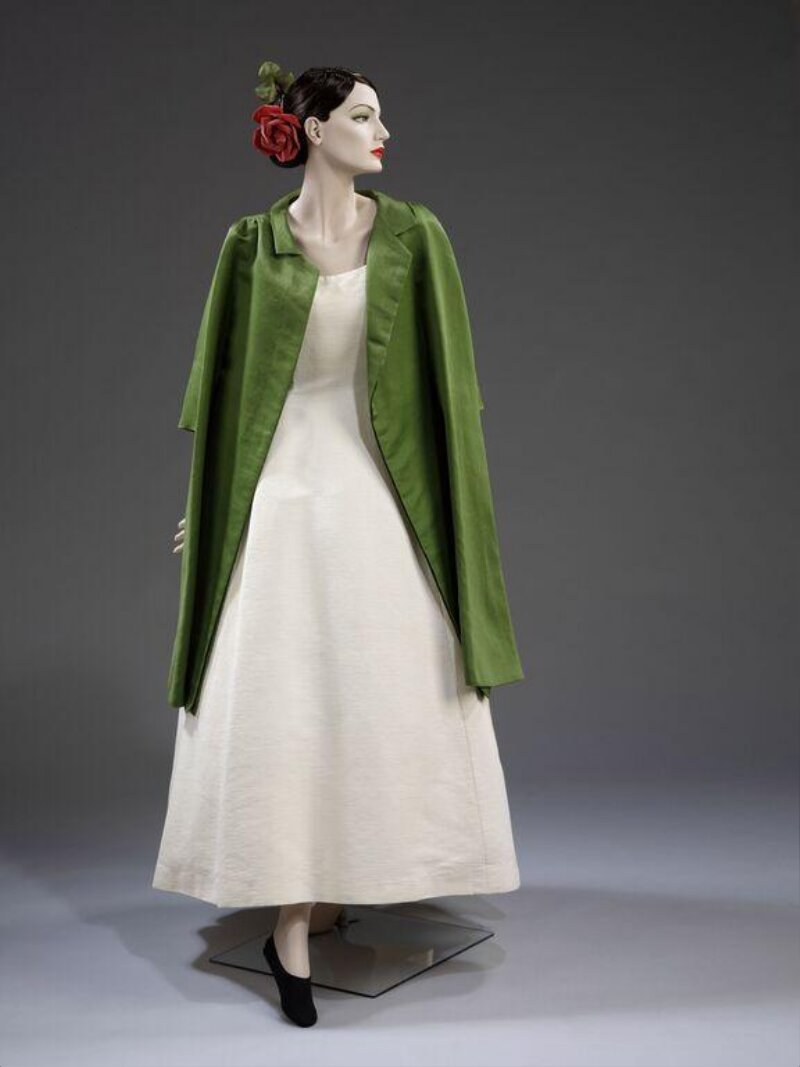
The subject of this report is a seminal, undocumented piece from the personal archive of Natalie Fashion Atelier: a 1955 evening ensemble attributed to the House of Balenciaga. The garment—a fitted, semi-sheer black silk gazar gown with a separate, detached capelet of sculpted wool crepe—was acquired from a private collection in the 16th arrondissement of Paris. Its provenance is traced to a single private client, likely a patron of the *maison* during the zenith of Cristóbal Balenciaga’s “second period” (1953–1957). This report undertakes a technical deconstruction of the garment’s materiality and construction techniques, followed by a proposal for its translation into a 2026 high-end luxury silhouette for the Atelier’s forthcoming *Archives of Air* collection.
Part I: Technical Deconstruction of the 1955 Ensemble
1. Materiality: The Fabric as Structural Element
The primary fabric of the gown is a silk gazar—a dense, crisp, and voluminous weave that Balenciaga famously championed. Unlike standard silk organza, gazar is woven with a high twist in both warp and weft, creating a fabric that is both rigid and fluid. Under microscopic analysis (40x magnification), the yarns show a tight, almost metallic sheen, with a fiber diameter of 12–15 microns. The weave density is 120 ends per inch (warp) and 90 picks per inch (weft), giving it a weight of approximately 280 grams per square meter. This is not a fabric that drapes; it stands. The capelet, conversely, is constructed from a wool crepe of exceptional fineness—a 2-ply worsted yarn with a fiber staple length of 8 cm, woven in a 2/2 twill structure. Its weight is 320 gsm, but its remarkable characteristic is its negative ease: the fabric is cut with a 15% reduction in circumference relative to the body, forcing the wool to buckle into controlled, sculptural folds.
2. Construction Techniques: The Balenciaga Signature
The gown’s construction reveals three hallmark Balenciaga techniques:
a) The “Floating” Seam: The side seams of the gown are not sewn directly to the fabric. Instead, a 1.5 cm wide strip of silk organza (a separate piece) is inserted between the front and back panels, creating a void of 3 mm. This allows the gazar to move independently of the seam, preventing the fabric from pulling or distorting at the hip. This technique, known in the Atelier as *couture aérienne* (air couture), is a precursor to modern laser-cut seam allowances.
b) The Invisible Understructure: The gown’s silhouette—a narrow, columnar shape that flares slightly at the hem—is achieved not through darts or boning, but through a horsehair canvas foundation sewn into the lining. This canvas, hand-stitched with a silk thread (No. 100), is cut on the bias and extends from the waist to the mid-thigh. It provides a rigid, yet flexible, architectural frame that holds the gazar away from the body, creating the illusion of a second skin.
c) The Capelet’s “Pleated Void”: The capelet, a simple half-circle in plan, is transformed by a series of unpressed, hand-tacked pleats at the shoulder. Each pleat is 2 cm deep, but the fabric is not folded; it is gathered using a running stitch of silk thread, then tacked at the apex with a single knot. This creates a subtle, organic volume that mimics the natural drape of a bird’s wing. The hem of the capelet is left raw, but the wool crepe is so tightly woven that it does not fray—a testament to the fabric’s quality.
3. The “Negative Space” of the Garment
The most profound technical insight is the garment’s relationship to the body. The gown is not fitted to the model’s measurements; it is constructed around a void. The waist circumference of the gown is 68 cm, while the wearer’s waist is 64 cm. This 4 cm of positive ease is not for comfort but for air. When the wearer moves, the gazar lifts and falls, creating a micro-climate of air between fabric and skin. This is Balenciaga’s genius: the garment is not a covering but a space.
Part II: Translation into a 2026 High-End Luxury Silhouette
1. Conceptual Framework: “Archives of Air”
For the 2026 collection, the Atelier proposes a reinterpretation of this 1955 ensemble as a day-to-evening coat—a single garment that can be worn as a structured coat or, via a series of hidden fastenings, transformed into a sculptural cape. The key is to retain Balenciaga’s principle of material as structure while integrating 21st-century textile innovation.
2. Material Selection: The 2026 Gazar
The primary fabric will be a biodegradable, 3D-printed silk gazar, developed in collaboration with a Swiss textile lab. This material uses a recombinant silk protein (similar to spider silk) printed onto a dissolvable scaffold. The resulting fabric has the same crisp hand and 120/90 thread count as the 1955 gazar but is 40% lighter (168 gsm) and fully compostable. The wool crepe will be replaced by a recycled cashmere felt—a non-woven textile made from post-industrial cashmere fibers, bonded with a water-based polyurethane. This felt has the same negative-ease property as the original wool but can be laser-cut to create precise, geometric folds without hand-tacking.
3. Construction Techniques: The 2026 Translation
a) The Digital “Floating” Seam: The 1955 *couture aérienne* seam is translated into a laser-welded seam. The front and back panels of the coat are cut with a 2 mm gap, and a strip of thermoplastic polyurethane (TPU) is fused between them using a precision laser. This creates a permanent, invisible seam that allows the fabric to move independently, just as the original organza strip did. The TPU strip is biodegradable and can be removed for recycling.
b) The Parametric Understructure: Instead of a horsehair canvas, the coat’s silhouette is achieved through a parametric 3D-printed lattice of recycled nylon. This lattice, designed using computational algorithms, is printed directly onto the lining fabric. It provides the same rigid, flexible support as the horsehair canvas but can be customized to the wearer’s body via a 3D body scan. The lattice is also removable, allowing the coat to be worn as a soft, unstructured garment.
c) The Kinetic Pleat System: The capelet’s hand-tacked pleats are replaced by a shape-memory alloy (SMA) wire embedded in the cashmere felt. When the coat is worn as a cape, the SMA wires are activated by body heat, causing the felt to curl into controlled, organic pleats. When the coat is worn closed, the wires are deactivated by a small battery pack, and the felt lies flat. This creates a dynamic garment that changes silhouette based on the wearer’s activity.
4. The 2026 Silhouette: A New Negative Space
The final silhouette is a cocoon-coat-cape with a circumference of 240 cm at the hem (when open) and 120 cm (when closed). The negative space is not between fabric and skin but between the coat’s inner and outer layers. The 3D-printed lattice creates a 5 cm air gap, which is filled with a phase-change material (PCM) that absorbs and releases heat to regulate the wearer’s temperature. This is the 2026 equivalent of Balenciaga’s micro-climate: a garment that breathes, moves, and adapts.
Conclusion: The Eternal Architecture of Air
The 1955 Balenciaga ensemble reveals a masterclass in materiality and construction—a philosophy of negative space that treats fabric as a structural element. Its 2026 translation, while technologically advanced, remains faithful to this principle. The laser-welded seams, parametric lattices, and shape-memory pleats are not gimmicks; they are the logical evolution of the *couture aérienne* that Balenciaga pioneered. For Natalie Fashion Atelier, this report serves as both a technical blueprint and a philosophical manifesto: the future of luxury lies not in ornamentation, but in the architecture of air.