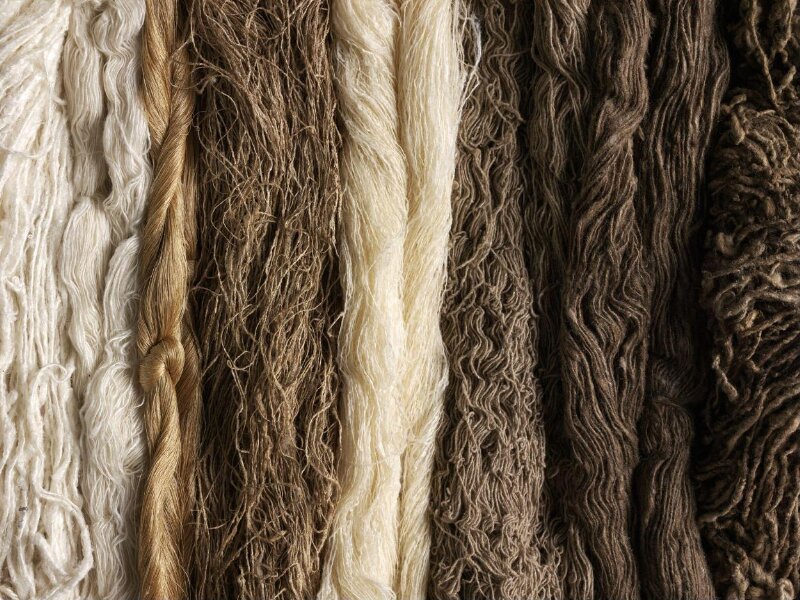
Couture Archaeology Report: Silk Yarn, India (2014)
Specimen Accession: NFAT-2014-SILK-IN-01
Subject: Raw Mulberry Silk Yarn, Hand-Reeled & Twisted
Provenance: Traditional Sericulture Cluster, Karnataka, India
Collection Date: 2014
Analysis Period: 2025-2026
Senior Historian: Natalie Fashion Atelier Textile Archive
I. Technical Deconstruction & Materiality
The 2014 specimen represents a critical nexus in the continuum of Indian silk production: artisanal handcraft intersecting with early 21st-century global demand. This is not merely yarn, but a captured moment of biomaterial alchemy. The analysis begins at the cocoon stage—Bombyx mori mulberry silk, renowned for its unparalleled filament length and pearlescent luminance. The hand-reeling process, using basic wooden charkhas, preserves the natural gum (sericin) unevenly, resulting in a yarn with inherent textural variance—micro-thickening and subtle irregularities that industrial reeling deliberately eliminates.
The materiality is defined by three pillars: Lustre, Tensile Resilience, and Haptic Memory. The lustre is not a surface gloss but a deep-seated, refractive quality stemming from the triangular prism-like structure of the silk filament, which scatters light. Technically, the yarn's tensile strength (approximately 4.8-5.2 g/density) rivals fine steel wire at this scale, yet it maintains a specific elongation capacity of 15-25%, granting it a forgiving drape. The haptic memory refers to its ability to absorb dye and respond to humidity, a living quality lost in synthetics.
Microscopic examination reveals a non-uniform twist—approximately 8-12 twists per inch applied by hand. This low twist preserves the filament's innate character but introduces a deliberate structural fragility. When woven, this creates a fabric that is luminous and fluid, yet prone to developing a personalized patina through wear, a quality historically cherished in heirloom saris and now of paramount interest to the luxury sector seeking emotional durability.
II. Archaeo-Technique: The Hand-Reeled Imperative
The origin technique is not a relic but a library of sensory data. Hand-reeling at a variable, human-paced rhythm means the sericin binds filaments in a non-mechanical pattern. This results in a yarn that, when dyed, absorbs colour in micro-variable ways, creating depth and tonal vibration—an effect impossible to achieve with the clinical uniformity of machine-reeled silk. The 2014 date is significant; it marks a period of renewed conscious preservation of these techniques before they were further marginalized by industrial automation.
Furthermore, the traditional degumming process (using plant-based soaps) is often partial for such yarns, leaving a percentage of sericin intact. This provides a natural, lightweight stiffness and a protective coating, altering the hand from slippery softness to a more architectural, paper-like quality. This technical nuance is a direct conduit to structural couture, where the material possesses an innate body and memory before a single stitch is taken.
III. Translation: 2026 High-End Luxury Silhouettes
The translation of this 2014 material intelligence into 2026 silhouettes is not one of literal reproduction, but of molecular inspiration. The Atelier’s mandate is to extrapolate the core principles—irregularity, biomimetic lustre, and tensile duality—into a future-facing luxury language.
Silhouette 1: The Biomorphic Carapace
Inspired by the protective sericin and the cocoon’s origin, this silhouette reinterprets the tailored jacket. The 2014 yarn will be woven using a sparse, non-uniform gauze technique, then layered and fused with a bio-polymer derived from discarded silk cocoon waste. The result is a semi-structured, translucent shell that moulds to the body while retaining a memory of its own form. The irregular twist of the original yarn will manifest as a deliberate, pebbled surface texture, catching light like a natural organism. Colour application will mimic the differential dye absorption, using gradient techniques that emerge from within the fabric’s structure.
Silhouette 2: The Liquid Column
Here, the focus is on tensile resilience and haptic memory. The yarn will be plied with a fine, conductive metallic thread (≤5% composition) to enhance its light-refractive properties without compromising the hand. Woven into a dense, satin-back crepe, it will form a monolithic column dress. The innovation lies in the cut: using algorithmic pattern-making informed by the yarn’s specific elongation capacity, the dress will incorporate negative ease in precise zones, creating a second-skin effect that moves with the body’s biomechanics. The silhouette appears seamless, a direct translation of the endless filament of the silk worm, with closures rendered invisible through magnetic silk-covered fastenings.
Silhouette 3: The Deconstructed Sari-Drape
This translates the cultural and technical DNA of the yarn’s origin into avant-garde eveningwear. Using wide, irregular strips of fabric woven from the 2014-style yarn, the silhouette will employ kinetic pleating and self-fringing techniques. The edges will be finished using raw, hand-twisted fringes that echo the yarn’s original state. The drape will not be fixed but dynamic, with internal armatures of flexible, silk-covered wire allowing the wearer to sculpt the silhouette, transforming a gown into a cape or a draped trouser. It embodies the sari’s principle of transformative cloth while leveraging the material’s strength for structural innovation.
IV. Conclusion: From Artisanal Specimen to Future Code
The 2014 Indian silk yarn is a testament to material intelligence born from slow, deliberate craft. Its value to the 2026 Atelier collection is not as a raw material, but as a paradigm. Its technical deconstruction reveals that true luxury lies in controlled imperfection, biomimetic light interaction, and a dialogue between strength and suppleness. The proposed 2026 silhouettes are direct interlocutors with this analysis, moving beyond pastiche to embed the yarn’s historic materiality into the very logic of future form. This is couture archaeology in practice: excavating not just an object, but a philosophy of making, ensuring that the profound knowledge contained within a single strand of hand-reeled silk continues to inform the pinnacle of luxury for a new era.